Fuse #8

Thursday, June 07, 2007

Review of the Day: The White Giraffe

The White Giraffe by Lauren St. John. Illustrations by David Dean. Dial Books. $16.99.

I was at an ALA Conference skimming through the convention center when I stumbled across the Dial booth. I was a little too late to get the hottest galleys that day, but a person can still root out a hidden gem here and there if they’ve a yen to. I think it may have been the cover of “The White Giraffe” that caught my eye first. Deep blues with a pale ghostly giraffe obviously reflecting the moonlight off its hide. I’m not usually drawn to animal stories but there was something deeply compelling about the image I saw here. “Is this any good?,” I asked the clearly exhausted Dial employee. To the best of her ability she assured me that it was a worthwhile read, so I took it home. So here’s where it becomes awkward. It may well be that in the future this is a much beloved title that no one disputes as distilled genius in a glass. Maybe. But as far as I could tell, author Lauren St. John hasn’t quite yet gotten a feel for how to write for a young audience. There are things in this book that work, but by and large they’re outweighed by the sheer mass of the things that do not. A good start, but a book that could have stood a little more editing

When eleven-year-old Martine’s parents die in an accidental fire, she finds herself bundled away from England and sent to live with her grandmother in Africa. And that might have been fine except for the fact that it’s obvious right from the start that Martine is not wanted by this unfamiliar relative. Lonely in a strange new land, one night the girl spots a white giraffe in the moonlight. And unaware of a legend that speaks of a girl who will someday ride such an animal, Martine begins to fall in love with her new home. Yet poachers are invading Martine’s grandmother’s land and Jemmy, the beautiful white giraffe, is almost certainly in danger. It will take all the girl’s strength and resilience to discover who the traitor on the reserve is and, when the time comes, realize how to rescue Jemmy.

Now it’s clear that St. John’s a writer through and through. Listen to this line: “Pale spiky thorn trees and ragged shrubs dotted the long yellow grass, which glowed beneath the blazing summer sun as if it was lit from underneath.” THAT is how you write a sentence. THAT is how it is done. Food too is described deliciously as “omlettes made from fresh farm eggs and wild mushrooms, a heap of crispy bacon, and tomatoes fried with brown sugar.” A human being could subsist on these words alone if you let them. So imagine my distress when on the next page the resident magical black friend puts her hand on our heroine’s forehead and says, “You have the gift, chile . . . Jus’ like the forefathers said.” Even if you take away the whole white-girl-is-going-to-save-us-all idea, surely there was a better way to introduce that idea.

All right. So maybe some of my objection to this title is rooted in its basic premise. White girl goes to Africa and connects with a magical creature there better than any actual African could because she is “the one”. So how much does Martine’s race really matter? I read the first chapter or so of “The White Giraffe” after reading the bookflap, secure in the belief that my heroine was black. When it turned out that she was not, the entire reading experience took a shift to the left. I had been enjoying the book, you know. As first chapters go, I may have to nominate “The White Giraffe” for Most Gripping Opening of 2007. It’s thrilling in the best sense of the word. So do we blame a book for putting a European lady in an African setting? Not a bit of it. But when it's clear that there are legends built around Martine, that's when things start to get uncomfortable. I mean, just for argument's sake, would it have been so bad if Martine had been black? It's not like we're swimming in black heroines in children's books these days anyway (and certainly not in fantasy).

There were other issues, I suppose. Martine is eleven but in terms of basic ideas like racism she resembles a six or seven-year-old more. That means that you get passages where apartheid gets a brief glossed over mention without much meat or heft to it. There are small plot gaps as well. Martine doesn’t tell her grandmother about her gamekeeper’s unnatural violence because Tendai “didn’t want to distress her unnecessarily.” It’s a literary device that’s as unnecessary as it is frustrating. Like those movies where the characters won’t call the cops, even when the homicidal maniac is threatening them with a machete. Heck, when Martine’s grandmother, a woman who (we later find) would protect her granddaughter with her life, allows Martine to go BACK into the super scary ship full of bad guys with guns there is just no good reason for it. No sane guardian would let their kid do that. And there are other moments of sheer coincidence. Grace, a holy woman, spontaneously appears in Martine’s secret alcove at just the right moment. You know Ms. St. John must have felt some slight awkwardness with moments like this. After all the book even says, “Martine was still reeling from the bombshell of finding the woman she’d wanted to see, here, in this sacred space.” You me both, hon.

But did I mention that the writing was sometimes great? That a giraffe’s eyes are described as the wisest and “most innocent” in the world? And I liked Martine’s dreams and the subplot that involves some mean kids in her school. It’s the details and the idea of a white gal being the savior of Africa that gives me the willies. I look forward to what St. John puts out in the future. A memorable read, but it could definitely have been stronger.

On shelves now.

Notes On the Cover: Can’t put it down. Credit Dial with snagging one smartie of a cover for this puppy. Artist David Dean's interior illustrations are lovely to look at too. It's a pity they weren't in color, what with the beautiful hues on the cover and all hat. A good choice in any case.

First Line: “People like to say that things come in threes, but the way Martine looked at it, that all depends on when you start counting and when you stop.”

Labels: , , , , ,

Tuesday, May 15, 2007

Review of the Day: On the Wings of Heroes

On the Wings of Heroes by Richard Peck. Dial Books (a member of Penguin Group, Inc.). $16.99.

Yeah, well. What kind of review site would this be without a little Richard Peck once in a while anyway?

Richard Peck is such an old-fashioned guy. Go through his books and look what you find. Nasty bullies getting their due. Pranks. Upright citizens. Heroes. Work that makes a boy strong. And wise old people who dole out necessary advice and make the rest of us look weak in comparison. It takes a couple heaping helpfuls of nostalgia to write a Richard Peck book, and as far as I can figure it, nostalgia falls into two distinct categories: Good Nostalgia and Bad Nostalgia. Bad Nostalgia bores the socks off its readers. It wallows too deeply in the idea of how great things used to be and would rather eat its own shoes than allow that there might be some pretty great things going on right now. Good Nostalgia’s a different beast entirely. It conjures up the past, transplanting its readers to another time. A time where there was good and there was bad, but most of all there was just a world that wasn't too unlike our own. “On the Wings of Heroes” is rife with Good Nostalgia. It bears the flaws of its genre without apology, but is a pretty good book in the end anyway.

Everyone has to have a hero. For Davy it’s his older brother Bill. It’s World War II and Bill’s off to fight in a handsome B-17, carrying with him his small town’s good wishes. Life before and during the war couldn’t be more different. Before the war Davy spent a lot of time with his best friend Scooter, trying out their new bikes, enjoying Halloween, and playing in the warm summer nights. During is different. Now the kids are doing regular collections for the war effort. Bill's been sent off to fight and Davy's avoiding the malevolent (not to say violent) Beverly C. while dealing with family worries to boot. With a great cast of kooky characters and superb writing, a book that could have been yet another dull historical novel distinguishes itself. A great slice from the past.

A co-worker of mine is a gigantic Richard Peck fan. She’s read his books cover to cover and then back again. As such, she’s probably his biggest critic. After going through “Heroes”, she found she was not entirely impressed. Richard Peck lite, she called it. She even pointed out certain elements to me. The dirty bully girl in the book? Wasn’t she in a couple of his stories before? Ditto the ancient teacher idea, the pranks, and even the Midwestern setting. To her eyes, he’s done it all before and he’s done it better. Be that as it may, I am not a fan of her caliber. I read “A Long Way From Chicago” and “A Year Down Yonder” and enjoyed them just fine. Then I read “The Teacher’s Funeral” and “Here Lies the Librarian” and was disappointed. So for me, “On the Wings of Heroes” represents a return to form. Sure Peck is reusing some old tropes and techniques. Still, if you take the book in and of itself and don’t compare it to his past or future work, I think it stands rather nicely all on its own. It may not garner the biggest awards out there, but there’s no doubt in my mind that it’ll have its fans.

Peck’s writing makes the whole enterprise well worth a peek anyway. First of all, he's funny, which is of vast unrecognized importance. Like any kid assigned this in school, I actually wasn't too keen on reading, "On the Wings of Heroes." Historical fiction is fine and all but I shy away from it when I can. So it's nice to get sucked into novel, especially if it's against your will. The individual sentences get all evocative and suggestions are made of future events. For example, whenever Davy’s father hears of an injustice or a wrong, we hear that, “something coiled in him again.” That “something” never uncoils in this book, but I suspect that it probably happens long after this particular story is over.

Of course, Peck writes of a white white world. If you’re looking for a little diversity, he’s not your man. It doesn’t usually occur to me when I read him, but this book in particular shows just how pale as newly fallen snow Peck’s universe is. He doesn’t deal with racism or social injustice much at all. So when the DAR gets a mention, it sticks out more for me than it might if there was a single African-American character living in this Midwestern American town. Those of you who would prefer to read a book with a little more racial complexity would do well to look to another novel.

Will kids read it? Not if you don’t sell it to them. Look, if a kid is standing in front of a row of books and one book has the title, “Alcatraz and the Evil Librarians” and the other book reads, “On the Wings of Heroes” which book is the kid going to pick up first? I mean some will read this book and love it, no question. It sounds odd to say, but the book this reminded me the most of was Ray Bradbury’s, “Dandelion Wine”. Know me and know my love of “Dandelion Wine” and you’ll see how grand a compliment this really is. It doesn’t have Bradbury’s dark surreal undercurrents, of course, but there’s a lot of joy here and a lot of familiar ideas. Plus, other books crop up in the old memory as well, like the moment when the root beer brewing in the basement explodes like a fourteen gun salute. It reminded me of nothing so much as the brewing that goes on in that great 30s novel, “Cheaper by the Dozen”. Though it shouldn't be confused with an accurate representation of the past in all respects, there's a lot in Peck's novel to enjoy. It has the ability to make children nostalgic for a time they will never know. Recommended.

Notes on the Cover: Okay. Dial, I know what you were going for here and I can’t blame you. And this jacket image is entirely faithful to the book, no question. You’re going for a nice 40s look, and who can blame you? So I’m giving you a pass on this one. Personally, I think this kind of image draws a very specific kind of reader. But let’s be honest here. Peck has written a very specific kind of book, so the packaging is faithful to product. Plus, this was done by Chuck Pyle? That wouldn’t happen to be the grandson of Howard Pyle, would it? Well his bio ain’t saying but it wouldn’t be a completely peculiar assumption to make. I wouldn't have commissioned it, but I can see why you did.

First Lines: "Before the War the evenings lingered longer, and it was always summer when it wasn't Halloween, or Christmas."

Previously Reviewed By: BookMoot, the Books for Kids Blog, Emily Reads and the BCCLS Mock Awards.

Labels: , , , , ,

Wednesday, March 28, 2007

Review of the Day: Emma-Jean Lazarus Fell Out of a Tree

Emma-Jean Lazarus Fell Out of a Tree by Lauren Tarshis. Dial Books (a division of Penguin Young Readers Group). $16.99.

First and foremost I want to stop right now the temptation anyone may have to compare this book to "The Curious Incident of the Dog in the Night-Time". It ends here. “Emma-Jean Lazarus Fell Out of a Tree,” is a treat. A delight. An engaging romp, if you will, but it is NOT to be compared to Mark Haddon’s book, no matter how tempting a prospect. Let us consider this book entirely on its own merits and leave speculations regarding the main character’s mental state to the readers themselves. Newbie first-time author Lauren Tarshis has written a book with some serious buzz flitting about it. Memorable and supremely interesting, this is a book worth holding on to for a very long time.

She’s not like other girls, that Emma-Jean Lazarus. She doesn’t burst into tears every day in middle school or giggle about boys with her friends. Come to think of it, she doesn’t seem to have all that many friends to begin with. That’s okay, though. If Emma-Jean is anything, she’s comfortable being herself. That’s something Colleen Pomerantz would probably pay anything to be. When Emma-Jean finds Colleen sobbing in the girls’ bathroom (which is just as illogical as it is out of character) she vows to help Colleen out any way she can. Of course, that may mean some forgery here and there, but Emma-Jean is confident in her abilities. Now, however, she has mixed feelings towards her widowed mother falling for the nice Indian guy boarding with them, while at the same time learning that this whole “friendship” idea may not be as straightforward as all that. People don’t always make sense and the world is not always fair, but sometimes change can be good. Even if it's not entirely comfortable.

I’ll level with you here. I read this book roundabout a month ago. The thoughts that have percolated and popped in my noggin are not first-impressions or sudden flashes of inspiration. So as I picked this book up to review it, something strange occurred to me; I could remember everything in it perfectly. I could remember the plot, and the characters, and teensy tiny little details here and there. When you review a lot of children’s books, they all tend to run together after a while into a big old slurry blur. Not this book.

Part of Tarshis’ strength lies in her characters, of course. Emma-Jean isn’t emotional, but at the same time she isn’t so cold that the reader doesn't care for her. You warm to her instantly, even as she puzzles through the peculiarities of middle school interactions. I like that from page one you get a sense of Emma-Jean’s personality. “. . . crying was not a logical way to express one’s opposition to the seventh-grade science curriculum,” she thinks after two girls cry at having to dissect a sheep’s eyeball. As for Colleen, she was exactly the kind of person I could understand. “. . . Colleen was always thinking and worrying and obsessing about things.” Been there. Most of us have. It's just rare to see that feeling fleshed out so well into a living breathing person.

The writing, in and of itself, is subtle, but not so subtle that it won’t make for good discussions. For example, when Colleen decides not to get angry at Emma-Jean it reads, “She couldn’t be mad at Emma-Jean, because poor Emma-Jean didn’t understand anything about anything.” The heck she doesn’t! Emma-Jean is a uniquely skilled individual. When she wants to hook her teacher up with the man boarding with herself and her mother she knows how to drop a dinner invitation with a sly, “You could bring your boyfriend if you like,” to determine her teacher's relationship status. Descriptions pop out at the reader with a bit of intensity you wouldn’t expect off-hand. When Colleen feels terrible, the pink wall color, “made her feel like she was trapped inside an old dog’s ear.” Not just any dog, mind you. An old dog. Ick.

The assumption is going to pop up (hence the “Curious Incident” reference at the beginning of this review) somewhere suggesting that Emma-Jean has some mild form of autism. Yet the book never says that, and the book is, when you think about it, the only reference on the topic we have. I don’t think we can go about leaping to conclusions willy-nilly. Just because someone isn’t doesn’t act like everyone else, do we have to label them? When Emma-Jean explains why she doesn’t want any friends she simply says, “They are too complicated.” You don’t have to diagnose a person to agree with a statement like that.

Now I run a homeschooler bookgroup, and recently I’ve been taking the time to assess the readability of the books that come my way. For example, recently my kids and I read "Rules" by Cynthia Lord and we were just bowled over by how well that title works as a point of discussion. It engages the child readers so much so that everyone loves the book. So I’m gonna go out on a limb here and say that Tarshis ’ book does the same thing. It has that indefinable quality that makes the reader just want to pick up the title again and again and again. The ending is top notch (coming up with a quilt-related solution to one of Emma-Jean’s woes that gives me shivers to read), the beginning biting, and the middle engaging and endearing in turns. Recommended with a "yes, indeed" for kicks.

Notes on the Cover: As someone pointed out on this blog not too long ago, it does the book no favors. It’s not a terrible cover by any means. And you can even tie it into Emma-Jean’s pet bird, the trees she and her father loved, and the fabric that is eventually sewn onto her quilt. That said, this is not a kid-friendly cover. This is the kind of cover you put on an adult book of poetry (one that uses words like "thrush" and "entirety"). So it’s nothing against you, Dial, but when this pup comes out in paperback (and it will if it gets the attention it deserves) let us take into consideration the possibility of doing something just as classy but with a touch of child-friendliness to boot. Let us, to be blunt, make this book like like it’s worthy of its buzz.

Labels: , ,

Wednesday, March 21, 2007

Review of the Day: Where I Live

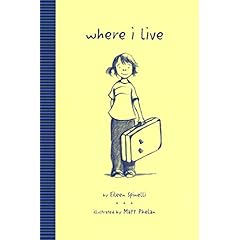
Where I Live by Eileen Spinelli, illustrated by Matt Phelan. Dial Books for Young Readers. $16.99

Once a children’s book author wins the Newbery Medal, their title receives a certain amount of attention, praise, and (in some instances) controversy. We know that this means that future books under that author’s name, while not guaranteed to be bestsellers, will still be purchased by a certain segment of the population based on name-recognition alone. How fare the illustrators of Newbery winning books then? In the last 20 years there have only been four medal winners with illustrations (not counting the photographs found in “Lincoln: A Photobiography”). Some, like Peter Sis, have gone on to fame and fortune. Others, like Eric Beddows, have mostly stayed under the radar. So when I saw that Eileen Spinelli’s newest verse novel, "Where I Live", was being illustrated by “The Higher Power of Lucky”’s own Matt Phelan, I didn’t know how it would potentially affect book sales. The story in and of itself is a simple one that tries for a pure, straightforward emotional response from its readers. With this in mind, Phelan’s illustrations can only cast Spinelli’s work in the best possible light. If not a match made in heaven, at the very least what we can define here is a match made under the auspices of particularly beneficent stars.

Right from the start, you know that Diana is living a pretty nice life. She loves her house, with the family of birds living in the wreath hanging from her front door. She loves her best friend Rose and her floppy purple hat. She loves how well she does in school in terms of poetry and she enjoys learning about the stars. Imagine how devastated she feels, then, when it suddenly becomes clear that the family needs to up and move in with Diana’s Grandpa Joe in his house that is six whole hours away. Author Eileen Spinelli delicately tell the story of one girl’s hurt and confusion. She loves her Grandpa, but how can that make up for moving away from her best friend in the entire world? In the end, Diana finds that it isn’t about making your new life exactly like your old but creating a space for yourself in your new surroundings that leads to happiness.

I hadn’t read any Eileen Spinelli books prior to seeing this one (which, considering how prolific she is, strikes me as a bit odd). Then I found that some of the choices she made as an author caught my attention and caused me take a closer notice of this title. I found it interesting how long it took Spinelli to get to Diana’s actual move. The book stands at a slim 112 pages (give or take a few) so it’s funny that it’s not until 45 or so that our heroine gets the big news. It works in the end, but I wouldn't call it a natural choice. The writing itself is very simple. Spinelli does little things with her words that might go unnoticed, but add to the overall reading experience when you examine them. At one point near the end we read, “When Mom and I go back ‘home’ Twink is waiting at the door.” “Home” in parentheses is a clever little touch. “Where I Live” is a good title to hand to children who like to read but aren’t quite up to regular chapter books yet. And they’ll still be able to get lines like, “Ha. / Ha. I’m / never / laughing / again,” when Diana refuses to smile at her Dad’s jokes the night of her move.

Illustrator Matt Phelan has certainly created some lovely picture books in his day, and rumor has it that he even has a graphic novel in the works. Even so, “Where I Live”, is the first book of his that I’ve seen where he’s had to prove that his illustrations are capable of telling a story like and unlike the narration written by the author. The pictures in this book have to be able to show not only what Diana is saying but also was she is incapable of conveying. When, for example, she is drowning in self-pity after the family has moved in with Grandpa Joe, Phelan knows to show the look of mild hurt in Joe’s eyes when she refuses a game of chess. Even if those eyes are just tiny dots with whiskery lines above them for eyebrows. Phelan also mirrors the book’s purposeful repetition visually, just in case kids miss it in the words. The beginning of the book, where we see Diana waving out of her bedroom window at Rose in the morning, matches the twilight scene at the end where Diana is waving out her bedroom window at her new friend, Sam. I know that at this point in time it’s hard to separate Phelan from his work on “The Higher Power of Lucky”, but I don’t think it’s wrong to say that the characters of Diana and Lucky have quite a lot in common. Both girls notice the distinctive elements of their homes and love them. Though the reading levels for the two titles don’t encourage a pairing, it’s clear to me that Mr. Phelan is drawn to a particular type of writing (or, at the very least, type of heroine).

A sick part of me is amused by the fact that the title of this book is not too dissimilar from Meg Rosoff’s VERY young adult novel, “How I Live Now.” For your own sake (and the sake of those who benefit from your gift-giving impulses) do not get the two mixed up in your brain. The book also reads in a manner similar to “Amber Was Brave, Essie Was Smart,” by Vera B. Williams. It hasn’t the same emotional punch to the gut, but rather emulates the sweeter moments in Williams’ tale. You might consider pairing "Where I Live" with other “moving” titles if you know of a child who’s taking the change especially hard. It would work beautifully alongside Ralph Fletcher’s small verse picture book, “Moving Day”. The hero of that particular book is a boy, but it shouldn’t make much of a difference in the long run. Altogether this is a nice little story that will best fit the needs of children experiencing the situation faced by the main character. I’ll be interested to see if it garners a larger audience as time goes by.

Notes On the Cover: We can do better. I'm sure that the market for verse novels that look like Cliff Notes can't be as high as everyone's saying. You know that I adore Matt Phelan's illustrations, and the image of Diana on the cover is charming. However, let's take practical manners into hand here. This cover feel stuck and static. It needs to breathe a little. Let's consider livening it up in some way. Even the inclusion of the floppy purple hat would have been a welcome addition. Ah well.

Labels: , ,