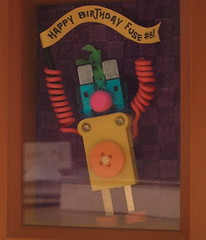
Fuse #8

Monday, December 18, 2006

Review of the Day: My Little Yellow Taxi by Stephen T. Johnson

My Little Yellow Taxi
By Stephen T. Johnson
Red Wagon Books

ISBN: 0152164650

$13.95

Ages 3-7

No longer in print


To succeed in the world of children’s book publishing, an author/artist needs to exhibit a certain level of flexibility. If your first book for kids is a rousing success you may certainly coast on that for a while, but eventually you’ll want to expand your horizons. The best artists out there, be they Paul O. Zelinsky, Maurice Sendak, or Faith Ringgold, know how to switch gears and try entirely new things. I mention all this because I cannot wrap my head around the books of Stephen T. Johnson. If flexibility is a talent then this man’s a veritable contortionist. Look at his past for a moment. He puts out Alphabet City and City By Numbers which were realistic and industrial and clever. Then at the same time there's My Little Blue Robot and My Little Red Toolbox, which made the idea of an interactive book more tangible than ever before. Turn around again and he’s putting out Hoops, Love As Strong As Ginger and The Tie Man’s Miracle, with yet another different look. Finally we come to 2006. On the one hand Mr. Johnson paired with Diane Siebert to put out the magnificently reviewed, Tour America: A Journey Through Poems and Art. Then you turn around again and in the same year is My Little Yellow Taxi. Taxi, truth be told, will encounter far more fans than Tour America if only be deint of its amusing premise. As long as you are able to break-in the book before your kid gets ahold of it AND you find a way to keep all the pieces together, this may well be the best loved title your entling ever receives.

The book puts the child reader in the driver’s seat of a taxi cab. Literally. Kids are given the chance to operate their very own car. They can check their tire pressure with a removable gauge. They can look in the glove compartment, adjust the shiny shiny mirror, and even place the key in the ignition. This being a taxi and all, kids can also set the fare box so that the taxi is available for rides. Then, as you reach the back of the book, there is a little removable taxi just waiting to be driven over, under, around, and about for the car-loving child’s pleasure. Part book, part interactive toy, what My Little Taxi achieves is the ability to make books fun for book-phobic little ones.

The nice thing about the title is that aside from the fare box, kids that read this book needn’t be familiar with what a taxi cab is. Just as long as they've seen a car, they’ll be happy. And trust me, cars are a continual fascination for some little ones. Often I’ll find myself directing children under the age of three to the car section of the library so that they can stare in wonder at the pictures of shiny automobiles. Put this book in their hands and their interest immediately skyrockets. Of course, in watching kids play with this book I’ve determined that left to their own devices, these future drivers of America haven’t the clearest of ideas on what to do with each page. For example, one kid removed the tire gauge and proceeded to move it about the carpet, making little “vroom vroom” sounds as he did so. Another took the car key and did his darndest to start the tires. With adults at their side, however, this book is a perfect learning tool. Not only is it accurate (albeit with a slightly outdated yellow cab as its guide) but you haven’t lived until you’ve sat in a room of ten librarians all playing “car” and waiting their turn to have a go at it.

The objection to Johnson’s My Little books in the past is the quality of the construction. My Little Taxi, unfortunately, is no different. The book is simultaneously too well put together in some parts, and too poorly constructed in others. Take, for example, the driver’s side door. In one book the door broke clean off of the book itself on a first read, leaving at least one library patron more than a little perturbed. On the opposite side of the spectrum, my co-workers and I were convinced for a very long time that not all the doors in this book actually opened. The glove compartment, for example, seemed welded in place. After some extraordinary tugging and pulling and swearing and crying, however, we were finally able to wrest that little door open. So my advice to you is this: Find the strongest person you know and prior to handing this book to a child make them open every door, window, and tab allowed. Once an item is removed from the book it slides in and out with relative ease. Otherwise I doubt very much that the strength in your four-year-old’s arm is going to make much of a dent here.

Now, we have a circulating copy of My Little Taxi in my library. This may or may not be a mistake. Many of the parts in this book are small. There’s a section that shows kids three different street signs, all of which are removable and all of which are small enough to lose. The problem with My Little Robot (aside from the fact that when you placed a heavy object on top of it you’d hear it squeal) was the missing components. I like to think that this will be less of a problem with My Little Taxi, but keep a sharp eye out at all times just in case.

No, it’s not perfect. No toy with removable parts is perfect. I can’t imagine why a book should be any different. However, I will tell you that exactly one hour after I placed a copy of this book in my library’s display window, a patron walked up to me demanding the title immediately. When I told her that our circulating copies were all checked out she almost begged me to remove the display copy so that her daughter could see it. The book’s a hit with everyone and it pretty much constitutes a sure-fire 100% hit with any and all children under the age of 6 (some would say 8) you hand it to. Worth the clean-up.

Out of print.

Labels: , , ,

Saturday, November 18, 2006

Review of the Day: The Invisible ABCs by Rodney P. Anderson

The Invisible ABCs: Exploring the World of Microbes
By Rodney P. Anderson
ASM Press
ISBN: 978-1555813864
$19.95
Ages 5 and up
On shelves now


It would be an understatement to say that the American Society For Microbiology is perhaps not amongst the most prolific publishers of children’s books. You can imagine my confusion then when I learned that they not only had a book out, but one of an alphabetic nature. There are more alphabet books on this earth than grains of sands on the shore. Yet for every one you see, huge debates probably went into its making. Take The Invisible ABCs as your example. If you’re going to create the greatest scientific abecedarian text ere conceived, you need to know who your audience is. Any parent, teacher, or librarian will tell you that at a certain point alphabet books are NOT cool anymore. Kids with their rudimentary reading skills in place will avoid “baby” books like the plague. And sadly, anything with the word “ABC” in its title may apply. The trick is to sell this book to them on its scientific foundations. Fortunately, this book doesn't exactly come across as a hard sell. With images that burst from the pages, fun facts, riddling every letter, and more sheer information than you'll know what to do with, Anderson gives us the ultimate in learning about infinitesimal microbes in a truly engaging fashion. And the purty pictures certainly don’t hurt.

Each letter is shown on a two-page spread. In the upper left-hand corner, a small box shows each letter as formed by some preternaturally talented microbes (in photographs of them no less). Then we learn a little something of our invisible-to-the-human-eye neighbors. Did you know that microbes help us make chocolate and are the reason termites are such a pest? Have you ever seen a jaw-droppingly gorgeous microbe or peered at a real strain of the ebola virus? From gross to great and everything in between, author Rodney P. Anderson gives the average everyday alphabet books out there a definite run for their money.

The text accompanying the letters is always informative, even when it initially comes off as lame. “C” is for cows? But then you learn of the special bacteria that allow cows to eat and live off of grass. Even the endpapers of the book are cool when they begin by showing how small a virus is (if it was the size of a grain of sand then YOU would be the size of Mount Everest). Less effective, perhaps, are random question bubbles that pop up with every letter. On occasion the questions are of the, “Would you rather have a shot or be very sick with a preventable disease?” variety. Other times they become thoughtful, asking dreamy hypotheticals like, “Aren’t we lucky that microbes help clean our dirty water?” Not really a question, that one. Finally, some are so obvious that you seriously wonder what kids would say when asked something like, “What would happen to wolves if they couldn’t eat deer, or to deer if they couldn’t eat grass?” On the whole these questions are interesting, but the strain of creating 26 of them creeps out at awkward times. There is also the odd statement along the lines of, "Moms think mold in the bathroom is disgusting and try to scrub it away." Do they now? I suppose Dad's think it's peachy keen. This was such a weird throwback of a statement, I half-wondered what the author was trying to imply.

Of course, the first thing anyone does when they see a new and interesting alphabet book is to flip to the letter “X” to see if the author cheated. A “cheat” is when the writer has proffered a word that has an “X” in it, rather than one beginning with that letter. I thought that with a book of microbes, this letter would be fairly safe. For crying out loud, where else are you going to find Xanthidium lying about? Admittedly, making “X” part of the word, “eXtreme” makes a certain amount of sense here, but a part of me still yearns for a xanthidium explanation.

Facts are all well and good, but when a publisher sits down and takes the time to include lush full-color photographs of every ciliate, arthroderma, zygnema, and rotavirus that comes their way, you know that someone really cared. It’s hard to pooh-pooh a book that’s not only overflowing with fabulous facts, but has the visuals to back those statements up. When Anderson begins by saying, “There is an unknown world too tiny to see”, and follows that up with, “It is a hidden land where monsters with oozing feet catch and eat their smaller neighbors”, you’re gonna want to see that. And see it you do as page after page is packed with images that a number of talented photomicroscopists allowed Anderson to use. Every letter of the alphabet is represented by a microbe in that letter’s approximate shape (with some more approximate than others). Kids will marvel at the forms and colors of things too tiny to ever see with the naked eye. Best of all are the truly beautiful images. Anderson does diatoms right, calling them, “tiny glass-like boxes that look like colored jewels in different shapes and sizes.” They’re triangles filled to brimming with remarkable hues and patterns. They are circular actinophtychus, colors spiraling out, and later in the book a diatom arranged in a rosette looks more snowflake than tiny critter.

Credit where credit is due, not all the pictures in this book are of microbes. There are stock photos of a 1970 “Rubella Fighter” and an 1802 anti-Dr. Jenner political cartoon of a disgusting (not to say mesmerizing) nature. Contemporary images of scientists, animals, places, and objects are all sharp, clear, and colorful. The photographs are amazing, but there is the occasional non-sequitor. Consider, for example, the letter “B” for “Bacteria”. On one page we learn about how useful bacteria can be and where it exists. On the opposing spread there are photos of crackling staphylococcus aureus, zig-zaggy leptospira, pickle-like vibrio, frightening spirillum volutans, a decaying tree, a microscope, and . . . wait for it . . . a bighorn sheep. A completely random bighorn sheep. There is no mention of how bacteria affect sheep in the text. No specific attention paid to the bacterial properties of their horns or whether or not their wool is a particularly effective carrier. A closer examination of the text shows a description of a microscope, saying that it, “makes small things look big.” But that still doesn’t really apply to the creature in the lower left hand corner. Little things like that occasionally pop up in the text, and while they aren’t ever distracting, you may find yourself scrambling to explain to your scientifically-minded tot why the book’s creators saw fit to squirrel that photograph into the narrative.

The best thing you can say about this book is that it leaves you wanting more. When you hear that microbes “help clean up pollution from our environment, and they’re used to help remove copper and gold from the rocks that miners dig up”, it’s hard not to want to yearn for a couple more details. And what are ice bacteria or the bacteria that live in hot springs? In its alphabetic format, The Invisible ABCs is only able to tantalize budding scientists with this info. Let us hope it tantalizes them straight into scientific careers of one sort or another. Behold before you a book that, for all its eccentricities, deserves attention and inclusion in every proper library.

On shelves now.

Labels: , , , ,

Tuesday, November 14, 2006

Review of the Day: Blue 2 by David A. Carter

Blue 2
By David A. Carter
Little Simon (an imprint of Simon & Schuster)
ISBN: 9781416917816
$19.95
For ages 5 and up
On shelves now


Give a man one red dot and it’ll start to give him ideas. When I reviewed David A. Carter’s One Red Dot back in 2005, I thought it to be one of the cleverest little exercises in contemporary design I’d ever had the privilege to enjoy. Under normal circumstances, good design in children’s books feels like an ungodly mix of adult dollars and misbegotten enterprise. Carter is different. One Red Dot was fun for both kids and their parents AND was seriously attractive to the old eyeballs. But though I am a children’s librarian I do not track the career of David A. Carter, and so it was with the greatest of shock that I received a package from Simon & Schuster containing an unexpected sequel, Blue 2. Blue 2 features a sparkly cover with the words of the title made up entirely of iridescent dots. It also features alphabetic phrases of a peculiar nature, a scavenger hunt for an elusive number, and more skips and tricks than most of the beautiful pop-up books you’ll find on the market today.

Open the book before you. On the first page, forgoing publication information or even an introduction of some sort, the first thing you see are two yellow pages and a small forest of trees that have sprung up to greet you. The first words of the title, “Abundant Blossoms Collide” indicate that as you go through the pages of Blue 2 you will find an alphabetic guide to help you along. Now the reader must search closely within the blossoms to find the blue 2 hidden (remarkably well) amongst the foliage. Once you’ve done that you can move on and find a far easier “glistening Blue 2”. And so it goes. Before your eyes Carter conjures up hypnotic swirls and the first practical use of spandex I’ve ever seen in a children's title. There are hidden mirrors in a carnivalian atmosphere, a hanging mobile, pyramids, see-saws, whirling-twirling optical illusions (that don’t quite match up), and tricks like you’ve never seen before. This isn’t your usual lift-the-flap trifle, kiddies. This is a mind-blowing production for an audience of one.

Carter hasn’t just tricked out his newest book and given it an alphabetic modus operandi. He’s also made the basic search nearly impossible. First of all, the very first hidden 2 you’ll find is so cleverly concealed within the “Abundant Blossoms” that I doubt very much that the first person to read this book will always necessarily catch it. Once someone does, it’ll be easier for future readers (and I really can’t say any more without giving something away). The second most difficult puzzle appears on a page that reads, “Seesaw Ticktocks Upside down and an inverted Blue 2.” My husband and I, both grown adults with Masters degrees and the requisite amount of brain cells sat on our futon for a good fifteen minutes and became convinced that I’d been given a defective copy of the book. Fifteen. Minutes. I will never get that time back. Eventually I was able to locate the 2 (it’s there fair and square) but I felt remarkably small in achieving this. On the other hand, I know perfectly well that the right kind of enterprising child may well look in places that a stodgy old adult like myself won’t.

It’s a pity then that the abecedarian technique doesn’t work any better than it does. No one will quibble with the fact that the words do sometimes describe what’s on the page well enough. Yet phrases like “Mobile Nonsense Oscillating” or “Jubilant Kookiness Laughing” are usually followed by a sentence like, “and a suspended Blue 2”, and don’t fit together as a whole. Listen to the following as it’s put together: “Gleeful Helixes Illuminate and a slippery Blue 2.” Doesn’t really work, does it? I like the idea of throwing words into the text, but I’m not convinced that the book wouldn’t have done better just to include brief non-alphabetic, coherent sentences. Ah well.

Because I am a children’s librarian, I’ve seen firsthand the effects that little hands have had on Mr. Carter’s past work. Keep One Red Dot on your circulating shelves and watch as the flexible binding tears under a toddler's concentrated efforts. Marvel as all those adorable little circles on string suddenly start lolling lazily out of the pages of the book. Cry as your once beautiful little title rips at the seams, falls apart at the glue, and generally proves itself to be a beautiful object not long for this world. With Blue 2 I foresee a similar fate. Of course, One Red Dot had a fold-out section that fell out after 2 or 3 openings of the book. “Blue 2” seems sturdier than this. I've played with the book several times and the worst I can say is that the first puzzle in the book may lead to kids tearing some of the pictures apart in misguided zest.

It is as if Mr. Carter were saying to the world, “You liked that? Try THIS!” Kids who love I Spy books, Where’s Waldo and any other title that requires a single-minded intensity of searching will adore this book. I could give you some high faluting dissertation on modern art and picture books or I could discuss the short lifespan of your average pop-up. I’m not going to. Blue 2 is mesmerizing, enchanting, and a worthy successor to the ever fabulous One Red Dot. Certainly the words could have stood a bit of tweaking, but the mischievousness of the design itself will win anyone over. This is a book that was born with a twinkle in its eye. It may frustrate you beyond all measure, but in the end you’ll come back to it time and time again.

On shelves now.

Labels: , ,

Sunday, November 05, 2006

Review of the Day: The Charles Addams Mother Goose by Charles Addams

The Charles Addams Mother Goose
By Charles Addams
Simon & Schuster Books For Young Readers
ISBN: 0689848749
$7.98
Currently out of print.
Ages 7 and up.

With the recent publication of Random House’s, Charles Addams: A Cartoonist’s Life, by Linda H. Davis, rival publishers appear to be looking to their own overstocked warehouses to take advantage of this newest Addams literary craze. At least, that’s how I’m interpreting the sudden reappearance of books like Simon and Schuster’s, The Charles Addams Mother Goose, which originally made its republished debut back in 2002, onto our bookstore shelves. Not that I mind, of course. Any republication of the Addams repertoire is fine with me, and had S&S not started sending out this book once again I never would have known what a fine complement C.S.A. made to some of the darker nursery rhymes out there. Mother Goose books come and go, but if you want to go for the memorable, the dark, and the amusing then there really is only one title you should even begin to consider. And it sports a Stephen King by-line on the cover.

Told in about 28 different nursery rhymes, The Charles Addams Mother Goose is everything you might expect from that most infamous of New Yorker cartoonists. Here you can find all your favorites word-for-word, accompanied by the most peculiar of pictures. The mouse from “Hickory Dickory Dock” takes on enormous proportions. Jack Sprat and his wife seem to have eating habits outside of what we might consider the norm. Even the three blind mice are included, though the carving knife is now of the electric variety. The familiar Addams family characters do indeed make an appearance in some of these poems, and always in a fashion that seems tailor made for them. Plus it takes a kind of genius to be the illustrator who decides that the reason all the kings horses and all the kings men couldn’t put Humpty Dumpty together again was because out of Humpty hatched a baby dragon/dinosaur/scaly creature. Certainly the unique Addams brand is clear and present in every pic.

Kids who read this book, and there will be quite a few, may find themselves in later years wholly unable to separate Addams’ vision from certain peculiar rhymes. Take, for example, that old chestnut “Solomon Grundy”. Entirely apart from the fact that his name is now synonymous with a Batman villain, his story here is told in seven/eight panels. “Solomon Grundy, Born on Monday, Christened on Tuesday, Married on Wednesday, Took ill on Thursday, Worse on Friday, Died on Saturday, Buried on Sunday. This is the end of Solomon Grundy.” Addams really takes the poem even further, though. His Grundy resembles a slightly undersized and grumpy Uncle Fester. And once he’s, “Died on Saturday”, his body resembles nothing so much as a cloud of dirty air. Then, wonderfully inexplicably, that same dirty air is put into a corked bottle and thrown into the sea with the line, “Buried on Sunday.” It’s this kind of random twist on old stand-bys that gives this collection just the right burst of original peculiarity. I’m not even gonna go into the eyedropper of holy water on the second panel or the mysterious mushrooms that grow out of Solomon’s head on Thursday.

So which poem wins the Most Likely To Disturb Already Wary Adults Award? It’s a toss-up, to my mind, between “Mistress Mary, quite contrary” and “Wee Willie Winkie”. On the outset, neither poem seems particularly dark. In “Mistress Mary” however, an unhealthy waif of a woman with dark-lidded eyes and a lifeless expression waters mushrooms in a darkened basement. Lit only by a single bare lightbulb, the mushrooms have begun to sprout feminine heads, each with the creepy cheer of a babydoll's face. The picture looks almost institutional, what with the pale blond’s stare into nothingness and the mushrooms’ eerie plastered smiles. Compare that, however, to “Wee Willie Winkie”. In that picture a boy and girl stare aghast at a window where a ghoul in a nightcap stares unblinkingly at them, his right hand ah-rapping at the pane. The whole picture is tinted a sickly green and blue and you’ve the feeling that the little boy who is not in bed could be in for some trouble soon.

When you get right down to it, however, maybe the most disturbing part of this book is the Foreword written in 2001 by “Mrs. Charles Addams”. In this section, the woman gives a bit of context to the original publication. It came out in the midst of Vietnam. It could be credited to two equally possible sources. But Mrs. Addams goes even further and finds in Charles’s work an odd source of, of all things, comfort. “How wonderful to find a dinosaur inside Humpty Dumpty, rather than worrying that he had fallen and couldn’t be repaired. Or being reassured that the old woman who lived under the hill had all the comforts of a real home and was better for it.” You’ll note that she makes no mention of the vampiric Doctor Fell who’s poem reads, “I do not like thee, Doctor Fell” or the leather-clad specter of death that shakes hands with a little girl by a graveyard. Countering such an Intro, however, is the remarkable “Mother Goose Scrapbook” compiled at the end of the book. In it we see a poem that “for reasons unknown” was pulled from the original book moments before publication. In it, a worried shepherd holds open the doors of a fallout shelter as his lambs pelt past him into the darkness. A mushroom cloud erupts in the distance. Says the poem, “A red sky at night is a shepherd’s delight. A red sky in the morning is a shepherd’s warning.” Since we’ve already determined that the book came out in 1967, I doubt the reason for the deletion is all that mysterious at all. Other choice details include New Yorker covers, photographs, book jackets, and even a drawing Charles made at the age of four.

Charles Addams has a following not too dissimilar to the Edward Gorey fans out there. This collection, however, demands to be owned by people outside of the regular obsessives. You can’t say that Addams’ visions of these nursery rhymes are anything but logical extrapolations. What’s more, after repeated viewings they insinuate themselves into your unconscious. I’ll never hear “This is the house that Jack built” without visions of knives, bulldogs, and dirty rats again. And I’m okay with that. A must-have purchase for anyone with a penchant for the peculiar.

No longer in print.

Labels: , ,

Tuesday, October 31, 2006

Review of the Day: Behind the Mask by Yangsook Choi

Behind the Mask
By Yangsook Choi
Farrar Straus and Giroux
$16.00
ISBN: 978-0374305222
Ages 4-8
On shelves now


Around early October, children’s booksellers and librarians perform synchronized shudders as an influx of bad Halloween titles swamp bookshelves everywhere. You can’t get away from them. Will the parents walk off with the repugnant tale of a little witch who just wants to be loved or something ironically sacchrine involving a boy who learns to share his candy? Whatever the case, the sheer piles of Halloween-inspired dreck is heady. With that in mind, a book like Yangsook Choi’s, Behind the Mask comes across as a breath of fresh air in the midst of all this garbage. Choi tells a measured tale of a boy’s wish to have the best and scariest costume for Halloween and throws in a good measure of Korean history and culture along the way. Consider this book the antidote to all the colorful horrible Halloween books that end up clogging the kiddies’ brains.

Kimin has a problem. A Halloween problem. He has no idea what to dress up as this year, and his mom isn’t being much help. All she's done is suggest that he look through his grandfather’s old belongings stuffed away in two heavy boxes. Kimin is aware that his grandfather was once a famous dancer in Korea, but he’s just uncovered a hitherto buried memory from when he was younger. When he was very little, Kimin spied on his grandfather late one night, only to find that the beloved relative had transformed his own face into something horrific. Now, going through the old boxes, Kimin discovers a scary mask that is EXACTLY the face the boy thought he saw that night. Now everything is clear for Kimin, and better still, he’s found his new costume. His choice of disguise comes off as a hit with the other kids, but when Kimin accidentally bruises his family’s priceless family heirloom it’s his mother he’ll have to explain everything to in the end.

Choi makes certain to end her book with a useful Author’s Note at the back, explaining fully what a Talchum, or mask dance, really is. Now I’m not entirely certain why great Korean-American picture books are more plentiful than picture books from many other cultures these days. Maybe it’s just my own perception, but when you’ve such high quality titles like Linda Sue Park’s, The Firekeeper’s Son and Bee Bim Bop alongside, The Have a Good Day Cafe, by Frances and Ginger Park, you begin to take notice. This is by no means Choi’s first book for children, but for those of us who are unfamiliar with her work, it makes for an ideal introduction. The story itself is intriguing. I was particularly interested in Kimin’s repressed memories of seeing his masked grandfather and how that played into the plot. The last image in this book is of the boy asleep under the formerly “scary” mask, which gives the story a lasting feel of comfort. For me, the illustrations were touch and go. Some of them, like Kimin staring longingly out his window on a dark creepy night, have a wonderful tone and feeling to them. Others, like group shots of children on the playground, come across as two-dimensional and flat. By and large these illustrations carry the story along well (though my husband pointed out the Charlie Brown-ish shirt on the cover as a touch distracting).

For those amongst you who might want to pair this title with another dance inspired picture book, consider, Little Sap and Monsieur Rodin by Michelle Lord. Both books use similar illustration styles, but while one speaks of traditional Korean dance, the other concentrates on the dancing style of young girls in Thailand. The two together would make for an eclectic storytime. Original, interesting, and fun, this book is bound to garner itself some well-deserved attention.

On shelves now.

Labels:

Wednesday, September 06, 2006

Review of the Day: Beach by Elisha Cooper

Beach
By Elisha Cooper

Orchard Books (an imprint of Scholastic)
$17.99
ISBN: 9780439687850
Ages 4-8

On shelves now


Recently I’ve been shying away from reviewing picture books. Not out of any particular dislike of them, of course. I just hadn’t run across one recently that really whet my whistle. Earlier in the year I heard some librarians commenting on the various picture books of 2006 that struck them as particularly fine. One title that cropped up was Elisha Cooper’s, Beach. I’d seen the cover before and there wasn’t much there to lead me to think of it as a strong contender for awards. Pretty cover, yes. Oh, the same author as created Magic Thinks Big? Nice, nice. Big format, so that’s enjoyable. With all these thoughts sloshing about in my head, it wasn’t really until I was on my lunch break one day that I thought to go ahead and, oh I don’t know, pick it up and read it. I found myself charmed. Utterly and wholly charmed. I’m not saying “Beach” is gonna totally blow away all your conceptions of what a beach picture book constitutes. I’m just saying that alongside David Wiesner’s Flotsam and Chris Gall’s Dear Fish, there has never been a better time for shore-related picture book fare.

Open the book and we’ve a two-page spread of an empty beach, blue sky above, water stretching far into the distance. Says the book cheerily, “Away to the beach! Away to sand and salt water, to rolling dunes and pounding waves”. Turn the page and three separate images of the beach meet your eye. In each one, more and more people crop up. This section is without text. Turn the page again then. Twelve small scenarios are here, each one showing different people settling into their beachgoing routines. They’re all familiar. The people who inch into the water a miniscule centimeter at a time. Or the person who inflates a large inner tube... and then just walks into the water up to her ankles. The people frolic and the waves, “come in hills and valleys, in mountains and canyons, in craggy peaks and sweeping plains.” Meticulously Cooper captures the sounds, the tastes, and even the detritus that constitutes a day at the beach. And at the end, the three panels of the shore become six, and people start to go home. “Sand is everywhere – between toes and in bathing suits and inside ears. Inside, too, is the motion of the waves, the knowledge of a day well spent, a day to remember when the beach is far away.”

First of all, this book stands at an impressive 12.3 x 10.2 inches. So right off the bat you find that you’re dealing with an impressive beastie. Then the color scheme starts to hit you. The endpapers are all soft sea-friendly greens, pinks, blues, and brown/purples. These are the colors you find near the ocean, captured perfectly by Mr. Cooper. Now in the past I’ve always found Cooper’s people and animals to be almost too bulky to thoroughly enjoy. With Beach this problem is perfectly alleviated. It’s like Cooper went to the Chris Ware School of Tiny Humans (albeit with a child-friendly touch). The people in this book are little more than small, penciled figures. You cannot make out their individual features or digits, and it doesn’t matter a bit. Somehow, Cooper is able to suggest a whole range of emotion, movement, and energy with his tiny people. The woman who changes into her swimsuit under her towel makes all the awkward movements, arms akimbo and body twisted, you’d expect from such an attempt. The dog that dives into the waves to retrieve some driftwood splashes and cavorts in a thoroughly canine manner. This kind of miniscule study of the human (or animal) figure is deeply impressive. More importantly, it’s interesting in a way that kids will find particularly fun.

But it was Cooper’s language that surprised me the most about this book. First of all, the little situations involving the beachgoing crowd are almost Zen at times. “A woman lathers on sunscreen and reaches for the spot that cannot be reached”. Or better still, “A boy and a girl ride their parents in a crab race”. “A man wades with his baby, keeping an eye out for jellyfish”. “Seagulls pull their heads tight into their shoulders and watch everyone leave”. And then the descriptions grow broader as the illustrator starts to pull back from the individuals. We see a couple benches under a roof and the text reads, “Picnic baskets open with peanut-butter-and-jelly sandwiches, peaches, cookies, and iced tea. Towels get sticky. After lunch, children walk past the outdoor showers to the truck that sells ice-cream sandwiches”. This book is now begging to be read aloud. And, quite frankly, you’d have to be made out of stone itself not to crave an ice-cream sandwich after the reading.

Maybe because Beach brought to mind all those wonderful Anno books I read as a child (Anno’s Journey, Anno’s USA, Anno’s Spain, and so forth) I really connected with this tale of average people doing something as basic and familiar as relaxing on the shore. This has all the makings of a personal family classic to be treasured for years to come. I don’t know if the hungry masses will be as taken in by its charms, but I personally feel that this is a wonder of a picture book. A pure unadulterated delight.

On shelves now.

Misc: Be sure to check out Elisha Cooper's website as well.

Labels:

Sunday, April 16, 2006

Review of the Day: Why Did the Chicken Cross the Road?

Why Did the Chicken Cross the Road?
By Jon Agee, Tedd Arnold, Harry Bliss, David Catrow, Marla Frazee, Jerry Pinkney, Chris Raschka, Judy Schachner, David Shannon, and Mo Willems
Dial Books (an imprint of Penguin)
$16.99
ISBN: 978-0803730946
Ages 4-8
On shelves now


There are some jokes out there that are so classic they’ve passed the point where they’re funny anymore. Knock-knock jokes fall into this category. Light bulb jokes too. And then there’s the best one of them all. Why-did-the-chicken-cross-the-road jokes. Boy oh boy you just can’t make anyone laugh with one of those anymore, can you? Well that’s the way my thinking would have gone had I not picked up a bizarre little picture book title by the same name. In this book fourteen different children’s illustrators are each granted a two-page spread to offer their answer to this, the oldest of questions. No two answers are exactly alike and no two illustrators have styles even vaguely similar. It makes for a book that kids will adore, grown-ups will pore over, and incipient illustrators will want to keep very close at hand.

So why did the chicken cross the road? The answer may surprise you. Marla Frazee, illustrator of things like Roller Coaster, and the recent smash hit, Walk On: A Guide For Babies, shows a determined chicken crossing a road away from a rain-soaked gray-skied chicken coop towards a blue-skied brightly colored fun-factory of a building. Her single thought: “duh”. Turn the page and Mo Willems has taken an entirely different tack. In the gloom of a police department some hard-boiled cops are giving a very nervous chicken (note the number of eggs under its chair) the third degree. The chicken itself is insisting that “I just did it to get to the other side! Honest!”. To one side a detective is pouring the contents of a significant looking charcoal bag onto a grill. The entire book is like this. David Shannon taps into a vein not dissimilar from his beloved Duck On a Bike to show us chicken at the wheel of a fancy red convertible. Flip further through the book and you see pictures by everyone from the great Jerry Pinkney to the far-out Mary Grandpre and the more than slightly twisted machinations of David Catrow. Here you may find more answers than you ever could have thought up yourself.

The great joy of a book like this is that it also serves to introduce people to hitherto unknown illustrators. I remembered most of the people from this book before, but then there were people like Chris Sheban who’d entirely escaped my notice in the past. Mr. Sheban’s picture is an evocative piece where one chicken has accidentally hit a baseball over another chicken’s head and into a window. The two stand poised in a kind of frozen shock as late afternoon light seeps over the suburban scene. Or there was Judy Schachner who’s tiny-brained chick, “wasn’t just free range ... she was de-ranged!”. I suppose my favorite pictures in here were from people who seemingly were working in unexpected ways. Take Jon Agee as your example. If you’ve seen his Terrific or The Incredible Painting of Felix Clousseau then you are aware of his clean lines and sparse palette. Now consider a picture that consists of cars, people, dogs, pigs, motorcyclists, buses, etc. fleeing from three hungry look dinosaurs. And perched on the side of the road, not immediately apparent to the eye, stands a lone chicken. Or consider Harry Bliss. I was used to his New Yorker-like picture books like, Don’t Forget To Come Back that tend to have an innate sophistication to them. The last thing I would have expected was for him to come up with the answer, “Ask the mutated zombie chickens from Mars!”. But you know what? It works.

Children’s illustrators banding together to put together a book... it’s not a new concept is it? I mean, you can always find books like, Oz: The Hundredth Anniversary Celebration or The Art of Reading: Forty Illustrator’s Celebrate RIF’s 40th Anniversary. The problem with those titles, though, is that they’re really not produced with kids in mind. Far rarer is the picture book filled with different illustrators that kids might recognize and love. I’m not saying it’s never happened before. But name me three such books off the top of your head and I’ll be mighty impressed, if not utterly blown away. No, sir, this is an original idea and a classy little work. Consider this book to be an essential addition to any picture book collection. Funny and fabulous.

On shelves now.

Labels: , , , , , , , , , ,

Friday, April 14, 2006

Review of the Day: I'm Not Cute

I'm Not Cute
By Jonathan Allen
Hyperion Books
$9.49
ISBN: 978-0954737382
Ages 4-8
Currently out of print


My situation is a little different from most. I work with four other well-trained, well-read, fabulous children's librarians. That means that when a new children's book hits one of our desks, everyone starts salivating simultaneously. And if it's especially good the claws come out, the teeth bare, and the hair pulling begins. In the case of I'm Not Cute, however, people were kept fairly civil if only because the book's such a short read. But guess who got to bring it home to review? HA HA HA HA HA! I'm Not Cute first came to my attention when a fellow co-worker ran up with it clenched in her hot little hands and pronounced that this was one of the best books of the year. I glanced at the author. Jonathan Allen. I've never heard of Jonathan Allen. I looked at the cover. A very fuzzy owl, as wide-eyed as the pigeon of Don't Let the Pigeon Drive the Bus fame, stares at the viewer under the words of the title. I didn't know what to think. Then I read through the book, closed it up, and made a startling conclusion. This is one of the best books of the year, bar none.

Baby Owl, we are told as it stares fiercely at the viewer, "decided to explore the woods". He's under the distinct impression that his appearance will allow him to walk about uninterrupted. Unfortunately, a rabbit (with aspirations towards kangaroohood, by the looks of it) gives the cutey a big big old hug and tells him, "You're so cute, Baby Owl... And so small". This doesn't go down very well. The now thoroughly irate owl denies the charges. "I am NOT cute! And I am not small". What is he then? “I am a huge and scary hunting machine with great big soft and silent wings”. But a fox sees the owl next and before you know it he too is petting and hugging the Baby Owl. Angrily Baby Owl cries, “I am a huge, sleek hunting machine with great big see-in-the-dark eyes”. When a squirrel does exactly the same thing Baby Owl can take it no more. He complains to his mother that everyone thinks he’s cute but he’s not. Jovially his mother agrees that he’s not cute at all. But this does not go down as well as it might. After considering a moment Baby Owl screams, “But I am cute!... I am! I AM!”. Which Mama interprets, rightly, as a sign that Baby Owl needs to go to bed. As she tucks him in she whispers, “You’re so cute, Baby Owl... For a huge, scary, sleek, sharp-eyed hunting machine, that is”. And Baby Owl is content.

This is a toddler problem that I, for one, had completely forgotten about. Some kids just hate to be called cute. They may have big brown doe-eyes, or a head full of curls, or the sweetest little faces you ever did see. But call them cute? They’ll have none of it. They are, in a way, human equivalents of sleek, sharp-eyed hunting machines. But you know what I thought when I first picked up the book? Readaloud. This book would make an EXCELLENT readaloud for preschoolers. I kid you not. Think how you could make the Baby Owl’s voice dip and become dark and mysterious when he describes his very very frightening qualities. Then you could counter that with the other animals talking in a baby-talk voice to him as they patronize the little fluffball and call him cute. I half want to take this review copy of the book that I hold in my hand and test it out on my library’s next preschool storytime.

The books bears some similarities to Suzanne Bloom’s A Splendid Friend Indeed. Both books are misleadingly simply and extraordinarily good. I’ve always thought that the easier a book is, the harder it is to write. “I’m not cute!”, uses very simple words and simple pictures but is, in the end, a very funny title for both kids and adults. Not an easy thing to accomplish, I’ll wager. The art of “I’m not cute!”, isn’t as accomplished as Suzanne Bloom’s, of course, but for the purposes of the story it is perfect. Allen has done an excellent job at making Baby Owl look fluffy as all get out. You really can’t blame the other animals when they pick him up for a hug. He looks like a tiny screech owl, all peach and light orange feathers. Allen draws in a style similar to Mo Willems, but without becoming outright cartoony.

Yeah, I loved it. There are some picture books that a person would be willing to go to the mats for to get them on some Best Books lists. This is one of them. I’ll do whatever I can to let the world know that this THIS is a book well worth reading. A fluffy magnificent gift for any small child who happens to believe that they are a warrior at heart. Adorable.

Currently out of print.

Labels: ,

Sunday, February 19, 2006

Review of the Day: A Room With a Zoo

It appeared on the New York Public Library's 100 Books For Reading and Sharing, but that's not why I read it. I read it because my homeschooler bookgroup wants to discuss it as soon as possible. As it happens, I was much taken with it, in spite of the somewhat bratty narrator. But see for yourself....

A couple months ago a child walked into a library where I was the children's librarian. Softly she asked if we had anything else by the author of "A Room With a Zoo". My library is notorious for getting new books in late, but in this particular case I had seen the title already in a bookstore. I showed her Jules Feiffer's other books, like "The Man In the Ceiling" and "A Barrel of Laughs, a Vale of Tears". She looked them over vaguely but they were obviously not what she wanted. What she wanted was another book exactly like, "A Room With a Zoo" and I (not having read it) was hard put to find her something similar. Time has passed, I have read the book, and I STILL cannot for the life of me figure out what I should have told her. Feiffer has deftly tapped into a single child's love for the animals she keeps in such a one-of-a-kind way that animal loving kids out there are sure to find a kindred spirit in the character of Julie. Using everything from slapstick to sweet moments to the reality that comes with owning a variety of different animals, Feiffer is always real, always interesting, and never dull.

Based on Jules Feiffer's real family and real family members (though to what extent I am not certain) the book is told through the eyes of nine-year-old Julie Feiffer. Julie wants one thing in the entire world. A Chihuahua. A cute little doggie that she would tend to and take care of. Her parents insist that she is too young for such a responsibility. So instead she gets a cat named Timmy. But Timmy isn't a sweet cat, he's a frightened one and to make up for him they buy her a hamster named Hammy. Problem is, Hammy tortures Timmy with his edibleness. So to distract Timmy from Hammy they get an Oscar fish named (oh so appropriately) Oscar. That's all well and good until it becomes clear that Oscar likes to eat the other fish purchased with the sole purpose of keeping him company. So she gets a turtle for comfort. Then Julie wants to bring home the class rabbit, she gets a new kitten who is as friendly as Timmy is distant, and all this reaches a screeching climax when fish, hamster, and cats combine to bring the story to a slam bang finish.

I'm intrigued by the reviewer of this book who responded with horror to the fact that Julie makes poor judgments with her animals. They seem to be under the impression that the protagonist in a children's story should always do the right thing and never make mistakes. Julie is nine and some of her addle-headed theories result with a sticky end, but this isn't one of those books where the kid makes a mistake and gets away with it. Each time Julie does something stupid she (and the animals) pay for it. And, by paying for it, learns. To the animals' detriment, of course, but in this story only two critters get eaten and nobody (aside from the eaten) dies. There's a strong sense of reality to this tale, leading me to believe that much of this story must've actually happened to Feiffer & Co. When one of Julie's goldfish is eaten by the Oscar, Feiffer's accompanying illustration of Julie screaming is dead on. I well remember the horror of waking up in the morning, walking over to the fishtank, and seeing half a skeleton of a fish floating at the top of the bowl. "A Room With a Zoo" is hardly so graphic, but it acknowledges right from the get-go that pet ownership is not for the weak. The individual personalities of the pets ring true each and every time. Plus I think that no children's book describes quite so well the agony some adults feel when their backs go out.

There are wonderful little touches spotted throughout the text that make for a great read. When Julie discovers the Oscar fish her parents have bought for her the fish is describes as follows: "His eyes were black like a gangster's, and on top of his eyes there was a bright red line the color of his speckles. `He reminds me of Tony Soprano,' my father said, so he called my fish Tony". The book isn't afraid to do a little shout out once in a while as well. Though it's never mentioned by name, proud parent Jules mentions his daughter Kate Feiffer's new picture book, "Double Pink" at great length. I was amused that he would be so gutsy as to unrepentantly draw attention to his daughter's work in this fashion. Not every daddy would do so much.

It's the truth in this tale that is its strength and its weakness. Some parents will bemoan the fact that Julie is a real little girl and not a perfect-pet-takin'-care-of-machine. She does pretty darn well, all things considered, and some elements of this tale are so real (such as a classmate's family trying to drop a sick rabbit off onto Julie's family) that they could only have been inspired by true life situations. Most importantly, kids really identify with Julie. She's one of them. They understand what she's going through, even when they don't agree with her decisions at all times. It makes for a great story, an amusing tale, and an altogether hepped-up storyline. Bound be beloved for quite some time.

Labels:

Thursday, February 09, 2006

Review of the day: Zoom by Istan Banyai

Zoom
By Istvan Banyai
Viking Juvenile (an imprint of Penguin)
$16.99
ISBN: 978-0670858040
Ages 4-8
On shelves now


When I read Banyai's, The Other Side I had little intention of reviewing his other work as well. The fellow seems nice enough but he's a one trick pony in the end. Everything he draws ends up looking the same in the end. Also, since he's the kind of guy who gets more complex with each additional picture book, why go back and view his simple stuff? So I'm working in the Children's Department of my library one day when a full truckload of paperbacks come in, newly returned. And what should be sitting on the top of them all shiny and orangish/red? You got it. So I pluck little Zoom from the cart, take it home myself, and find I was right in the first place. Here's the review I wrote in its honor:

Though he's illustrated books for other authors before this, it was really with Zoom that artist Istvan Banyai first tried his hand at the wide world of children's picture books. Do a quick Google search of Banyai and you'll see that the man has dipped his toe in everything from book illustrations to pictures for Playboy. Now as a children's librarian I am always on the lookout for good wordless picture books. The wordlessier they are the better. My favorites up until now have been titles like The Boy, the Bear, the Baron, and the Bard by Gregory Rogers and Anno's Journey by Mr. Mitsumasa Anno himself. In light of his more recent efforts (The Other Side comes to mind) it's funny to see how simple his books were at the start. Zoom is not a particularly new idea for a book, but it is a fun concept and is sure to garner itself some solid fans throughout the years.

The very first thing you see, on opening the book, is a fleshy and pointed starfish-like creature, but with too many points. Turn the page and the next image is of that same pointy image, but we can see that it's actually the crest of a rooster's comb. Turn the page again and we back up even farther still. Now the rooster is seen perched on a fence while two captivated youngsters look on. You get the gist of the book. The thing is, Banayi keeps backing up, even when you think that there would be nowhere else to go. A farm scene suddenly becomes a toy farm set with a child playing with it. A city street becomes a television program. And a cruise ship resolves itself to be an ad on the side of a bus. As the book backs off farther and farther and farther, in the end the earth recedes until it is only a single white dot in the center of a very black page. Want your kids to grasp the concept of their own inherent insignificance in the face of a vast unyielding universe? Then Zoom's the book for you!

It took me a little while to realize it, but the book that bears the closest resemblance to Zoom is Barbara Lehman's Caldecott Honor winner, The Red Book. Of course, the advantage of The Red Book is that it actually had a plot of sorts. Zoom, for all its charms, is plotless. In some ways, the best wordless picture books are the ones that dare to tell some kind of a tale. Home by Jeannie Baker, for example, told the story of a girl's life from birth to adulthood and how the world changes around her. As Banyai becomes more comfortable with creating children's books he begins to understand their purpose. Therefore The Other Side has an ending that summarizes nicely whereas Zoom simply drifts off into space.

Which isn't to say that the book is poorly done. It ain't. Using his customary thin thin black pen lines and a palette of all sorts of colors, Banyai brings to life everything from the hypnotic eye of a rooster to New York's Flatiron Building. Unfortunately for me, the version of Zoom that I am reviewing is the paperback edition. This is a real shame as I've been delighted by Banyai's small touches and flourishes made to his books' covers and bookflaps. If it comes down to purchasing the hardcover edition of this story or the paperback, I highly urge you to consider the hardcover. Though I can't vouch for whether or not there are any fun details attached to it, why take the chance? Besides, when it comes to viewing Banyai's books with true appreciation, only hardcover will possibly do.

As with most high-concept picture book, Zoom isn't aiming to be universally beloved. It will instead be enjoyed primarily by those children of the correct mindset. Some kids will get a huge kick out of the perpetually shifting realities captured in this minute little booklet. Others will be weirded out by the concept and clutch their Dora the Explorer paperbacks a little tighter to their chests. I sincerely hope your child is in the former category. Zoom certainly deserves to be looked at and makes a fine addition to anyone's wordless picture book collection.

On shelves now.

Labels: