Fuse #8

Tuesday, October 31, 2006

Halloween Kookiness

Happy Halloween, girls and boys.

We here at A Fuse #8 Production love the Halloween season. As such, today we're all about the Halloween-related material going on 24/7.

First of all, if you haven't yet seen author Lisa Yee's own method of celebration, you're missing out. I've always associated Peep jousting with Easter, but I see now that it can be a year-long joyous celebration if you just handle your props... uh... properly.


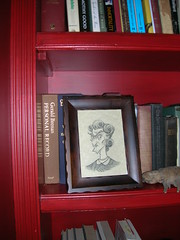
And from bookshelves of doom The Best Thing Ever (her words) and on video.

Plus a biography of Charles Addams is out. Its conclusion? He was "sociable and debonair".

Wrapping up, my new favorite site. Having provided me with such morsels as this:


... it also sports interesting pics from Wizard of Oz, Alice In Wonderland, and Harry Potter.
And that's just for starters!

Costumes Costumes Costumes

I love Halloween. I love Halloween costumes too. I already had my Halloween party this past week-end, and my guests were there in full force. These included, but were not limited to,

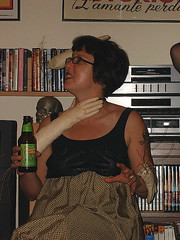
People Who Had Been Attacked By Robots and Got Away


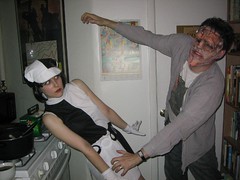
People Who Were In the Midst of Being Attacked
(I am on the left)


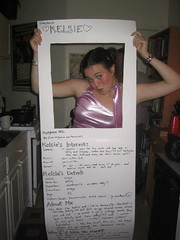
And the Occasional MySpace Page


There were others, but I think you would have had to have attended a Quaker college to appreciate them fully.

What I really love, though, is when a costume takes it to another level.


I found this via the ever-interesting files of the BB-Blog. You may have to blow it up a little to understand what it's doing. He looks great, but I doubt he'll be able to squeeze through any doorways.

Ghastlycrumb Tiny Quiz

Everyone and their mother commented on this last week, but today is the day to appreciate it fully. Here was my result in the Ghastlycrumb Tiny Quiz:


Which Gashlycrumb Tiny are you?


B is for BASIL assaulted by bears.
Take this quiz!


Quizilla |
Join

| Make A Quiz | More Quizzes | Grab Code


I shouldn't complain. There are worse ways to go. At least this one has the prestige of probably being the way in which Stephen Colbert also fears to die.

Thanks to Big A little a for the link.

A Cat Headed Poodle Walrus

My mother writes me and says that this is funny.
I do not believe her, but I check out the link anyway.
Five minutes later my co-workers think I'm having a seizure at my desk, the way I keep twitching and making loud inappropriate noises.

Best of all, it's Halloween-related (tangentially), so that's all right. Honestly, I wish I could write blogs posts like this. It's just too too good.

Review of the Day: Behind the Mask

Around early October, children’s booksellers and librarians perform synchronized shudders as an influx of bad Halloween titles swamp bookshelves everywhere. You can’t get away from them. Will the parents walk off with the repugnant tale of a little witch who just wants to be loved or something ironically sacchrine involving a boy who learns to share his candy? Whatever the case, the sheer piles of Halloween-inspired dreck is heady. With that in mind, a book like Yangsook Choi’s, “Behind the Mask” comes across as a breath of fresh air in the midst of all this garbage. Choi tells a measured tale of a boy’s wish to have the best and scariest costume for Halloween and throws in a good measure of Korean history and culture along the way. Consider this book the antidote to all the colorful horrible Halloween books that end up clogging the kiddies’ brains.

Kimin has a problem. A Halloween problem. He has no idea what to dress up as this year, and his mom isn’t being much help. All she's done is suggest that he look through his grandfather’s old belongings stuffed away in two heavy boxes. Kimin is aware that his grandfather was once a famous dancer in Korea, but he’s just uncovered a hitherto buried memory from when he was younger. When he was very little, Kimin spied on his grandfather late one night, only to find that the beloved relative had transformed his own face into something horrific. Now, going through the old boxes, Kimin discovers a scary mask that is EXACTLY the face the boy thought he saw that night. Now everything is clear for Kimin, and better still, he’s found his new costume. His choice of disguise comes off as a hit with the other kids, but when Kimin accidentally bruises his family’s priceless family heirloom it’s his mother he’ll have to explain everything to in the end.

Choi makes certain to end her book with a useful Author’s Note at the back, explaining fully what a Talchum, or mask dance, really is. Now I’m not entirely certain why great Korean-American picture books are more plentiful than picture books from many other cultures these days. Maybe it’s just my own perception, but when you’ve such high quality titles like Linda Sue Park’s, “The Firekeeper’s Son” and “Bee Bim Bop” alongside, “The Have a Good Day ?”, by Frances and Ginger Park, you begin to take notice. This is by no means Choi’s first book for children, but for those of us who are unfamiliar with her work, it makes for an ideal introduction. The story itself is intriguing. I was particularly interested in Kimin’s repressed memories of seeing his masked grandfather and how that played into the plot. The last image in this book is of the boy asleep under the formerly “scary” mask, which gives the story a lasting feel of comfort. For me, the illustrations were touch and go. Some of them, like Kimin staring longingly out his window on a dark creepy night, have a wonderful tone and feeling to them. Others, like group shots of children on the playground, come across as two-dimensional and flat. By and large these illustrations carry the story along well (though my husband pointed out the Charlie Brown-ish shirt on the cover as a touch distracting).

For those amongst you who might want to pair this title with another dance inspired picture book, consider, “Little Sap and Monsieur Rodin” by Michelle Lord. Both books use similar illustration styles, but while one speaks of traditional Korean dance, the other concentrates on the dancing style of young girls in Thailand. The two together would make for an eclectic storytime. Original, interesting, and fun, this book is bound to garner itself some well-deserved attention.

Monday, October 30, 2006

Plus Some Anne With An "E" News

Apparently the success of Geraldine McCaughrean's Peter Pan In Scarlet is giving people ideas. Craaaaazy ideas.
Budge Wilson, a Governor General's Literary Award finalist with twenty-nine novels to her name, has been commissioned to write the prequel, titled BEFORE GREEN GABLES. "When Penguin asked me to write this prequel, I was faced with an enormous challenge. But it was this challenge that made me want to write the book. "Given the appalling deprivation and emotional starvation of Anne's years in the Thomas and Hammond households and during her four agonized months in the orphanage, one is mystified as to how she became the person she was when she made her first journey to Green Gables with Matthew Cuthbert. How could she have become so vibrant a person, so talkative, so articulate, so optimistic, so full of extravagant dreams? This was the enticing puzzle that drew me into the project."
Because when you sit down and think about it, there just aren't enough bad ideas in this world being put into play.

Budge, for the record, has never had a book that took America by storm. This, however, may launch her little name heavenward.

Thanks to Galleycat for the link.

"He Has Six-Year-Old Teeth, Which Means Half of Them At Right Angles To One Another"

Podcasts are slowly becoming less frightening to me. Why this change of opinion? Credit, in part, this lovely lovely podcast with Eoin Colfer. I've seen him speak and he won my love instantaneously. And once you've won my love, my dearest darlings, that love can never be taken away. This is the only man you can listen to and really adore when you hear him teasing and plotting against a six-year-old with an unnatural resemblance to Gollum. Irish storytelling at its best.

Oh. And here's some Jonathan Stroud talking a bit about Ptolemy's Gate. That's fun too.

Adoption = Book Promo

Man oh man.
What some people won't do to sell a book.

Again, thanks to Galleycat for the link.

Review of the Day: The Cat With the Yellow Star - Coming of Age In Terezin

A couple of years ago, Maurice Sendak and Tony Kushner collaborated together to bring the world a picture book by the name of “Brundibar”. Based on the opera that the Jewish children of the Terezin concentration camp had to sing, the book was filled to brimming with good intentions and sadly lacking in any and all factual information. It was more a labor of love than a book meant to enlighten children as to the significance of its content. When “Brundibar” came out, it felt as if it was reliant on a book that had not yet come to exist. Where oh where was the children’s work of non-fiction that would tell younger kids what Terezin was, why “Brundibar” was important, and what it all meant? Three years later, Holiday House publishes Ms. Susan Goldman Rubin’s, “The Cat With the Yellow Star” and a gap in children’s collections everywhere is filled. And quite frankly, no other book could have felt quite as satisfying as this.

The story of young Ela Stein begins on Kristallnacht in Sudetenland, after it was annexed to Germany. Ela was eight when that terrible night occurred, and she and her family soon ran away to Czechoslovakia. Then, in 1942, Ela was sent with her mother to Terezin from their home. A converted fortress, the camp was a place where Ela and the other children who lived with her in Room 28 would secretly study, learn art, and cast themselves in the opera Brundibar. In the show, Ela was cast as The Cat and the Nazi leaders of the ghetto decided that they would use the children’s show as an example to the Red Cross of how well they treated their Jewish prisoners. Of course, of the 10,632 children sent to Terezin, only 4,096 survived. Ela was one of those survivors and the book shows how she grew up, met her friends from that time period years later, and has participated in Brundibar productions ever since. The end of the book shows a magnificent series of shows performed by children and Ela’s presence at them over the years.

The title is a rare creation: A children’s book memoir under fifty pages. As with her other 2006 publication, “Andy Warhol: Pop Art Painter”, Ms. Rubin is particularly good at writing factual biographies for younger readers. She knows that you can pen a book without growing overly reliant on chapters of fifty pages or more. As such, a lot has been left out of “The Cat With the Yellow Star”. The book makes the assumption that kids reading this will already be familiar with Hitler, the Holocaust, and The Final Solution. “The Cat” concentrates primarily on Ela’s tale, and explanations will not be forthcoming for those kids that don’t already have some of the basics of this story down. A person could learn so much from this book too. The fact that in 1945, “the Nazis turned Terezin over to the International Red Cross” as a way of liberating the prisoners amazed me. Ela’s mother even stayed on when her daughters left because she had been hired by a female Russian officer as a maid. Rubin carefully culls all the information she has been given, then keeps the book moving seamlessly from page to page. You may not be able to remember all the names of the girls as Ela befriended them, but you care for them just the same.

The level of documentation in terms of pictures, photographs, records, and images in this book is also astounding. Paintings created by the children of Room 28 are reproduced here and are sometimes able to shock because of what they leave you to figure out on your own. For example, there is a watercolor created by Ela’s friend Helga called, “Arrival In Terezin” that shows families walking past a guard into the camp. Look closely at the picture and you’ll see that everyone in the picture is smiling pleasantly, as if this were just a Sunday stroll in the park. Why would Helga present the people in this picture this way? Was it because she worried that the guards might see it and hurt her if they thought it was anti-Nazi propaganda? Was she just automatically making the smiles without thinking about it? Pictures of this sort raise all kinds of interesting questions suitable for debate amongst child readers. Of course, it would have been nice to be able to get a little more information from some of them. There’s a photography of the “special ghetto money” printed specifically in Terezin that shows an old man with a beard holding two stone tablets with Hebrew writing on them. The bills themselves even have small stars of David on them. Why would the Germans have taken this level of care in creating money for people they were just intending to kill anyway? Was this a part of the Nazi effort to fool the Red Cross into thinking that people were being taken care of? Maybe just a little more info here and there wouldn’t have been out of place.

Not that Ms. Rubin ever skimps on the quality source material. The Acknowledgments alone are worth the price of admission. Ms. Rubin’s Source Notes are of equal interest, to say nothing of the excellent list of Publications, Articles, Videos/DVDs, Sound Recordings, Interviews, and Internet Sites all clearly presented and beautifully aligned. If I’m going to get picky I might suggest that Ms. Rubin could have placed her four sentence Author’s Note at the beginning of the book (where it would have put everything to follow in context) rather than at the end, but that's neither here nor there.

All in all, this is a truly impressive piece of work. It pairs rather nicely with Kushner and Sendak’s, “Brundibar” (which only makes sense in conjunction WITH this book, to be frank) as well as the recent Jennifer Roy title, “Yellow Star”. “The Cat With the Yellow Star” really makes an effort, though, to show how life in a concentration camp wasn’t the be all and end all in Ela’s life. She made friends, left, created a life of her own, and is still speaking about what happened to this very day. This book is a testament to her strength, and it tells an important story to an audience that might otherwise never hear it. Certainly worth eyeing, at the very least.

Sunday, October 29, 2006

Wikipedia As a Teaching Tool

Like many librarians I have a love/hate relationship with Wikipedia. On the one hand, the very marrow of my bones starts to quiver whenever I hear someone refer to it as a research tool (someone = my husband). On the other hand, what's my one-stop destination of I want an all-purpose definition for something like, oh say, rutabagas.

What place could Wikipedia possibly have in the classroom? As always it's Monica Edinger with the answer. When a technology guru spoke to her class about the pedia of wiki, she took one look at a crummy plot summary of Charlotte's Web on the site and knew she had a lesson on her hands. The post is, in fact, so useful that next time I see Monica I'm going to try to wrangle her into making it an article for School Library Journal or some other national publication. Necessary reading, to say the least.

The ALA List of Books

I love long rolicking recommended book lists. And the ALA List of books recommended for the upcoming gift-giving season is here for 2006. Some interesting choices spot the list. I hadn't even really heard of Sue Corbett's Free Baseball, and The Entrance Place of Wonders: Poems of the Harlem Renaissance as selected by Daphne Muse has never crossed my doorstep. More to read, I see.

Took A While, But It's Here

It's been so long since someone claimed that graphic novels were not "real" literature that I was in serious danger of thinking them legitimate writing.

Thank God we've Tony Long to put us in our place.

Aw. Cry me a river.

Galleycat said it far better than I could on the matter:
Sounds like somebody's got a "real novel" gathering dust in a drawer someplace (or, these days, taking up space on a hard drive), and I bet he's a crummy draughtsman to boot. Comics newsblogs are being restrained in their attention to Long's whiny complaint, but bestselling author Neil Gaiman, who flits between comic books and real novels with the greatest of ease, gets in a blistering oh-shut-up retort: "I suppose if he builds a time machine he could do something about Maus's 1992 Pulitzer, or Sandman's 1991 World Fantasy Award for Best Short Story, or Chris Ware's Jimmy Corrigan winning the 2001 Guardian First Book Award, or even Watchmen's appearance on Time's Hundred Best Novels of the 20th Century list. Lacking a Time Machine, it seems a rather silly and antiquated argument, like hearing someone complain that women have the vote or that be-bop music and crooners are turning up in the pop charts."
Testify!

Review of the Day: Mama's Saris

I guess I never really realized that it was a universal instinct. You are born. You grow a little older. And then one day your raid your mother’s closet, trying on her dresses, shoes, scarfs, and so on for the sole purpose of becoming, if only for a little while, older. I remember trying on my mom’s wedding dress once, in all its frilly early 70s lace glory, and I was not a child usually prone to “playing dress up” as it were. Imagine then if you had a mother that wore clothes that had names like Zardosi, Banarasi, and Kalamkari. Pooja Makhijani has taken a very simple concept and has expanded it to encompass the whole wide world. With simple language and just the right words, she conveys better than anyone what it can mean to a daughter to find herself made into the image of her mom.

A small girl is about to celebrate her seventh birthday and you know what that means. Time for Mama to pull out the suitcase of saris she always stores carefully under her bed for special occasions. On this day in particular she lets her daughter pick out which sari to wear. Will it be the black chiffon one that “shimmers like the nighttime sky”? Or how about the blue with the gold flowers that dance along its border? No, nothing but the brilliant orange, “with edges that look like they have been dipped in red paint”, worn on the day when our little girl was first brought home from the hospital will do. Only, it’s not enough. The girl wants to finally wear a sari of her own, and this time, because it’s her birthday, she’s finally getting her wish. She is swathed in blue, bangled to match, and then in the final crowning touch is given the kiss of beautiful glittery bindi right in the center of her forehead. And when asked what she thinks, the kid answers in delight, “I think I look like you!”

There’s an awfully helpful Author’s Note at the beginning of the book that provides quite a bit of sari-related information for people who, like myself, haven’t been initiated into the world of Kantha and the like. Says Ms. Makhijani, “I wrote Mama’s Saris after realizing that my own fascination with my mother’s fancy clothes was not unique. It seemed as if each of my female friends, regardless of ethnicity or age, remembers being captivated by her mother’s grown-up clothes.” True nuff. Extra points for the rather nice Glossary of terms, also at the front of the book, that defines everything from what a didi is to chaniya choli, alongside pronunciations. As for the text itself, it really does convey the yearning many a little girl feels towards becoming as glamorous as her mother. Add in the extra delight of dress-up and you’ve got yourself a book that speaks to all kids of all persuasions.

Now sometimes the stars align in just the right way to allow a first-time picture book author like Ms. Makhijani to be paired with just the right illustrator. What this book required was an artist that could match the author’s eloquent ode to the sari in a realistic fashion. A messy illustrator or representational one working primarily in the realm of splotches and blots would not have done this book any justice at all. Elena Gomez is no newcomer to the world of picture book illustration, but she has yet to be recognized fully. And in the case of "Mama's Sari", she proves herself to be especially good at repeating vibrant patterns in this story, and everything from the bedspread to the saris to the wallpaper is reproduced here magnificently. I also enjoyed the moments when the narrator would discuss a moment from the past and Gomez would accommodate by showing the characters from that moment as snapshots lovingly framed and fallen against a multitude of glorious fabrics. Interestingly enough the artist’s figures are far more natural when they aren’t side-views of faces. Sometimes a shot from the side will look a little forced or unnatural. It rarely happens, however, and she makes up for these with pictures like the magnificent view of the girl’s mother smiling in her vibrant orange and red sari, as her daughter pouts over her left shoulder, simultaneously entranced and envious.

All in all, a soft and sweet little book. Written with love and illustrated with obvious care, it definitely is a keeper through and through. Consider adding it to your own collection should you feel you need to beef up your mother/daughter selection. A perfect Mother’s Day gift, to say the least.

On shelves May 2007.

Labels: ,

Saturday, October 28, 2006

Review of the Day: Changeling

When you find yourself a New York resident living and worked right smack dab in the center of this magnificently overblown city, you being to lose your perspective. Sure, I was born and raised in Kalamazoo, Michigan, but living in Manhattan is like drinking from the water of Lethe. I forget little things, like the fact that the world does not, in fact, revolve around NYC. So when I pick up something like “Changeling”, I find myself in a difficult situation. The book is a heckuva lot of fun, but I have to remember that all the places in it are New York-based. My responsibility as a reviewer, then, is to determine how well “Changeling” will relate to a kid living in Alaska or Hawaii. Will non-New Yorker children enjoy this book? Well, quite frankly I can’t see how they wouldn’t. I mean, it’s not the deepest piece of fiction you'll ever peruse, but it certain does owe a certain amount of allegiance to the form and function of fairy tales and quests. Plus it’s fun. Did I mention that its fun?

We’ve all read plenty of stories from the point of view of Changelings in the past. Sometimes, as I’m sure you all know, a human baby will be exchanged for its fairy Changeling double. The Changeling will grow up as a human, never quite knowing why it's different from its fellows. Well Neef isn’t a Changeling, but a child stolen by the fairies at quite a young age. Since then she has grown up in Central Park as the official Central Park Changeling. Her world exists apart from the world we live in, where all sorts of supernatural beings interact. As a human, Neef is naturally curious and when her curiosity upsets the Green Lady of Central Park (the ruling Genius) she comes in direct contact with the Changeling that once replaced her. Now Neef and Changeling are bound on an impossible quest to get the both of them home as fast as humanly, or rather magically, possible.

There’s no denying that the book has a distinctly Manhattan (not Brooklyn, Queens, Staten Island, or Bronx) feel. The Green Lady of Central Park, for example, could have sounded like your standard Midsumer Night’s Dream fairy queen. Instead, she’s far more prone to say things like, “Okay, kid, here’s the scoop.” And then there are little details, like the fact that even otherworldly spirits would kill to see “Wicked” on Broadway, if they could. I appreciated too the fact that Sherman wasn’t afraid to play with some old NYC standards. For example, the author had the wherewithal to notice that Kay Thompson’s, “Eloise”, is a good example of pure unvarnished evil. In this book she rules the Plaza Hotel and is the “official Patroness of Spoiled Brats everywhere.” Also, though I’m sure it’ll stick in the craw of some, for better or for worse George M. Cohan is now a vampire (and that goes double for Lynn Fontanne).

I did have a bit of a problem with the book equating Asperger’s Syndrome with Changlings. It seemed a risky correlation for Ms. Sherman to make. She’s never blatant about it, of course, but a quick examination of Changeling’s personality (she says that when she was younger she needed a therapist to help her develop social skills) coupled with the note in the book’s Acknowledgment section that reads that someone, “gave me an invaluable education on Asperger’s Syndrome”, was enough to put my hair on end. We don’t really want to equate Asperger’s with someone being physically from another world, do we?

So how does the book hold together as a whole? It’s very nice. For anyone who enjoys a good series of impossible quests, this book may be right up their alley. The character of Neef is willful without ever becoming annoying or unsympathetic. I was a little surprised at the ending, personally, but it’s entirely possible that Ms. Sherman is setting this book up to be the first in a series, if it does well. The types of fairies found here also have the same feel as those you’ll see in Eoin Colfer’s, “Artemis Fowl”, so fans of one may enjoy the other. And Sherman is kind enough to provide us with an elaborate glossary of the supernatural beings that crop up in this book.

And now, a personal kvetch. Early in the book we learn that, “Important New York places – Wall Street, Broadway, Grand Central Station, the New York Public Library, the Village – have Geniuses.” Very cool. And just at the beginning of Neef’s quest it is suggested that she visit the library to get some useful information. I, an employee of such a system, was briefly delighted. Then Neef doesn’t go, and we never get a glimpse of an otherworldly library system. Alas. The mentions of the library (there are two) suggest to me that there may have been a scene there in an early “Changeling” draft and that they were cut out so as to keep the narrative flowing smoothly. And while I celebrate the hopping speed of the book itself . . . bummer.

All in all, a pleasant little creation that deserves a look-see. Both Tamora Pierce and Holly Black were kind enough to give blurbs for the final book, so if you know of anyone who enjoys titles by either of them, you may wish to consider handing this little number over as well. A New York book that doesn’t require that you live here to appreciate it. And in spite of the all too obvious lack of librarians, a great read.

Notes On the Cover: Okay. Who did Delia Sherman’s agent bribe to get this magnificent cover? I mean, seriously people. Do you know what the odds are that a person with their first stand-alone children’s book (she’s worked on children’s anthologies in the past) would get this kind of eye-popping glamour? Very very high. I’m reviewing off an ARC here, so I can’t tell you who the cover artist or designer was that came up with this most spectacular piece of fantasy-laden magnificence. Needless to say, if a kid is into fairies, you will find yourself completely and wholly unable to wrench this puppy from their sticky little hands. My sole objection is that Neef is often referred to in this book as having a round belly. The waif on this cover, however, looks like she could use a sandwich or two. Otherwise, it’s perfect perfect perfect. Viking really does spend quality time on their covers.

Friday, October 27, 2006

Bad News. Really Really Bad News.

My husband warned me last night that if I didn't post about this ASAP, someone would beat me to it. That someone was Oz and Ends (of course) but I'll put in my two-cents as well.

Remember that whole Path to 9/11 brouhaha involving a film that was, to put it lightly, less than entirely accurate?

Remember director David Cunningham?

Guess what's he's working on now?

Director David Cunningham ("The Path to 9/11") will helm fantasy epic "The Dark Is Rising" for Walden Media and 20th Century Fox reports Variety.Part of a five-book series by Susan Cooper, "The Dark Is Rising" focuses on a youth who discovers at age 11 that he's a Sign Seeker, last of a group of immortals dedicated to fighting a growing presence of dark forces. He comes to the realization that he's charged with saving the world.Cunningham has already headed to Romania, where he'll prep the film for an early 2007 start and a September 28th release. The studios hope to launch a major kiddie fantasy franchise along "Narnia" lines

I knew that Walden Media was owned by a right-winger, but I never dreamed they'd get their hands on Cooper's masterpiece. Guess that scene in The Dark Is Rising where Merriman says the battle in the church is not one for the rector to fight (page 143, in case you're curious) won't make the director's cut.

For more info, definitely check out the take at Oz and Ends.

Obit

This just in via the ALSC listserv:

It is with sadness that we report that Theodore Taylor, author of numerous award-winning titles, including Harcourt's Billy the Kid, The Weirdo, and Timothy of the Cay, passed away this morning at his home in Laguna Beach.

A former merchant marine in World War II, he worked as a journalist before becoming a press agent in Hollywood. He was an associate producer and worked on seventeen major films, ending with Tora! Tora! Tora!

Talyor is perhaps best known for his modern classic, The Cay (1969). Over the course of twenty-three years following the publication of The Cay, Taylor received more than 20,000 letters from readers requesting a sequel to the beloved bestseller. In 1993 he published Timothy of the Cay, a prequel-sequel, which garnered many accolades, including an NCSS-CBC Notable Children's Trade Book in the Field of Social Studies, an ALA Best Books for Young Adults, the Judy Lopez Memorial Award, and a New York Public Library Book for the Teen Age

A Trip To the Brooklyn Arden

You guys are all perfectly aware that we're having a kidlit drink night on November 6th at Sweet & Vicious around 6 p.m. again, yes? Good, because Cheryl Klein has offered a kind of plea:

I will buy a drink for the person who comes up with the best alternate name for said drinks night; the name must contain fewer syllables (and especially fewer plurals). I nominate "Happy Bunny Hour," but I'm sure you all can do better. Take it away!

Too many bunnies for me. I'm still recovering from the one on LOST. Anyone have a smattering of inspiration they'd like to share?

Actually, that's not Cheryl's only recent plea. She also mentions that she is editing a, "book-length retelling of 'Rumplestiltskin' that has been described as 'a mystery, spun with a ghost story, woven with a romance, and shot through with fairy tale.' It is very, very good, and will be published in Spring 2008."

Great book, but again we have no name. Offer your suggestions to Ms. Klein if you are feeling extra extra brilliant. No making names with the word "spindle" in them either. The "Rumplestiltskin" story does not involve spindles. Know your spinning wheels, people.

Challenge (Usually They're More Interesting Than This)

I was sitting at the Reference Desk, minding my own business, when I came across the following statement on the Chicken Spaghetti blog:

1. Grab the nearest book.
2. Open to page 123.
3. Find the fifth sentence.
4. Post the text of the next four sentences on your blog along with these instructions.
5. Don't you dare dig around for that "cool" or "intellectual" book on your shelves. (I know you were thinking about it.) Just pick up whatever is closest.

I did. Here's what I found:

"I would like to know the truth about all these rumours and I am Your devoted Uncle, Aesculpaius Cultellus. Six weeks later, Gladius Ensa, the nephew, a captain of the VII Gallic Infantry, answered as follows: My dear Uncle, I have received your letter and I have obeyed your instructions. Two weeks ago our brigade was sent to Jerusalem. There have been several revolutions during the last century and there is not much left of the old city."

Dull, eh? This is a good kidlit quiz question, by the way. Can you name the book? In a way, it's the first of its kind.

And I Thought I Was So Special


HowManyOfMe.com
LogoThere are:
169
people with my name
in the U.S.A.

How many have your name?

Foo. I'm off to change my name to Moxy Freedomfighter then.

Wait...
Thanks to Librarianne for the link.

Six Word Stories

Everyone on the web has apparently been talking about these, so I see no need to stay silent on the subject. As I discovered initially through bookshelves of doom, dozens of writers recently attempted to create stories consisting entirely of six words. My favorites?

I’m dead. I’ve missed you. Kiss … ?
- Neil Gaiman

The baby’s blood type? Human, mostly.
- Orson Scott Card

Easy. Just touch the match to
- Ursula K. Le Guin

and my favorite

Machine. Unexpectedly, I’d invented a time
- Alan Moore

And then there is the Saints and Spinners version. These are little more kidlit friendly:

Charlotte's Web, by E. B. White:
Some pig! Some spider! No bacon.

Constance: A Story of Early Plymouth, by Patricia Clapp:
"I hate you!"
"Kiss me."
"Okay."

The contributers had some nice ones as well, including:

Lord of the Rings:
"This ring's heavy."
"Throw it away"

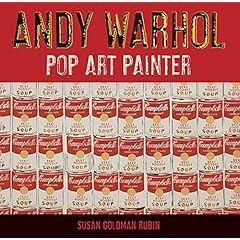
Review of the Day: Andy Warhol - Pop Art Painter

The construction of your average everyday children’s book biography is a complex proposition. You have to examine your biographical subject and determine their kid-friendly appeal. If, for example, you are doing a biography of an obscure Pope of limited charm, you may wish to reconsider the task at hand. If, on the other hand, your subject is the infinitely amusing, not to say fascinating, Andy Warhol then you may have better luck. Next, this may shock you, but not all children are the same age. What age group are you writing for? It sounds backwards, but it’s sometimes more difficult to write for younger rather than older children. Author Susan Goldman Rubin, however, has taken the challenge and has fashioned a book that someone under the age of 11 might find of interest. Finally, your pictures. With very few exceptions, young kids are not going to pay your book a whole lot of mind unless you find some cool and colorful photos/art with which to spot your book. In this sense, Ms. Rubin has not been entirely fulfilling. And so, “Andy Warhol: Pop Art Painter” is a great read and will certainly have young ‘uns grabbing for it, but it could have been a bit more forthcoming with the pretty pretty pictures of his work. Just my two cents.

He was born Ondrej Warhola in 1928 Pittsburgh, Pennsylvania to Slovakian parents. Never the most athletic of children (at age eight he came down with rheumatic fever), Andy loved comics, paper dolls, and coloring books. Once well, he started going to art classes and it was clear he had found his calling. Readers watch as Andy goes to school, moves to New York, and starts drawing shoes for Glamour magazine. Real pop art was soon to follow as Andy challenged what made something important and worthy of consideration. Can a comic be art if you blow up a frame? What about something as simple as a soup can? What is the worth of celebrity? By showing Andy’s life and the choices he made, Rubin is able to show us a man, his unique style, and why that man and style were important to the world.

Rubin takes certain steps to make the book kid-friendly right from the start. The almost picture book size of this ten by ten inch title makes it clear from the get-go that kids who pick this puppy up won’t have to contest with any 500+ page tomes. The text then pops out at the viewer on top of colored squares that change their hue with the turn of every page. The author also knows that kids like to read about famous people AS kids, so we get a nice glimpse of Andy’s younger years. Mind you, there are only 48 pages in this book and 15 of those are just a Time Line, Glossary, Source Notes, References and Resources, Illustration Credits, and an Author’s Note. Now one of my favorite books about Andy Warhol was, “Uncle Andy’s”, by James Warhola. In that book, Andy Warhol’s actual nephew recounted how he used to visit his favorite uncle once a year and discover through him what “art” was. Rubin doesn’t mention this detail, but does show and tell about Andy’s love of kids. As the book says at one point, “ ‘Children were drawn to Andy like a comic character with his wig askew, glasses and ... jeans,’ remembered Bob Colacello who worked for him for twelve years. ‘Andy loved to talk to kids. He found it interesting.’” And with this book, kids can find Andy interesting right back again.

Here is what I loved. I loved that at the end of the book there was a small section entitled, “Some Museums Where You Will Find Work By Andy Warhol.” Why doesn’t every single biography of an artist DO this? It is infinitely more useful than some of the other stuff they cram into the back of children’s books. Just the same, there is the occasional peculiarity. The Time Line is a bit of an extravagance here. More space filler than anything else, each date included is huge and the nine pages of Time Line after Time Line seem excessive. I would have loved to have seen a lot more of Andy’s work in the book too. Just exchange 8 of those Time Line pages for a couple portions dedicated solely to displaying some cool Warhol work and I’m there. Otherwise, it rankles with the rest of the book.

The other day I covered three tables in my library’s Story Hour Room with books published in the year 2006. At 4 o’clock that day I led in my homeschooler bookgroup, a small collection of kids between the ages of nine and twelve. I told them that we’d be doing something a little different that week. Instead of everyone reading the same book, the kids would have a chance to grab whichsoever book most tickled their fancy. They’d take it, read it over break, and return it to me the next week. Some kids snatched up Susan Cooper’s, “Victory”. Others took great pleasure in reading Janet Taylor Lisle’s, “Black Duck”. And sure as shooting, one of my more reluctant readers found a great deal to love in “Andy Warhol: Pop Art Painter”. It’s a lovable book. There are things that I would have changed about it, but that doesn’t make it any less of a wonder. If you’re going to have one children’s biography of Andy Warhol, let it be this one. Definitely a keeper.

Thursday, October 26, 2006

Not Velveteen or China, But Something Far More Precious

You are all well and truly familiar with the CBC or Children's Book Council, yes? I don't mention them very often on this site as they are a gigantic organization of such depth and learning that merely looking at their website causes me to quake in my sensible librarian shoes. The CBC, for the uninitiated, is "the nonprofit trade association of publishers and packagers of trade books and related materials for children and young adults." They do a great deal of good work with promoting National Children's Book Week and Young People's Poetry Week.

You might think a group of such importance would be lacking in a sense of humor.
You would be wrong.
Observe:


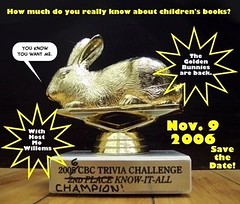
Yes, it seems that for the third year now there is to be a "Know-It-All" competition/party called the CBC Trivia Challenge, where staff of various publishers, "compete for bragging rights and, quite possibly, the tackiest trophies you'll ever come across which have been dubbed The Golden Bunnies." This year they will be hosted by none other than Mo Willems, everyone's favorite MC.

Think you know your kidlit trivia? Think again. Here are the 2005 questions and the 2004 ones as well. As you can see, 2005 displayed a definite uptick in difficulty. I didn't do too badly with the 04' list, but once you get to the final challenges of 05' you can just write me off as an ignorant goober. If any of you have ever played Literary Trivial Pursuit and found, to your shock and horror, that the children's book category was really really hard, prepare to relive that shock here.

And Trust Me, Smith/Scieszka Patter Is Hard To Replicate

Stripped Books is an irregularly published, non-fiction strip
covering book- and comics-related events in comics form.
As you can tell from the site, it hasn't been updated since April of this year. I consider this a particular shame since the events recorded on the site are great. I like how creator Gordon McAlpin will attempt to do one strip or another in the style of the artist featured. For example, for Jon and Lane Go To Barnes & Noble (Jon Scieszka & Lane Smith, to exact) Mr. McAlpin does a rough Lane Smith approximation. And the Marjane Satrapi speech is almost eerily good. Mr. McAlpin was last interviewed in June, so hopefully more posts will be forthcoming.

Thanks to KT Horning for the link.

Our Frightening Youth

I tell ya. Kids today. I don't know where the youth of America is headed. With their rock and roll and their interwebs and their movie posters.

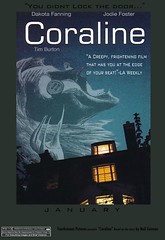
Take this young 'un, for example. She attends school in Santa Monica and last year in her 7th grade class she created this book-related movie poster:


What scares me is that a middle schooler is creating cooler stuff than half the adult movie poster-makers (there must be a better word for that) out there today.

Thank to Beth for the link.

Misc.

Consider these three little items too small to warrant their own separate posts. I just discovered that The Toothpaste Millionaire, for years beholden to a crappy ancient cover, has finally been reissued with a new look. Observe:

Place this one in the It's About Bloody Time file.

In other news, I'm in the New York Times . . . . . . obliquely on the review page for the book Deadly Invaders (I'm found under "Read a review"). Hey, man. Beggers can't be choosers. Watch now as I make a headfirst lunge at their Sunday book review section.

And finally, the Forbes list of Top-Earning Dead Celebrities was announced this week. Wave hello to Dr. Suess and J.R.R. Tolkein. You can't take it with you, and you can't stop it from pouring in once you're gone.

Review of the Day: Everlost

Simon and Schuster’s favorite Shusterman is back and he’s cooked up a doozy of a new title for general consumption. Proving to the world that he likes a little gritty with his nitty, Shusterman takes a dark turn with a tale of death, life, and an entire world that exists in-between. It’s an elegy to the historical New York region and a fun new way of looking at the nature of ghosts. Because essentially, “Everlost” is a ghost story at its heart. Kids and teens alike will enjoy the story’s arc, and though there are a few loose ends waving about here and there, it’s an enjoyable read just the same. A book with a chance at being remembered as Mr. Neal Shusterman's best.

Two complete strangers collide in a car accident on a treacherous bit of road. Neither person (both children) was wearing their seatbelt at the time. They die, but that’s just on the second page. It seems that Nick and Allie have knocked one another off-course when they were traveling towards "the light" and the two of them find themselves stuck in the middle of a beautiful leafy green forest. They are in the Everlost now, a land somewhere between life and death. No one who ends up in the Everlost is ever much older than fifteen or sixteen, and now our heroes find that the rules they used to live by no longer apply. There is no pain here, but as Afterlights (or ghosts) the kids can only stay in ghostly areas or they’ll sink to the center of the earth. They also have to avoid monsters, roving gangs, forgetting who they are, and falling into comfortable eternal ruts. To get some answers, Nick and Allie join up with the long dead Leif and head towards the Everlost version of New York City to get some answers. How do they leave this impermanent world? Where would they end up if they left? And what is their purpose after all?

Engaging? Entirely. If Shusterman wanted to write a book on how to create first chapters with a bit of bite, this might not be a bad title to reference. Right from sentence one the book gets the reader in a throttle-hold and never lets go. This book has plenty of magic, escapes, villains, mystery, and more to entice a couple reluctant readers here and there. I suspect that reading a chapter a day to a class of kids would work especially well.

The author does an excellent job of thinking up his perfect little world. In fact it's too meticulous in some ways. He has rules for everything to the point where little details that didn’t quite fit would nag at me. For example, once in a while food crosses over to Everlost and children can eat it. As such, Nick at one point gets trapped in a pickle barrel full of Everlost brine. It can’t hurt him, but it’s significantly unpleasant and he stays there for quite some time. Now one would think that Nick would figure that the best way to help his situation would be to drink the pickle brine and keep it from surrounding him if it’s so nasty. Silly? Oh my, yes. But creative kids readers may find lots of situations like this where the heroes don’t act in quite the manner you’d prefer. I also found it interesting that though Allie uses her smarts in various ways, getting herself out of a couple difficulties (though she seems to need rescuing just as often), she never actually saves anyone. Nick, at one point, is captured in quick succession by two wholly different villains. And though Allie works tirelessly to try to save him, in the end he rescues himself alone. Perhaps as a result, Nick ends up with a heroic job to do by the story’s finish while Allie’s fate is left unclear.

Of course Shusterman's language is always a treat. For example, at one point a bad guy has chained a bunch of kids upside down since the only way he can think to torture them is to bore them to death. They just hang there, but Shusterman is quick to remind us that there was always, “the occasional fight, and group sing-along”, which I found rather charming. This is the same evildoer, by the way, who when he finds out that his captives are having a rather nice time says to his best henchman, “Do we have something vile to pour on them?” Shusterman also creates what may be this year’s cleverest villain. You won’t know this person even is a villain for most of the book (though I’m sure that some canny souls will figure it out fairly early in). At the end, however, the real baddie is unveiled and the book ends on a wry note. I don’t know if the author has envisioned sequels to “Everlost” as of yet, he could certainly set himself up for a series here, if he wanted one.

Now there is one little aspect to this book that had me scratching my head and kvetching softly under my breath. The only places an Everlight can remain safely are places that have, like people, met their demise but were well-loved just the same. Old Penn Station, for example, is alive and well in the Everlost. Ditto the Steeplechase Pier and the Steel Pier. However, the Twin Towers appear in this book, and their very inclusion can only be called a calculated risk on Shusterman’s part. How comfortable will readers be seeing the Towers up again and housing hundreds of child ghosts? Is that cool? Is it too soon? As someone who wasn’t a New Yorker on 9/11/01, it doesn’t bother me. I just wonder how people who were in NYC will feel. There is also a mention of the as-of-yet nonexistent Freedom Tower that throws the book for a loop. Perhaps that part of the story will make more sense when and if the tower ever is built.

Some bits in this book work and some don’t. The parts that work include the Hindenburg (minus Nazi tail fins) in a grandiose entrance and the clever usage of a diving horse from Atlantic City. Parts that don’t quite gel include a bizarre reference to Roswell and another to Amityville. But in spite of these little bursts of peculiarity, the book holds together nicely. I didn’t see the twist coming at the end (even with my knowledge of Greek mythology). I liked the people in the book and the ways in which Shusterman chose to break up the text. The world of Everlost has seemingly thought of everything, which is swell. And when you get right down to it, kids are gonna eat this thing up. It may well be Mr. Shusterman’s best work, and it’s certainly an enticing read. Fun. Nothing more. Nothing less.

Wednesday, October 25, 2006

Condensing Monte Cristo

I cannot post from YouTube.
Am I letting this get me down?
Yes.
Am I going to let it continue to get me down?
Yes.
Am I going to find some kind of a workaround just the same?
You betcha.

The YouTube goodie I wanted to feed you involves the all new spooky world of book trailers. We've heard about them here and there, even if we've never seen one up close and personal. What about book trailer book reports, though? Where do they fall into the grand scheme of things? Danged if I know, but this summary of The Count of Monte Cristo has won me over. I'm still trying to figure out if it's authentic. I mean, do teens today still use the term "rad"? Really? That's back in style? Whatever the story behind it, though, consider this to be a possible alternative to those dry book reports we used to give in school when we were young. Now all you need is a projector and an iPod and voila! Instant craziness.

I Went To a Marvelous Party

I received the following anonymous comment this week:
Am I the only person who raises her eyebrows at the money these big publishers throw around? Am I the only person who thought that the Lemony Snicket thing was a huge waste of money? Can't a presentation be professional and appealing (and user-friendly) without overt extravagance? Shouldn't a great book or a great list stand on its own?
It's all in how you look at it. Allow me to point out, however, that the Snicket party was not, is not, and never will be the norm. This was a once-in-a-lifetime blowout event of publisher extravagance that likes of which I shall never see again. But see it I did and now you can too.

The full experience was already written here, so I'll just give you a walking tour of the space.

Okay, so you come in and this is the kind of place you find yourself in.


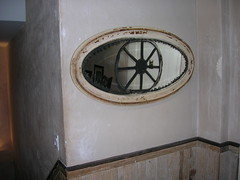
Kinda cool. You go up the first flight of stairs and see that someone has been given a liberal amount of freedom with that oval mirror in the hallway.


It doesn't take much to create the VFD eye symbol, it seems. And really, it wasn't until I uploaded these pictures that I noticed that this involved magic market at all. Live and learn.

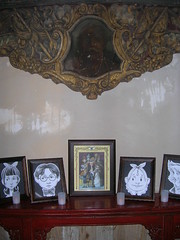
This next little set-up worked on a number of levels. Give it a long look.


The casual passerby could be forgiven for thinking that the face above these framed portraits was their own. At first it looks like a very dirty mirror. Then, as you lean in closer, you see that either you have grown a moustache or that's a painting you're examining so closely.

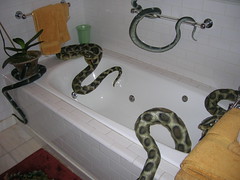
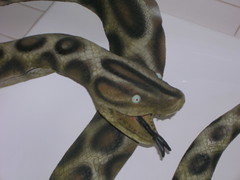
You have already seen the bathroom/Reptile Room, but here are some action shots.


My husband actually has to physically remove himself from the room when that second picture comes up. He has a snakes in bathrooms fear. No, really. He does.

I found this cutie tucked away one of the space's many hidden rooms.


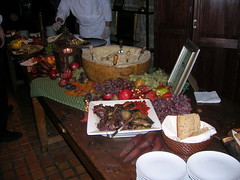
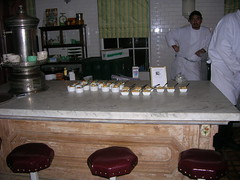
And then we get to the ridiculous overabundance of delicious food. See the round thing sitting in the center of the table below?


Do you know what that is? I'll give you three guesses. Soup? No. A gigantic melon the size of a punchbowl? No. Ice cream? No no no. It's cheese. The largest parmesan cheese in the world. You basically walk up to it, grab a knife, hack off a chunk, and devour it. And that guy in white behind it? Slicing mozarella as we speak. Turn around and you had the macaroni and cheese and pot pie . . .


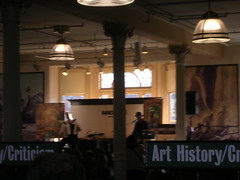
. . . albeit in teeny tiny ramekins. So that was that. I did not get a photo of Mr. Handler since it seemed rather silly. No one else, for the record, was taking any photographs and I felt a bit gauche. Gauche and librarianish. Hence I left and attended the official release of the book at Barnes and Noble. My view of Mr. Handler at the previous party had been from a 2 foot to 3 foot distance. My view of him at Union Square?


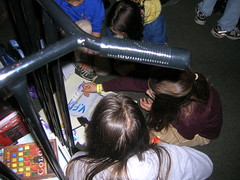
He's the one on the left with the accordian. Stephen Merritt is on the right singing the song Shipwrecked. Yes, I really was that far away. On the down side, not the best view. On the upside, I saw these kids below me.


Do you see what they're doing? By the yellow wristbands you can tell that somebody stood in line at 10 in the morning (for a 4:00 signing) so that they'd get a closer view of Mr. Handler when he signed books. Until that happy time occurred, however, they were perfectly content to sit on the floor painting this elaborate picture of a book entitled, "Violet's Diary" instead. He could sing all he wanted at the front of the room. They were having none of it until they finished the last touches on this, his present. Note the nice use of VFD on the left photograph. A pleasant end to a remarkable experience.

Republican Finds a Use For Children's Books

Unfortunately it's ... well.... here's the title of the article:

Candidate Proposes Using Textbooks As Shields

As Maud Newton said, "Note that this link is not to The Onion", hard as that may be to believe.
Bookninja, on the other hand, had this to say on the matter:
A school type in the US has suggested all students be provided with thick textbooks to use as shields during what seem to be the weekly shootings down there. Nice metaphor. I remember that old version of Snakes and Ladders based where the justification for a climb or slide was based on a set of morals. One of the longest snakes had a girl leaning back, relaxing at her desk, obviously slacking off from studying. At the bottom of the snake, the same girl was huddled in rags on a bench. If you don’t use your books wisely, you’ll end up fashion-poor and cold. Or in this case, if you don’t use your books wisely, you’re likely to be shot dead by that nutbar kid you’ve been pushing around at recess. Of course, students are free to open these books as well and see if there’s anything useful inside besides the Kevlar pages.

For People Who Wear Prefer To Wear Words On Their Chests

I'm not one of them, but that doesn't mean I can't enjoy this from afar. It's cute, but I incline more towards the Radical Militant variety.

Daily Shout-Out

Today's shout-out goes to Virginia Walter, professor in the UCLA MLIS program. Ms. Walter is one of the proud, the few, the MLIS profs who acknowledge and even go so far as to recommend blogs in their contemporary children's lit classes. Ms. Walter is the author of such books as Teens and Libraries: Getting It Right, which means she knows her stuff. Boo-yah, Ms. Walter! We of the Fuse salute you.

Review of the Day: Shark and Lobster's Amazing Undersea Adventure

I know that Book Buds already reviewed this puppy, but until I finish reading my current novel, I'm down to posting about picture books. Fortunately, this one's a hoot.

You take Viviane Schwarz and you add her to her partner in crime Joel Stewart and things happen. Craaaazy things happen. Crazy mildly disturbing things, but with enough goofiness to allow the duo their place at the children’s literature table. If the innate surrealism of writing “The Adventures of a Nose” together wasn’t enough for them, now they’re back with “Shark and Lobster’s Amazing Undersea Adventures”. The entire book feels like someone picked up a picture book, found the format dull, and decided to shake things up a bit. Okay, maybe more than a bit. A LOT. Charming and wacked out all at once, this is undoubtedly one of the more eclectic titles of the 2006 publishing year. Like nothing you’ve ever seen before.

Shark has a confession to make to his best friend, Lobster. Maybe shark is big and scary with lots of sharp teeth, but do you know what he fears more than anything else in the world? Tigers. Now no one else under the ocean has even necessarily heard of tigers, but what shark says about them is enough to give ‘em all the heebie jeebies right quick. After some fast thinking the underwater denizens set about building a protective fort. When that turns out not to be enough, though, they enlist the unknowing help of a sleeping monster. The monster, however, finds itself a little put-out regarding the role it’s supposed to play and after some thrilling chase sequences the it returns to the briny deep. As for shark and lobster, they decide that tigers aren’t anything to be afraid of and all is well in the end.

Now the book is one of those rare horizontal formats. You know what I mean. The kind of thing where you read the story with the book on its side, up to down rather than side to side. Other books have done this in the past of course. I think the best known was probably “Tops and Bottoms” by Janet Stevens (and IT won a Caldecott Honor). Inevitably the reader has to ask if this was a necessary way of presenting the book. I mean, is the author/artist just doing this for kicks or do they have a real reason for wanting elongated pages? “Shark and Lobster” definitely justifies the format, to my mind. The first full spread, after all, shows shark floating frightened in a beautiful blue sea. If a kid can look at this image and comprehend what’s going on then you’ve no need to fear for the rest of the book.

I began this review by talking about how weird this book was, and you might have gotten a small sense of that from my discussion of Shark’s fear of tigers (finned tigers!) or the fact that you read the book from top to bottom. But those weren’t really the weird parts. Remember when I mentioned that Shark and Lobster decide that the only thing to do is find a monster to help them prevent the onslaught of tigers? Allow me to describe this monster to you a little more fully. It has seven eyes, a light at the tip of its tail (on a lantern), what looks like butterfly wings, some tentacles, two arms (wrists akimbo) sticking out of the top of its skull, and freakiest of all, hundreds of high-heel wearing women’s legs. Hundreds. Oh... and a forked nose. She’d be cute if she wasn’t quite so DADA. Time and again, the legs are what stop people when they stare at this book. I’ve never really seen anything quite like them in a children's title before. Monsters come and monsters go, but few look as if they’ve spent their spare hours modeling for Dali on the side. I, personally, think the monster is heavenly, but I guess I could see how some middle-of-the-road people would be seriously weirded out by her appearance. In short, consider handing this book to a kid with easygoing parents. Those of an uptight nature may find monster-dear just a tad off-putting.

With this book, Ms. Schwarz does the writing and drawing and her husband is relegated to coloring only. There’s quite a bit of hand-lettering and some illustrations are drawn in ink, but color-wise this puppy’s been digitally filled in. And that’s all right. It’s not your mother’s picture book and it doesn’t want to be. Instead it’s goofy, and sweet, and will end up being one of those books that plague librarians in future years. Example: “Uh, hi. Do you remember a picture book, it came out in the early 2000s, and it had some ocean stuff with a shark. And there was a monster too, I think. And... and okay, I know this sounds crazy, but I think there were tigers? Does that sound right?” I don’t envy those future librarians. I do, however, hope lots of kids grow to read and love this interesting English import in all its goofy little glory.

Oh. And I've grown rather attached to Ms. Schwarz's blog too. She's British, as it happens. Spells words funny like "favourite". And since I've never run across a British children's author blogger, I may or may not be adding her to my blogroll. What do you guys think?

Tuesday, October 24, 2006

What's Little, Brown, and Read All Over?*

I have been a librarian with the Central Children's Room since January 2006. Less than a year. What I have accomplished in my time alongside such luminaries as the perpetually kvetching Winnie-the-Pooh? Well, I seem to have acquired an odd form of snobbery. A girl goes to 3 publisher presentations and suddenly she's under the distinct impression that at 28 she's seen it all and bought the t-shirt. She has not, for the record, seen it all. That much was proven yesterday when I attended the Little, Brown & Company Spring 2007 preview.

Joining me was none other than the illustrious Liz B from A Chair, A Fireplace, And a Tea Cozy, my co-worker Warren of Children's Music That Rocks, Monica Edinger of Educating Alice, and many more. Warren, Liz, and I arrived just a touch early at the Time-Warner building, directly across the street from Radio City Music Hall. The Time-Warner building is apparently under the distinct impression that they are a very important location in dire danger of horrible happenings. As such, they are the only building housing a publisher that requires that you have your bag x-rayed on the way in. I almost took off my shoes, it was so airport security-ish. Odd doesn't quite describe the experience.

Once you are inside, however, you proceed past incredibly famous photographic prints and goldfish bowl-like rooms containing board meetings towards the fan-freakin'-tastic Victoria Stapleton who is walking towards you in red shiny heels that would make Dorothy of Oz's tootsies seem drab in comparison. Some publishers will hand you a plate of cheese at their previews. Others satisfy you with a scone and a glass of orange juice. You wanna know what Little, Brown & Co. do? They give you hot foods, cold foods, tiny sandwiches, deviled eggs, spicy chicken, cheesy sticks, brownies, and chocolate chip cookies that are crunchy on the outside and chewy at their center. They give you real honest-to-goodness coke in a glass with ICE. Then you sit down at a table to indulge and perhaps kick yourself for eating lunch that day.

The real joy though is that this house's previews are one of those sit at a table affairs. You eat food and the editors come to you to tell you about their books. The rotate from table to table and all you have to do is munch on your fourth cookie as they describe why this book will be popular or that book a hit. There is, of course, art along the sides of the room for the viewing pleasure of the audience, and a wall of free ARCs with cute little red bags to put them in.

Unlike Random House, LB&C doesn't give you a powerpoint spreadsheet for glancing at afterwards. Therefore, I will only be able to tell you of the books I took home that looked especially promising. Lemme see here...

Atherton: The House of Power by Patrick Carman - I was disappointed with Carman's Elyon trilogy, but was persuaded to give this new series a go for the following highly scientific reasons:
1. It is a 2-parter rather than a trilogy with less than 400 pages, so that's nice.
2. It has a pretty cover and involves a world shaped like a dreidel.
3. I like the premise. It seems to bear some strong similarities to The Edge Chronicles at times, but I'm giving it the benefit of the doubt.

Eggs by Jerry Spinelli - If you happen to be at a party with Alvina Ling, have her tell you the background to how this book came about. Little, Brown seems to have a pretty good cover season coming up (which is a relief when you consider the fate of poor All of the Above), and this one is perhaps the prettiest of them all. No title on the cover, of course, but then neither did Stargirl.

Miracle Wimp by Erik P. Kraft - I don't read or review YA much, but when I heard that this was the same author as those early chapter books starring Lenny and Mel, I liked the idea of an writer skipping middle readers entirely and creating something older. That and it looks like a quick read.

The God of Mischief by Paul Bajoria - I reviewed the first book in this series The Printer's Devil for SLJ a year or so ago. In my review I pointed out that Bajoria got super sloppy with his ending and NOTHING was resolved. It's a testament to his otherwise engaging writing that I'm willing to give this puppy a chance. But if there isn't an explanation for that mysterious snake behind the wall in this book I am going to be seriously pissed off.

Celeste's Harlem Renaissance by Eleanora E. Tate - A relation of our own dearly beloved Don Tate, I hear. This looks good. I like the premise, I like the author, and I think it might be worthy reading. We shall see.

A mysterious picture book about the history of country music that is SO COOL that I couldn't help but mention it - It's illustrated by the up-and-coming Bret Bertholf (ironically enough, also the illustrator of The God of Mischief) and it was by far the most impressive piece on display. Unfortunately I didn't write down the title and LB&C wasn't handing out any ARCs of picture books. *growl* Amazon doesn't even have the book up yet, so memorize this name instead - Bret Bertholf. Bret Bertholf. When the book comes out you'll know what I'm talking about. It's Frankenstein Eats a Sandwich meets Honky-Tonk Heroes and Hillbilly Angels.

There had been a mention of a "surprise guest" for the evening in my invite, but I hadn't given it much thought beforehand. Turns out that Marc Brown was stopping by for a howdy. He's recently illustrated a book with Rosemary Wells about obesity (delivered, I might point out, after my second brownie and third chocolate chip cookie) and he signed posters for one and all. I had him sign one for my new little niece born this past September, though hopefully her parents won't think I meant it as a hint or anything.

Maybe this will amuse only me, but at first I was especially amazed that the LB&C presentation didn't feature roving bands of attractive young women. Young editorial females of incredible chic are usually prowling around their own publisher parties, usually in large groups. For most of the day, however, I didn't see any except for the people talking with us and I wondered if this would be an event free of under 30-year-olds by the dozens. That curiousity was well-satisfied when Mr. Brown took to the podium. Suddenly these attractive young women popped right out of the woodwork, clustering around the doorways to hear what the creator of Arthur had to say. *snicker*

All in all, a fine fine showing. Classy white tablecloths, great guests (kudos for getting someone who could call Mr. Rodgers a "good friend"), fabulous food, books galore, and even some mentions of the Class of 2k7. So if you happen to get an invite to one of these shindigs, do yourself a favor and go. My 2007 galley pile is now reaching immense proportions and I couldn't be happier.

*With apologies to Alvina.

New Search Engine

Which is putting it mildly. The future of search engines or the reason why Target is offering a sexy librarian costume this season?
Personally, I'm rather entranced with her handsome intern. He only crops up once in a while, though.

Where the Wild Things Ain't

Not every day is full to brimming with a wide assortment of delicious children's literature news. The sad truth of the matter is that bloggers like myself must sometimes scramble to find anything even tangentially related to my profession. Some days this is easy. Let's say, for example, that Maurice Sendak decided to tap dance naked at Radio City Music Hall with the Rockettes. Now THAT would be a good news day! Too good, probably. It would be better if he tap danced naked with the Rockettes in my living room. I'd be the only one who knew about it, making mine the exclusive blog to watch. This goes double if I remember my digital camera.

Then there are days like today. I mean, aside from the already described Little, Brown & Co. Spring preview, there ain't a lot to say.

So what do we do when the going gets tough?
We blog about freezing shadows, THAT'S WHAT!


This high-tech strobe freezes shadows on the wall – you keep moving, but your shadow doesn't. Add doodles, details and other drawings with the special light pen.
Oh, BB-Blog. The hours of enjoyment I've suffered at your hands more than makes up for my hollow little lie of a life.

Not too long ago I showed you some cool clouds from the bloomabilities blog. Now I've a whole lovely link to billions of freaky creations like so:


... or this ...


And in a final bit of this-has-nothing-to-do-with-kidlit schtoof, wherefore do they fear my love?

Shout Out To My Kidlit Peep

This one's going out to Judy Freeman who, in turn, gave Fuse #8 one heckuva shout-out at the Rutgers University writers' conference on Saturday. Judy, I only just heard of this and I totally owe you a coke. I was mentioned alongside Planet Esme as a hip and happening blog to visit. I'm so proud. Ms. Esme and I both do the book a day thing (she does more books but I do more days), and it is an honor to rest in such distinguished company. I'm off to powder my nose.

Party on, Judy!

Review of the Day: Noah's Mittens

I grew up the daughter of a fiber artist. There are, of course, a couple distinct advantages to growing up surrounded by wool day and night. You never lack for warm colorful sweaters. You eventually learn how to spin yarn from wool on a real live spinning wheel. You can dye wool with Kool-aid once in a while for kicks (this is true). On the other hand, there was one element of my fiber-rific life that never really won me over. My mother loved creating little brightly-hued felt balls out of wool. Just take an old pair of nylons, stuff a ball of wool into the toe, tie it tight, throw it in the washing machine and voila! Instant felt. I had actually forgotten about my felting past for a spell, until I picked up Lise Lunge-Larsen’s recent attempt to spice of the Noah’s Ark story. Entitled, “Noah’s Mittens”, the book sent me back to my feltin’ youth with a rush of memory. Though I’ve seen plenty of picture books talk about sheep, where wool comes from, and sometimes even how to spin fiber, I’ve never seen anyone try to explain the process of felting to children. Credit Ms. Lunge-Larsen, then, with being one of the first.

Thought you knew the story of Noah? Think again. There’s more to that tale than meets the eye. As we all remember, Noah was told to build an ark and, because he asked good questions, he was able to create it, stock it with two of every kind of animal, and set sail. Not everything was hunky-dory on the voyage, however. Noah had sealed the boat with pitch which had seemed like a good idea at the time. Unfortunately, that meant that “no moisture or heat could escape”. And even then, that might not have been so bad, had the sheep not suffered so terribly. Trapped in a situation where the wool fibers would lock together and shrink in the hold, the sheep are soon trapped in white, tight felt. Noah cuts it off and all is well, until the ark comes to a stop at the top of snowy icy Mount Ararat. Now Noah must make use of this new substance if he’s going to find a way to navigate down the mountain in peace and comfort.

You may remember illustrator Mr. Matthew Trueman from his eye-popping work on what may well be called the best Rosh Hashanah picture book ever, “The Day the Chickens Went On Strike”, by Erica Silverman. As an artist, Mr. Trueman gives this book enough zip and verve to attract the eye, sometimes against its will. To be perfectly honest with you, I’m not Noah’s Ark oriented, and this title could easily have escaped my notice had Houghton Mifflin failed to engage Mr. Trueman’s talents. “The illustrations are mixed media using pencil, gouache, acrylics, and collage, with an overglaze of oil paint”, says the publication page. In other words, gorgeous. Pictures of Noah, whether he’s plowing a field or tumbling down a flight of stairs are packed to brimming with energy and action. At times, his fingers and toes become geometric, echoing the boxy pattern of the ark and its denizens. Squares of action or characters float on top of the wavey seas, sometimes with hash marks scrawled to count the days. Best of all, Trueman isn’t afraid to go for the clever visual gag. When two beavers set about chewing the ark to pieces in the hold, the image ties in nicely to Lunge-Larsen’s appropriately vague statement that Noah would, “settle disputes” onboard.

The story, as it happens, was thought up when the author learned from a friend that Noah discovered felt upon the ark. In fact, in a final section of the book entitled, “Facts About Felt”, the writer goes on to say that “the oldest pieces of felt ever found were discovered in Turkey, home to Mount Ararat, where the ark landed.” Such a statement was just bound to end up in a picture book someday. Why not now? The story actually holds together rather well. Mount Ararat being a mountain and all would OF COURSE have been covered in snow when the Ark landed. There are little elements to the tale that work rather well too. I liked how Lunge-Larsen was careful to mention that Noah was smart because he asked good questions. I liked the characters, the plot, and the way in which the book was written. The book doesn’t go into why God thought it would be a good idea to rain for 40 days and 40 nights, though. In fact, the words 40 days and 40 nights never appear in the text. Be aware then that this book is making the assumption that kids are already familiar with Noah’s tale and don’t need to hear it word for word recounted here.

I adored too the aforementioned facts at the back of the book that mention felt’s appearance in everything from the felt shield and helmets of the Chinese warriors to the end of your felt-tipped pen. Of course, it would have been nice if the author had provided some quick and dirty instructions for creating your own felt. I guess wool is not as abundant in some places as in others, but cheapo yarn can certainly be felted just as easily. Maybe the publisher didn’t want to give up the space, though. Besides, at least there’s a nice little Bibliography of four feltmaking books for those kids, parents, educators, and librarians that might be interested in creating their own felt creations.

A bit of a quibble with one element of the book, though. The back flap’s illustrator info reads that the mighty talented Matthew Trueman, “had fun researching the wall carvings, murals and other art of ancient Israel, Mesopotamia, and Turkey.” I don’t mean to be a stick in the mud or anything, but in the midst of all this research is there any particular reason why he failed to look up how many children Noah had? Cause that last image of Noah, his wife, and his young son sledding down the side of Mount Ararat, for all it’s charms, is short about two other sons and three wives. I believe that a person can change little elements of stories to their liking, but when Ms. Lunge-Larson wrote that, “God told Noah and his family to go and people the earth”, that whole peopling process is mighty hard when there’s just one kid on the page. I think Trueman missed the whole two by two element here.

That’s okay, though. I, personally, could just page through this book all day, enjoying the pictures I find there. For sheer beauty, Trueman’s work is hard to match. And it’s nice to see the process of felting finally getting its kiddie lit due. I may complain long and hard when my husband accidentally felts my favorite scarf in the dryer, but I still have a respect for the process. A rather lovely book.

Monday, October 23, 2006

Hog Heaven

The owner of this book didn't find the surprise ending a bit funny.
I, on the other hand, think it's a stitch. I will now dedicate every inch of my being towards finding more copies to add to my collection.

Thanks to the Blue Rose Girls for the link.

Lose Yourself In a Book

The other day Kay Vandergrift came into my library, which was a bit of a thrill. She was looking for inspiration, as it happened. Recently she received a grant to update the children's rooms of some libraries in Lancaster, PA. We talked about great ideas for renovating kid spaces, and had I but known about this magnificent book furniture I would have asked her to look no further.

Thanks to Gotta Book for the link.

A Party It Would Have Been Fun To Attend

. . . and the person who did.
Remember when I told you about the “Fear and Fiction: The Power Of Children’s Books and The Inner Life of The Child” Conference? Had you gone you could have seen, "children’s book authors David Almond, Chris Crutcher, Neil Gaiman, Robie H. Harris, Lois Lowry, Pam Munoz Ryan, Martin Waddell, Mo Willems, and Jacqueline Woodson. Speaking with them will be six child analysts, Judy Yanof (Boston), Karen Gilmore (New York), Alicia Lieberman (San Francisco), Nick Midgley (London), Arietta Slade (New York) and Jenny Stoker (London).Keynote speakers will be Gregory Maguire, author of Wicked, and Stephen Marans, Ph.D., of Yale University Child Study Center, author of Listening to Fear."

Well Monica got to go. Lucky lady.

Review of the Day: Saving the Buffalo

You are an author. You have decided to write two non-fiction children’s books on two entirely different animals: rats and buffalos. As such, you will need to devote just as much energy to one as to the other. The rat book, one might assume, is relatively easy. Rats (as found in the book, “Oh Rats: The Story of Rats and People”) are disgusting/fascinating creatures that lend themselves to interesting writing. And then there are the buffalo to consider. Unlike rats, buffalo might seem a much more difficult subject. A lesser author might quail at the thought of producing a 128 page lushly illustrated, meticulously cited, and FUN book recounting the history of this King of the Plains. You, however, are Albert Marrin and you’ve got skills (as they say in the biz). So lo and behold this is the result: “Saving the Buffalo”, by Albert Marrin. More interesting than it has any right to be, Marrin skillfully tells not only the tale of what a buffalo was and how it was saved, but also how they fit into the plain’s ecological balance alongside the larger implications of their near disappearance.

Things you might not have known about the buffalo prior to reading this book:

1. The removal of the buffalo from the plains contributed significantly to the Dust Bowl of the 30s.

2. Wild buffalo have terrible eyesight, a great sense of smell, and won’t mind if a human comes up to them on all fours wearing a wolf’s skin.

3. Teddy Roosevelt and the ASPCA played a large part in the return of the buffalo to the wild.

And on and on it goes. Marrin pulls fact after fact about the buffalo out of his hat, all the while doing so within the structure of the story. Basically, the book begins by giving you a little background on buffalo basics. What they look like, how much they eat, their mating habits, size, etc. Two separate chapters then discuss how different tribes of Native Americans hunted buffalo, and this part is truly engrossing. The section on Native Americans before the introduction of horses to America and how they hunted buffalo is meticulous. We learn about trading routes between the agricultural Hopi and other Pueblo people and how they contributed to the nomadic plains Indians diet. We see elaborate and incredibly well thought out buffalo jumps, such as the Head-Smashed-In World Heritage Site. And THEN we find out what it was like when horses came to America and everything changed. After that it’s two chapters, one called “The War On the Buffalo” and “Saving the Buffalo”, which are fairly self-explanatory. There’s a distinct structure to the book, but it allows for all kinds of tidbits and remarkable illustrations to dot the text the whole way through.

Actually, as much as I would like to credit Marrin only with superb writing, his illustration choices are just as impressive. In full-color prints we see great paintings of the buffalo in their prime by people like John Mix Stanley, Meyer Straus, and of course George Catlin. Photographs of buffalo today illustrate their bone structure, the difference between female buffalo and male, and the look of a herd as it moves. Then we have photos from the height of the war against the buffalo. Shocking photographs like that of three “sportsmen” standing in front of at least twenty-two taxidermied buffalo heads, to say nothing of the mountain of buffalo skulls later in the book, drill home the wastefulness that came with the destruction of the “Lord of the Plains”.

Just the level of detail Marrin has taken with his book elicits respect. He spots his children’s non-fiction book with endnotes, something more authors should consider taking the time to do. In addition to this, there is also a Glossary, a list of books containing further information (both for “young people” AND “adults”) as well as a much needed list of reliable Web Sites, and an Index. When Marrin shows an image of native hunters impounding buffalo, he notes that the engraving “combines fact and fiction”. The picture displays the “pound” close to a native village. Says the caption, “With their keen sense of smell, the buffalo would have easily detected the village and run away.” Well noted, sir.

There is an odd moment at the beginning of the book where Marrin seems to feel obligated to note every single way a buffalo could have died, aside from at the hands of man. As such, Marrin recounts seasonal changes, thin ice, quicksand, mud, lightning, fire, wolves, and stampedes with perhaps an unhealthy interest. All that aside, this is one of the foremost non-fiction titles of 2006 and a heckuva good read to boot. Kids will find it interesting, adults will find it informative, and people who are entirely picture oriented will be able to take something from it as well. Great great stuff.

Notes On the Cover: Who’s a smart little jacket designer? That’s right, I’m talking about you, Nancy Sabato. You just want to plunge both your hands into the thick wool of this cover and never take them out again. What a magnificent photograph! What a great cover! Honestly, I did not initially want to read this book, but something about the cover convinced me to pick it up and enjoy it for all that it was worth. And THAT, ladies and gentlemen, is how covers are supposed to work. Take note.

Sunday, October 22, 2006

Oz and Ends on G.P. Taylor

G.P. Taylor elicits no love from the majority of the kidlit world out there. We all heard about the recent "attempts on his life" but I never felt particularly compelled to offer the man the one drug he's so obviously in need of: publicity. J.L. Bell, however, has written a truly enticing piece on Mr. Taylor's questionable antics. Following the article's link to Mr. Taylor's website also shows the Shadowmancer author to be the world's greatest poseur, rivaling only Neil Gaiman in terms of photographic broodiness. We still like Neil more, though.

Teapots, Cupcakes, and Feelin' Fine

As for all the other kidlit news out there this fine n' frisky Sunday morn, I'm just going to squish them all together into one big mondo posting.

So what do we have on our plate? Well, insofar as they include crowned frogs and doormouse references, you might want to take a gander at the world's loopiest teapots. Twenty points to anyone who can tell me what exactly the characters on the Lion and the Unicorn teapot are doing and dibs on the conker one below.


In other news We Feel Fine. No, really! According to my good buddy old pal old Don, there's a site out there that, "searches blogs for the phrase 'I Feel' and adds the remaining context to a catalogued database. With Harris’s design, the result of We Feel Fine is a trippy visualization of how the world’s bloggers are feeling at any given time. Sub-sort by genre, gender, location, and narrow results to see specific sub-sets of the blogging demographic." We're happiest in Hawaii (no surprises there, earthquake notwithstanding) and saddest in Florida. Don's going to screw with their results by constantly saying things like, "I feel impressed." I'm going to personally muck with them by saying, "I feel a brief spate of ennui."

Contest-wise, here's an interesting one. Wonderful Portland, Oregon based Powell's Bookstore is offering you a chance to Win Our New Staff Picks For Kids!. 24 in all from the year 2006 and all you have to do is plug in your e-mail address before Halloween. It's a good idea for the most part, though some of those titles err on the goofy side ("Yoga For Kids"? Really?).

In the bloggorial part of the world we turn out attention now to another contest involving free cuppy cakes and how you, the viewer, can get your hands on some. Yes, the fine as fishhair Blue Rose Girls are having a cupcake contest so as to assess viewer feedback to their blog. The voting closes at 11/5/06, so get your comments in now. A randomly selected personage will then receive delicious, moist cuppy cakes for the chewing.

My personal vote on the best piece they've ever run? Megan McCarthy's recent article on How Much Does Our Appearance Matter? I mean, how much does it? A taste of her opinion:
Example: Ever noticed how certain children’s authors use THE SAME PHOTO on the back of their jacket FOR YEARS? I always think “Hey, who are you fooling? That hat is straight out of the 80s. Update it! Proudly display your aged face!”
Just as amusing was a recent statement on the Misrule blog:
The two most evil characters in 20th century literature are Mrs Danvers and the fish from The Cat in the Hat.
I wonder, then, what it means that I was the child who thought that fish and Bert from Sesame Street had the right idea all along. Should anyone ask, I was a uniquely lame child. The kind who would create an inventory for the shelving and cataloging of the family VCR tapes.

It occurs to me that by giving you all these links today, I've left nothing for Monday morning. Let the scrounging begin then!

Review of the Day: Time Spies - Secret In the Tower

Wizards of the Coast have their own publishing company for non-D&D/Magic the Gathering titles? Now I’ve seen everything. At this point in time, I’ll be entirely blunt with you. When I picked up this first book in the new “Time Spies” series, “Secret In the Tower”, I was not especially thrilled. But I’m a fair children’s librarian. I try to allow every book I read a chance to surprise me, though few actually take me up on the challenge. In the case of this “Time Spies” book, everything was working against it. For one thing, it’s a series book for kids that probably already love “The Magic Treehouse” and “The Chronicles of Droon”. And my familiarity with those two series has taught me that when good authors like Mary Pope Osborne (as with her “Pompeii" book) and Tony Abbott (as with “Firegirl”) write series fiction for the early-chapter set, often the books are two-dimensional dribble with some of the worst dialogue on the planet. Hopes were, needless to say, not high for “Time Spies”. So I started reading... and reading... and reading... until it suddenly occurred to me what it was I held in my hands. This is a series book, yes, but it’s more than halfway decent. About the time I discovered that the youngest child had a stuffed elephant named Ellsworth, I was sold. You absolutely have to have series books in your home and library? Well, bypass all the other books out there and take a turn with “Time Spies”. If you’re gonna do historical series fiction for young ‘uns, you may as well do it right.

Alex, Mattie, and Sophie are all dealing with their recent move with their parents to a renovated country inn in the middle of Virginia in different ways. Five-year-old Sophie’s cool with it, eight-year-old Alex is excited by it, and nine-year-old Mattie is seriously perturbed. Once they arrive at the house their parents have bought, the kids discover that parts of the building date back to colonial times. There’s also a mysterious Revolutionary War reenactor there who tells them about the history of the region. When the three discover an old spyglass in one of the house’s hidden rooms, suddenly they are sent back in time to fulfill a job of the utmost importance. Codes, revolutionary heroes, and spies abound when these kids become messengers from the future to the past.

So what sets this apart from all the other “Magic Tree House” knock-offs on the market today? Well, for one thing, it’s far better written than any of the “Magic Tree House” books churned out. If you know of a kid that’s read all of Ms. Osborne’s series, you would do very well to encourage them to move on to “Time Spies” as they are similarly historically-minded. The book moves fast so that kids reading it won’t get bored, but at the same time you get a clear view of who the characters are right from the start. Facts about the time period they’re dealing with (in this case, both the Revolutionary War and the ride of Jack Jouette) are dealt with in kid-friendly but factual terms. The book also happens to be both understandable and exciting, a rare early chapter book combo. Ransom, to her credit, never leaves ends dangling or details swaying in the wind. If there’s a mystery at the end of the book, that’s only there so that kids will be enticed to read future books in the “Time Spies” series. Extra points to “Secret In the Tower” for including some of the little known George Washington spy info too often ignored in kid lit.

I’m obviously not saying that “Secret In the Tower” is going to win huge awards and revolutionize the way we read series books or anything. I just happen to know that finding quality books for kids of this reading level can be hard sometimes. If you’re gonna hand them a series, you may as well make it a good one. You may as well also make it “Time Spies”. It’s worthy of your consideration.

Saturday, October 21, 2006

You Don't Need A Blog - So Go Nominate

I know you're all sick as sin to here me once more talk about my precious little Cybil Award. Still, it occurs to me that I may have been unclear in the past. I want you to go to the Cybil Award homepage and nominate the best children's books of the year (one per category) AND you don't need to be a blogger to do it. Nope. Just go on, nominate, and watch for the results.

Megan Whalen Turner Fans Have a Blog?

Do they ever! It's called Eddis, Attolia, Sounis, and they post almost every single day. Wow. When I mentioned in my review of The King of Attolia that, "There are people in this world who have devoured Turner’s, 'The Thief' and 'The Queen of Attolia' and have been salivating over the prospect of consuming this, her latest work", there was a reason I followed that immediately up with, "These are the people I fear." They are literate, insightful, and did I mention that they pretty much post ever single day about Turner's books? Did I?

Anywho, recently they caught wind of my review and their comments on the matter are fascinating. They say I didn't mention how I felt about Gen personally, a problem I will alleviate right now. Um... I thought he was cool. Lord Peter Whimsy (I think Gail Gauthier called him that) is an excellent descriptor. One of the other most consistent points on the blog too is that it's not confusing at all as to why Relius was imprisoned. But then they NEVER say why! Why why why, people? Why was he arrested? Clear it all up for oblivious little me.

This Is News?

Obviously, those of you who read the P.L. Travers piece in the December 12, 2005 edition of The New Yorker will fail to find anything particularly new in this brief CNN.com article that makes use of the fact that *gasp!* she didn't like Walt Disney. Ho hum. Slightly more interesting is the mention in it that a Ms. Valerie Lawson is writing a new biography of the woman in question. And, should any of you be willing to make a Mary Poppins pilgrimage, I happen to know the secret location of the original parrot-headed Mary Poppins umbrella. Shhh.

His Dark Materials Photos

Ahem.
Should you be so interested, there are copious pictures from the current filming of His Dark Materials. Copious. Like, for example, this one of Lyra:


Apparently the green blog she's holding is going to become her daemon.

Thanks to Educating Alice for the link.

Horrible Histories

I've been hearing many an Anglophilic comrade-in-arms mention lately that the fact that the Horrible Histories, Britain's (which is to say Terry Deary's) gift of amusing history to the world, are STILL not as popular in America as they bloody well deserve to be is a crying shame. I wouldn't know. I've never run across a copy of The Groovy Greeks AND the Rotten Romans or The Wicked History of the World. If you're a fan, though, you may wish to check out this article from The Telegraph that describes the series to the uninitiated. I liked this particular tidbit as well:
More exciting still, Deary is in discussion with "a major leisure enterprise" to establish Horrible Histories theme parks – each era housed in a different dome, like the Eden Project. So when children can visit the Terrible Tudors near Stratford or the Rotten Romans at Hadrian's Wall, we shall be having Horrible Holidays, too.
Thanks to my mother for the link.

Review of the Day: An Egg Is Quiet

You know how it is. A wave of newly published children’s books hits bookstore shelves nationwide and somehow you miss some of the lovelier offerings in the mix. Basically, by the time you’ve gotten your bearings and have waded through most of what’s out there, a fresh and entirely NEW crop of books fill the shelves and you’re left wondering what might have eluded your grasp. What did I personally miss? I missed “An Egg Is Quiet”, and I am thoroughly ashamed of the fact. Now I have come to right a great wrong and heap healthy scads of praise on this most deserving book. Beautiful and informative all at once, it brings scientific information to the kiddies in a form that both they and their very happy parents will appreciate.

Before we get to the words in this book, let’s just open the cover. Ahhhh. See that? I’m talking about the endpapers. They’re blue and artfully speckled. Okay, let’s move on. Turn another page and now what do you see? Two pages of eggs suspended against a white background. Now we enter into the book and we learn all sorts of things about these yolky wonders. We see a massive variety in shell colors, from the magenta-tinged black-capped mockingthrush to the deep sea-blue green of the glossy ibis. We see how eggs can be different shapes, sizes, and have variegated patterns. They’re even textured differently, and in the book we see the gooey, rubbery, hard, smooth, and rough eggs of the world. Old dinosaur eggs and the development of embryos lead up to the final discovery. Yes, an egg may be quiet. But just wait until it hatches and then just listen to the noise. The final two pages before the endpapers show all kinds of insects, birds, and other egg-hatching creatures taking a kind of final bow.

What I respect about Dianna Aston is that she doesn’t limit her scope. It would have been the most logical thing in the world to focus this book on bird eggs and go no further. Instead, she’s not afraid of being inclusive. The section on the shapes of eggs even shows a perfectly round sea turtle egg, next to an oval ladybird beetle, next to a pointy common murre, next to a truly disturbing can’t-get-it-out-of-my-brain-no-matter-how-hard-I-try dogfish egg of the tubular persuasion. Variety is the name of the game here and Aston has the situation truly well in hand. She was only half the team, though. Just as much credit, then, must be handed over to illustrator Sylvia Long.

First of all, paint me baffled when I discovered that the only materials that went into the creation of “An Egg Is Quiet” were listed merely as “ink and watercolor”. Now, I have seen watercolors in my days. They are sloppy and messy and they don’t leave much room for the kind of elegant white space you find in this book. Yet on closer inspection there was no denying it. Long has mastered the art of the tiny watercolor detail. Whether she’s tracing the green sinews of the passion vine butterfly’s home or embedding the tiniest of speckles on the egg of a southern cassowary, the meticulousness you find in this book only adds to its appeal. There is a realism to these images that never becomes so scientific as to render them dull (if that makes any sense). Best of all are the tiny labels found on each and every page that describe what it is we are seeing and that have delicious names like sooty tern, paradise riflebird, and hepatic tanager. There are even notes that for the sake of accuracy will make it clear when, “all eggs on this page larger than actual size.”

Something you may have missed when you gave this book a quick once over: Remember when you opened the book and saw the two pages of eggs? Now remember when you were at the end of the book and you saw the two pages of birds, insects, and sea critters? Well don’t look now, but a lot of those eggs and hatchlings match up. Not all and not perfectly (unless someone can locate for me the hatched katydid) but enough that any kid who loves a little “I Spy” will be flipping back and forth and forth and back like there’s no tomorrow.

The trend in children’s publishing right now can be summed up in a single word: Foil. Shiny shiny foil. Whether they’re reprinting “The Cat and the Hat” to make it glitter or they’re pushing the insidious “Rainbow Fish” on innocent children, foil is the new black. What everyone should be doing, though, is taking a page out of Chronicle Books’ ... uh ... book. “An Egg Is Quiet” has foil on its cover, but it’s supremely subtle. The cursive letters of the title have a blue sheen with just a hint of green with the light hits them correctly. Maybe it’s silly to compliment a book on what it hasn’t done rather than what it has, but when it comes to attracting the eye of glitter-happy tots, this is undoubtedly the most sublime use of sparkles I’ve ever seen.

Oh, it’s a joy. A factual informative delight. Kids will pore over it for hours and, once in bed, their parents will soon be doing the same. If you know a kid with a scientific bent, or at the very least a healthy interest in the natural world, consider this the perfect gift. A divine alignment of text and image.

Friday, October 20, 2006

Puppetry Done Right

Okay, fine. So there wasn't much book related news today. So sue.
What can I offer you instead? How 'bout puppets? Magnificent, freaking, frightening, fantastic puppets? What do they have to do with children's literature? I dunno. Slot this one into the It Looks Cool category and I think we're set.

Thanks to Warren at Children's Music That Rocks for the link.

As the Cybil Gains In Strength

Looks like we're beginning to hit the big-time, baby.
GalleyCat has posted info about the Cybils. Of course, they call it "A New YA Prize" which it is most certainly not (or at least, not exclusively), but we'll take what crumbs we can get.

Salty City

When Alkelda the Gleeful posted information on her blog about the highly popular pirate rock band Captain Bogg and Salty, I was intrigued. When they came to my library personally, I was entranced. Therefore, let it be known that should you be in the neighborhood for good pirate fare for your little 'uns, these are the guys to get. 2 out of 2 librarians agree.

Generation Schools Gap

I received this e-mail from a co-worker of mine. Check it out:

On the They Might Be Giants e-newsletter, they talked about playing a few shows to benefit an organization called Generation Schools . Never heard of it? Me neither, so here's a description the band included in their newsletter:
"Generation Schools is a nonprofit organization piloting a new urban public school model where skilled teachers teach a handful of students, not a roomful -- without increasing costs. The schools will offer unparalleled opportunities for students and comprehensive residencies for new urban teachers. The "break-the-mold" concept was honored in a prestigious global competition as one of the world's best emerging social innovations. Generation Schools is opening its first school in the fall of 2007. Their remarkable new school model actually reinvents -- not just reforms -- the possibilities of America's public schools. We all know it takes much more than test scores for a child to prepare for life. Kids shouldn't have to choose between academics and art. With the Generation Schools model they won't have to. Informed by research from many fields and expertise from varied constituents, it is strategically designed to be academically rigorous, physically and creatively demanding, and socially and emotionally supportive for every child enrolled. For more about Generation Schools go to http://www.generationschools.org/"
A different co-worker then pointed out that while the current model isn't hugely successful it would be hard to visualize how this new approach works in the classroom. And wouldn't it require some extensive changes in budget and teacher contracts? The website says otherwise but can you rely on that?

Good points. Is anyone personally familiar with Generation Schools?

Roger's Been Comicified

Comic-ficated?
Comicification?

Whatever the term, I recognized him before they revealed who he was supposed to be. Tales From the Slush Pile (you'll find it at the bottom of the page) is touch-and-go but I like seeing people I've met in it. Wonder how Roger feels about being represented as the kind of guy who says things like, "Allow me to replace them", though.

Favorite Title of the Day

As good new article titles go, this one wins for the week:

Confident students do worse in math; bad news for U.S.

Review of the Day: Hattie Big Sky

Imagine that you’re a children’s librarian surrounded by piles and piles of books for kids, all published in the year 2006. How do you choose amongst your various titles to figure out what to read next? Do you pluck up the books with the shiny foil covers and catchy titles? Do you zero in on the 400+ page titles that all have “Book One” or “First In the [blank] Trilogy” somewhere on the cover? Do you stick only to those books written by authors you’ve loved time and again? For me, the decision to sit down and read, “Hattie Big Sky” was helped immensely by this first sentence on the authorial bookflap: “Thanks to her eighth-grade teacher, Kirby Larson maintained a healthy lack of interest in history until she heard a snippet of a story about her great-grandmother’s homesteading by herself in eastern Montana.” And we’re off! As someone who also couldn’t have cared less about history and historical fiction for most of her natural born life, Larson’s declaration right from the start that history was never her bag came as quite the wake-up call. Plus the result of her newfound interest in history is this remarkable little book recounting a single girl’s wish to go out into the world and prove herself to others. You couldn’t have it any other way.

It’s December in 1917. American involvement in WWI is in full swing and Hattie Brooks has just found herself the proud new owner 320 acres of land on a homestead claim in Montana. Left to her by a hitherto unknown uncle, this unexpected inheritance is just the thing Hattie’s been looking for. Orphaned when she was young, the girl has bounced from family member to family member so often that she feels a little like Hattie Here-and-There. Now, with a big beautiful piece of land entirely her own she feels like she’s Hattie Big Sky. Of course there’s fence to put down, wheat and flax to plant and harvest, neighbors to befriend (or avoid), and more work than this sixteen-year-old young lady could ever have dreamed of. Still, who would have thought that here on the prairie you could find just as much adventure, true friendship, and heartbreak as anywhere else on the globe.

Part of what Lason does so well in this book is create truly lovable and believable characters. Hattie befriends a whole host of different people on her claim and each one feels very real and, with the exception of the villains (and there are some) very lovable. The woman Hattie grows closest to, Perilee Mueller, talks like someone your mother might be best friends with. She’s down home and comfy and says things like, “Sugar, you are a stitch.” May we all find our own Perilees somewhere. And the nice thing about the book’s bad guy, the handsome Traft Martin, is that he’s not 100% out-and-out evil. Sure, he’s willing to pick on Perilee’s German-born husband because of the war, but he has his own personala demons and it’s great that the author lets you see that. No moustache twirling found here.

I also liked that I couldn’t necessarily predict where the book was going. Every once in a while I’d catch myself saying something like, “Okay. Now we’re going to get the scene where there’s a mob” or “Now we’re going to come to the scene where someone gets shot or arrested” and it just wouldn’t happen. Larson refuses to allow you to predict the novel’s flow, and I respect that. I do wish that we had learned a little more about Hattie’s supposedly scoundrelish Uncle Chester. He appears in this book like a kind of fairy godmother (or deus ex machina), and we never learn much about him. He’s so mysterious he almost feels like a plot convenience. It would have been cool to flesh him out a little bit, or maybe show that he got the claim through questionable methods. Then again, maybe that would have taken the focus off of the story at large, so who knows? It’s distinctly hard to say.

So who would you say that this book is for? On the bookflap, Delacorte has come to the conclusion that the perfect reading age for “Hatte Big Sky” is “12 and up”. Yet I can see historical fiction loving ten and eleven-year-olds also truly getting into Hattie’s tale. I mean, isn’t this one of the coolest ideas? You strike out into the great big world, just you and your cat, to make a living. You’re young and you tend your homestead and deal with nature one-on-one. And you have your own land! And cow. And horse. And chickens. For some of us, this is the ultimate fantasy of living in a harsh world. For others, this is the ultimate fantasy of snuggling down to a cup of hot cocoa as you read about someone living in a harsh world. It’s win win. Some teens will definitely adore it, but there’s nothing here inappropriate for the younger set as well. Just make certain they don’t mind reading about long passages that describe what it really means to work a homestead. Add in the additional recipes and a Further Reading section of books and websites and you've a better researched book than a lot of the non-fiction coming out today.

There are historical fiction lovers out there, and they’ll come in droves to appreciate “Hattie Big Sky”, should they happen to hear about it. So tell them. In a way, it’s kind of in the same vein as “Julie of the Wolves” and “Island of the Blue Dolphins” in that it’s a single girl making her way in a harsh world and growing to love the struggle. A fine and truly enjoyable read.

Notes On the Cover: Oh, Delacorte, you sly honey, is this for me? This fantastic cover, I mean. Look at this puppy. See, now all you other publishers need to gather around and respect how well photographer Jonathan Barkat and jacket designer Vikki Sheatsley did with "Hattie Big Sky". Note that there isn’t ANY sepia to be seen. And while they seem to have adhered to the odd never-show-the-title-character’s-face rule so popular these days, at least this isn’t another one of those disembodied females (i.e. random legs or torsos tossed onto a cover for kicks). Whoever they hired to look like Hattie is perfect too. Here she stands, looking at land and a wide expanse of sky (though not too much) with an interesting combination of calm and watchfulness. And with all that sky and land, it’s easy to see where to put the medals this book will accrue. Nicely done, though Mr. Barkat, I think you need to work on your website a bit. I can’t seem to get the images from your other books to come up on Firefox. Just a note.

Thursday, October 19, 2006

Nominate.... NOW!

The Cybils site is up and running. We're already accepting nominations for your favorite book of 2006 (English language) in several categories.

Here are the rules. You have until November 20th to cast your votes.

As taken from the Big A little a blog.

We Are Young, Heartache To Heartache We Stand

Our topic today is youth.
Specifically youth in today's hot editors in the kidlit field. Whenever I attend a publisher function I am continually astounded by the veritable plethora of intelligent young women (and occasional handsome man) in their twenties and thirties who run their field like there was no tomorrow. I'm not one to talk, considering I fall into their age range, but it really is a fascinating fact. Books are edited these days by many a sweet young thing, so how does that affect what we see on our shelves later down the line?

The Analytical Knife had some smart thoughts on the subject, but it's a funny question. Librarians, by and large, span a much larger age range than their editorial counterparts. How do we account for this? And which, in the end, is the better deal? I have my suspicions...

Scream and Run Away

Puppets are creepy.
Coraline is creepy.

Puppets + Coraline?
Zippo sleep for weeks on end. Again and again I wish I lived in Britain.

Thanks to Neil Gaiman for the link.

The Neitzsche Family Circus

Pretty much what it sounds like. Imagine what they could do with Marmaduke or The Lockhorns. The mind boggles.

Thanks to Eric Berlin for the link.

Review of the Day: The King of Attolia

To be perfectly honest with you, I don't want to post this review. I really enjoyed this book and I don't know if this review is a fair critcism of what Turner's done with her material. I'm reluctant to ever post any review I don't think is the clearest cut view I have of the text sitting in front of me. On the other hand, having not read the first two books in the Attolia series, I'm at a loss. So I'll post my thoughts on the book here, but I want you to know that I can't say that I'm a fair judge of the series as a whole. If you want a better rounded review, seek elsewhere. This is just a bit of writing for people who, like myself, haven't read any of the author's previous books and began with this one. Odd as that may sound.

Oh boy. Oh boy oh boy. It’s been a long time since I’ve actively avoided reviewing a book I liked. For about a week now “The King of Attolia” has been sitting on my To Be Reviewed pile, staring balefully at me like it was some kind of neglected kitten. You may ask, why would I want to avoid reviewing it if I found it a great read. How do I explain? Have you ever met a Megan Whalen Turner fan? I mean, a real fan? It’s an experience like no other. There are people in this world who have devoured Turner’s, “The Thief” and “The Queen of Attolia” and have been salivating over the prospect of consuming this, her latest work. These are the people I fear. Because, you see, in their eyes I did it all wrong. Up until this novel, I’d never read a single work of fiction by Ms. Turner. It just never came up. Now, however, I wanted to see just how well this “King of Attolia” stood on its own merits. I knew that I was going to enter in to a complex world with its own set of rules and meticulously hammered out details. What I wanted to find out was whether or not a person could hand this book to a twelve-year-old child who had not read the prior books and expect them to a) enjoy it and b) understand it. Believe me, I thought this novel was extraordinary. A bit of genius for young ‘uns, of a particular mindset, to savor. But I take my life in my hands when I tell you that you better given them the first two books in the series to read before this one. It’s great. I just wish I’d been introduced to Turner’s world properly. My bad.

Recap time. Eugenides has married the Queen of Attolia and is, at this point in time, king. It’s not going as well as had been hoped. His attendants think him a backwards dunce. His guards may or may not end up protecting him from suspected enemies. He’s far from home, has only one hand, and to cap it all off one of the royal guardsman clocked him in a moment of particularly inappropriate rage. The guard goes by the name of Costis and it comes as an odd surprise to him to find that his only punishment is to remain at the king’s beck and call. As Costis falls into his newfound role, forces are swirling about the new ruler. Assassination plots, unlawful dealings with the barons of the land, impending war, kidnappings, divine intervention, and enough sword fighting to satisfy even the bloodthirstiest of souls. At the heart of it all, Costis learns that there may be more to his king than he suspected.

I’m rereading my summary and it seems… paltry. I usually like to summarize a book when I write its review in the hope that maybe I’ll be able to explain to myself what I liked about the title in the first place. Yet there are so many levels and depths to Turner’s tale that boiling it all down to a meager “guardsman learns to trust king” summary is irresponsible. Let’s see how other reviewers have gone about synthesizing this plot. Hrm. The KLIATT review may say it best when they mention that, “This third book is about the subtle ways Gen uses his shrewdness, skill, and strength to win over his opponents and earn their respect and loyalty”. But this doesn’t convey the undercurrent of intelligence that holds the book together. Better to look at the book in terms of its smarts and intrigue.

And I certainly hope to howdy your kids like court intrigue! This puppy could easily be renamed, “Court Intrigue: The Book”, and I doubt very much that anyone could reasonably object. Still, Turner is smart as a whip and, because of her, Gen. First of all, it’s great to read a book of this sort with a sense of humor. Gen has a supposedly easy air that makes his every move and countermove come across as particularly lackadaisical. He seems to be at his most cunning when he’s at his most relaxed. If he lazily suggests that the solution to a problem is to build a bridge, it may well turn out that such an answer is most intelligent way to handle a problem. I also liked how Turner would work into her story real world figures, like Aristophanes, in a humorous way. The Author’s Note at the end that explains how much of her world is and is not real was particularly useful as well.

Questions I found myself wondering as I read through this book. #1: Why on earth are these people married? Are they sadists? #2: What is a “Thief” and why the importance? How could a Thief be cousin to a Queen? #3: Why is the heir of Sounis important? And then there were just the basic confusions that left me baffled. At one point the Queen’s most trusted advisor, Relius, is arrested and tortured. For what reason? I have absolutely no idea. When the whole incident arose I assumed that the nature of his crime would be patiently explained and parsed for those uninitiated into Attolia’s world. I consider myself a reasonably intelligent human being. Yet try as I might I still, to this day, cannot figure out why Relius was considered a threat to the empire. And though it may sound vain, I suspect that if a twenty-eight-year-old children’s librarian can’t figure this out, children may have a bit of a hard time as well. Teens really into Turner’s world, however, could probably explain to me word for word exactly what Relius’s unforgivable act was. If you happen to know of any, please put them in contact with me at their earliest convenience. Ditto the scene where Gen flips the queen for the kingdom. I have no idea what’s going on in that passage.

So not for kids, no. A teen book, yes. Plenty of references to the queen’s marriage bed is enough to confirm this. Ditto passages that read, “Since then, new courses had been laid to make the walls of a naos, provisionally roofed in canes. The rest of the foundation was open, as all that remained of the earlier building were the basal stones, in some places still covered by mosaics in tessellated patterns”.

It all comes down to this: You can’t understand this book if you don’t know why a man would fall in love with the woman who cut off his hand. Nuff said. I’ve read this thing cover to cover and I still can’t figure it out. But that’s all right. I understand that over the course of her series, Turner has created an incredibly real and full-blooded relationship. When the book says, “Costis was puzzling through the convolutions of human relationships, which were so unlike the neatly arranged patterns in a fireside story”, Turner might well be talking about her own audience itself. Add in the intrigue and characters that live and breathe like real people and you’ve got yourself a mighty fine showing. This is a remarkable book and one that makes me want to run out and read its fellows. It may not stand entirely on its own but if I were a teen librarian I’d be booktalking it to the high heavens above. Beautiful work.

Notes On the Cover: Greenwillow knows how to treat its beloved. The gilt alone is worth the price of admission. So too the scars on the king’s left hand and the queen’s hand resting on his shoulder in a simultaneous show of affection and ownership. Of course, the guy’s face looks about 15. I read this book without the cover because I didn’t want to hurt its pretty finish, and I imagined Gen for the whole book around the age of 38 with a full beard. Now I see he should have been the subject of a Tiger Beat article. How disturbing.

Wednesday, October 18, 2006

My Committee!

We have a complete 10 blogs on the Nominating and Judging Committes. They are as follows:

Nominating Committee
Kelly - Big A little a
Stephanie - Children's Literature Book Club
Mitali - Mitali's Fire Escape
Tracy - The Central Woodlands Media Center Blog
Me - A Fuse #8 Production

Judging Committee
Jen - Jen Robinson's Book Page
Eric - Eric Berlin Blog
Sherry - Semicolon
Patty - Bookseller By Night
Brooke - The Brookeshelf

A nice mix. Would everyone on these committees please e-mail me ASAP so that we can get to work? I'll send you the info you need once you do, but I don't have e-mails for most of the Judging Committee members (and your blogs are of little help in the matter).

Many thanks!

The Second Official Kidlit Drink Night Is Nigh!

Lest you fall under the impression that all kidlit bloggers do is stand around consuming beverages of questionable integrity, why not stop by the next Kidlit Drink Night so that we can prove you wrong?

Yes, the second official Kidlit Drink Night is now scheduled for November 6th at 6:00 p.m. The place is once again Sweet & Vicious, as it worked so swimmingly for our lasting out.

What can you expect from this night? Howzabout a remarkable smattering of editors, authors, illustrators, and librarians? Bloggers too, I suppose. Last time we were lucky enough to get people like John Green, Meghan McCarthy, and a heaping helping of Longstockings.

So drop on by. Even if it's just you and me, we could have a great time.

Fantasy For the Fearful

Perhaps, like myself, you have grown so attached to children's books that you were unaware that Susanna Clarke had written yet another. Perhaps, like myself, you fear that it may not live up to its predecessor, Jonathan Strange & Mr. Norrell. And perhaps only a reassuring review by fantasy master Ursula LeGuin will soothe your worried soul. If so, look no further than here.

Dive Into a Book?

This one's going out to 15-year-old Eric who, as his mother put it, "has a morbid sense of humor." Thanks for the suggestion, Eric. You are now the very first person under the age of 20 who has ever looked at this blog.

ABC

Great post on Mediabistro's GalleyCat about National Book Award nominee American Born Chinese. Says the article,
"A win for Yang would be almost as earth-shaking as Art Spiegelman's Pulitzer for Maus," comments Heidi MacDonald at The Beat. "Just to be a finalist is a huge accomplishment for Yang and First Second."
I've noted for a little while the nice blog First Second created, where Mr. Yang currently has posted thoughts on his nomination. There were also a couple really good American Born Chinese posts in the past, particularly this piece on the origins of the book. If you're still unfamiliar with this graphic novel, find it and read it. Best GN of the year, bar none.

Review of the Day: Holbrook - A Lizard's Tale

What does a children’s author do when they want to write about adult characters dealing with problems only the fully-grown would face? By and large, the author has two choices. They could either skew the book towards the YA market and write something like, “Montmorency: Liar, Thief, Gentleman”, or they could make everyone in their book into animals. In the case of Bonny Becker’s, “Holbrook: A Lizard’s Tale”, the author has chosen to opt for the second categorization, and you wouldn’t want it any other way. Her book poses a particularly lofty query (i.e. What is art?) within a context that many kids will understand. With books like Neil Waldman’s, “Out of the Shadows”, offering kids a non-fiction view of how artists are born, it’s nice to see Becker come from the fictional side of the spectrum to offer a similar kind of subject. ”Holbrook” is a small, unassuming examination of what it means to create and what that creation may be worth.

It isn’t that Holbrook feels unappreciated, exactly. He knows that his neighbors in Rattler’s Bend don’t understand his need to paint “squiggles” (as they call them) rather than realistic art. It’s just that he feels so utterly alone. Nobody appreciates the burning drive Holbrook has to create original paintings that make him feel a certain way. So when he hears that there’s going to be an artistic exhibition in the metropolitan Golden City, Holbrook’s out the door and on the Golden City’s streets quick as a wink. Trouble is, the place is a vast and hustling urban environment and Holbrook’s not certain of his place in it. So when art patron Count Rumolde brings the lizard into his home as a guest, Holbrook thinks he’s hit quite a spate of good luck. Unfortunately, things are not always what they seem in the city. Now our hero has found the dark side of the artistic temperament and unless he and some newfound friends use their heads, they’re going to find their careers cut short in a terrifying end.

Yes, it’s talking animals wearing clothes, but less of the fuzzy woodland creature variety and more along the lines of the Hermux Tantamoq book, “Times Stops For No Mouse”, by Michael Hoeye. Becker isn’t cutesy here. Her world has been well-thought out and the arc of the story occurs in just the right way to get kids interested in Holbrook’s predicament(s). I have a slight dislike of any book that takes the name of real life stars and gives them anthropomorphized names. Turning Margot Fonteyn into Margot Frogtayne, for example. Becker makes up for it, though, by at least including an Author’s Note that lists the real artists and what their accomplishments really were. The accompanying line drawings by illustrator Abby Carter bore (in the not-yet-finalized art of the ARC I read) a mild resemblance to a slightly more expressive E.H. Shepard.

There have been plenty of children’s books published this year that question the meaning behind “art” but usually those books zero in on a single style. You can read books about painters or photographers or writers, and never really come to grips with the fact that the inspiration of these variegated geniuses all stemed from the same interior source. Art isn’t just painting, and Becker makes this clear by surrounding Holbrook with animals of various talents and persuasions. I liked that. I also liked that the book made it fairly clear to kids why something like Vincent van Gogh’s Starry Night is worth looking at, even if it doesn’t look exactly like the night sky as we know it. Becker is looking at the value of art, even when it doesn’t construe to our preconceptions. I was impressed that she was able to present ways in which the real art world works, but in a kid-friendly concept. She can reel off a line like, “Art is about truth, but it doesn’t have to be real”, without ever becoming confusing. At one point Holbrook is convinced to create a dull painting for a rich patron because, “perhaps, that’s the way it worked in the city. Small favors to the right creatures.” The real world in miniature, this is.

Becker skews dark near the end of her novel, but though there are plenty of threats of violence, we never actually see a drop of blood fall. And there are a couple loose ends in the novel, of course. We never find out what becomes of the gastronomically-inclined (and near homicidal) ape. Still, on the whole the book is a pleasure of a read. It is small. It is quiet. It does not draw attention to itself with dragons and flashy foil covers. It’s just a perfectly nice book about a perfectly nice lizard in perfectly nice packaging. A read that anyone, artist or otherwise, could enjoy.

On shelves November 13th.

Tuesday, October 17, 2006

We Have a Name . . .

. . . and it's fabulous.

The official title of the The Children's and YA Bloggers Literary Awards is now The Cybils. Shoot on over to Book Buds if you'd like to see how the name came about.

And if you'd like to serve on a committee, head on over to Big A little a and let Kelly know. The gears are turning slowly.

Ohmigodohmigodohmigodohmigod....

You may not know it, but I always reserve the top story on my blog each day for the piece of news or info I think is the MOST interesting and MOST deserving of note. Today's is a doozy too.

I receive an e-mail asking me if I'm familiar at all with a little something called Class of 2k7. I am not. I flounce over, and what do I find? A website that describes itself like so:
The Class of 2k7 is a group of first-time children's and YA authors with debut books coming out in 2007. We're helping to promote each other's books with this joint Class of 2k7 website as well as a collective blog, newsletter, forum, chatroom, and brochure. Our 36 authors hail from 20 states and D.C. representing a range of genres and publishers.
They aren't lying either. The blog is fast-paced and the chatroom hopping.

And from whence did such an idea spring? Here's what incipient novelist Rebecca Stead (upcoming book First Light, a Wendy Lamb Book in June 2007) had to say on the matter:
The group was started by a writer named Greg Fishbone (THE PENGUINS OF DOOM: FROM THE DESK OF SEPTINA NASH, forthcoming from Blooming Tree Press). Last March, Greg sent an email out to New England SCBWI members in order to gauge interest in a marketing coop for first-time children's novelists. Six people contacted him within the first twenty-four hours. Then the word spread, as word will. We now have members from all over the country (as you can see from the website, conveniently searchable by geographic region!).
True too. I counted at least 34 first-time children & YA authors that will be published for the first time next year. What really impressed me is that this collective group goes across publishers. We're used to debut authors in small groups coming together to promote one another. I've just never seen anything quite on this scale before, and it pleases me mightily. Those of you who also have books coming out next year (ahem, Eric Berlin, ahem, Jay Asher) might want to join up with this kooky crew. Lord knows I wish I could, and I'm not even a writer.

Ruling Society Vs. Running Around and Jumping Into Things

When J.L. Bell had a recent post about The City of Ember, I couldn't help myself. Has anyone else ever noticed the similarity between that book and the following:

The Wind Singer, by William Nicholson
The Giver, by Lois Lowry
Below the Root, by Zilpha Keatley Snyder?

To be more exact, in each book a child turns 12 and will now have the job they will carry for the rest of their life. Child then discovers the ugly underbelly of his/her otherwise perfect society. . . . If the child is a boy, as in The Giver and Below the Root, then the job he's been given is extra special. If the child is a girl, as in The Wind Singer and City of Ember, the job requires running around a lot.

Well leave it to Mr. Bell to take an idea and run with it. God. If you aren't reading your Oz and Ends every single friggin' day then start. Each posting is like a perfect little thesis. In a good way, of course.

Color Me Skeptical

The latest in the "Death of the Book" cries of doom. Only this time it's a "Death of the Bookstore" cry. Slightly more interesting. Slightly more ridiculous.

Thanks to Bookseller Chick for the link.

Boston-Globe Book Awards Recap

I gave a recent recap of the various NYC Lemony Snicket parties I attended. From this you may understand that I really enjoy parties. So how cool would it be to go to the Boston-Globe Book Awards? Thankfully there's Seven Impossible Things Before Breakfast to fill us in with the nitty and gritty of the event. From the ironic free gifts to the best people to embarrass yourself in front of, Eisha tells all in a suitably amusing fashion.

Peter Pumpkin Eater... He's American All the Way, Baby

Hi, children's librarians. My most beloved constituency, I've a little website for you today. Should a coot come to you and demand to know whether or not "Pop Goes the Weasel" is as suggestive a song as he's always assumed it to be, come on over to this particularly enjoyable Nursery Rhyme website for lyrics, origins, and histories. Skeptical old me, I always like to put such sites through the test of whether or not they say Ring Around the Rosie is a reference to the Black Plague (it ain't). This site says it is BUT they give a little time to the skeptics as well. They dismiss us, of course, but beggers can't be choosers in this business. Worth a gander anyway.

Hot Men of Children's Literature: Part 28 In a Series

You know what? You kids deserve a really good publisher hottie today. I love me my authors and illustrators but you know what really gets a children's librarian's heart ah-pumping? A guy who knows his book covers. Man oh man, how can I resist a fella who looks me in the eye and says to me, "Every day I have to solve some visual problem very quickly, like what to do for a jacket illustration for a novel or a picture book." Melt.

But what does it all come down to? Eye candy. I love my HMOCL, but once in a while you need someone like today's fella to make your job truly worthwhile. I present unto you, the masses:


CHAD BECKERMAN


Wow. Just.... wow.

The kicker is that he was nominated by an Editorial Assistant.

Here's a bit o' info on the boy via TheCareerCookbook.com article on him:
Chad Beckerman studied Illustration at the Rhode Island School of Design, but what he really learned while in college was how to problem solve. This is essential in his line of work as an Associate Art Director at Harry N. Abrams, a book publisher in New York City. With his job comes a lot of juggling of projects and personalities.
Our boy's an Art Director with Amulet and Abrams Books for Young Readers. That means he's the type of person I'm directly addressing whenever I go on a what-was-the-Art-Director-thinking cover rant. To the best of my knowledge, though, Mr. Beckerman has never deserved such a yelling. His covers are distinctly delightful one and all. I even like the one he did for William Sleator's "Hell Phone".

Technically I referenced Mr. Beckerman earlier in the year with this article, but it's nice to give a fella like this his due in full.

Review of the Day: Something Out of Nothing

The biography for children is rarely done well, if at all. It’s too easy to take the life of someone famous, slap a few facts together, and then sell copies of your newest creation to countless school libraries around the country. When it comes to bios for small fry there are two modes of thought. Either you’re going to do the least interesting, simplest biography (thereby boring both your child reader and yourself), or you’re going to put some work into your creation and place the subject of your biography within the context of their times. Ms. Carla Killough McClafferty has opted for the latter. “Something Out of Nothing: Marie Curie and Radium” starts slow and then builds and builds until you find yourself in a remarkable world of radium drinks, pills, and miracle cures. McClafferty is no stranger to the world of radiation, having penned a history of the X-Ray for kids before. Now she turns her sights to one of the greatest female scientists in the history of the world. From stage frightened Polish child, to Parisian researcher, to her death at the age of sixty-six, Marie Curie’s life is propped before us with just the right combination of kid appeal and facts.

She was born a poor Polish girl on November 7, 1867. Smart from the start, Marie Curie, born Marya Sklodowska, dreamed of someday being given the chance to study at the University of Paris. After many years of saving and unpleasantness, she was able to come to France to fulfill this dream. While there, she met and married Pierre Curie and together the two of them set about discovering a couple elements and the true nature of that most mysterious of substances, radium. Author Carla McClafferty takes Marie’s discoveries and counterpoints the rise in radium popularity with the high-profile Marie reluctantly had to adapt to. She was a celebrity of her time so that just as radium caught on with the public, so too did Marie’s personal life. Remarkable in more ways than one, this is a story of a scientist who broke with convention to become extraordinary. This telling matches her in magnificence.

I admit that in my ignorance I didn’t think there’d be much to say about Marie Curie in a book for kids. I mean, she grew up, married Pierre Curie, discovered radium, and died of radiation poisoning, right? I thought maybe Ms. McClafferty would have a chance to make a long book if she simply stretched out Marie’s early life for as long as possible. So when I got to page 32 and found the book’s subject already studying uranium rays, I couldn't help but yell at the narrator, “Slow down, McClafferty! There isn’t much more to say! You’re going too fast!” Of course, she wasn’t. This book goes at exactly the right speed, never dwelling on a dull factoid or pulling to inordinate length a moment in Mrs. Curie’s life that needed no stretching. And while I knew the basic “first woman” facts surrounding Marie, I had no idea what a great person she was as well. This is someone who refused to patent radium because she felt the element belonged to the world and not just the people who happened to find it. A woman who drove mobile X-ray units into war zones to aid doctors. Who named a new element Polonium after her beloved Poland. I knew none of this before and with McClafferty’s snappy writing helping me along, I feel any kid that reads this book will learn so very much.

A couple years ago I had a chance to visit Minneapolis, Minnesota’s now defunct Museum of Questionable Medical Devices. Besides the exhibits featuring ear candles and phrenology machines, there was a large section of the museum dedicated to the radium fads. It never would have occurred to me to think that Marie Curie had an indirect connection to the bottles of Radithor or the Revigator jars on display under glass cases. Even the Museum, though, didn’t have half the fascinating items shown in photographs in this book. Radium was the original glow-in-the-dark paint, making everything from watch dials to crucifixes shine when the lights were low. The most frightening of all of these? The “Atomic ‘Bomb’” ring. Says the book, "You could see tiny flashes of light come and go as individual atoms of a radioactive material gave off energy and lit up the zinc sulfide in the ring." McClafferty knows to pepper her book with stuff of this nature, giving the book just the right amount of zing and zazz for the kiddies reading it.

One problem I do have with the book is that McClafferty doesn’t really drill home the danger of all these radioactive consumer products. Take, once more, the Atomic Bomb ring. Was it really dangerous to kids or was it as harmless as the manufacturers said? Obviously McClafferty wouldn’t be able to say just how harmful each and every product shown in this book was (there are, after all, quite a lot of them) but I would have liked a little clarification on a couple points. It isn’t until we get to the end of the book that we learn exactly what it is that radium poisoning does to the human body. Even then, to what degree is radium outside of the body dangerous? We hear that when someone wants to view the original notebooks of the Curies they must, “sign a form releasing the library from responsibility for any ‘possible risks of radioactivity’”. But to what extent would those notebooks be dangerous? A little more clarification on contact with radium without ingesting it would be welcome in this title.

And yet nothing eases my fears faster than an author who knows the importance of displaying their source materials. Right from the start a "Note to the Reader" explains why the author chose one spelling of Marya Sklodowska over another. Later on, Ms. McClafferty gives us copious Source Notes, a rather impressive Selected Bibliography, Illustration Credits, an Index, and (most impressive of all) a wonderful list of well-selected Recommended Web Sites. Kudos all around. What I want to get through to you is that this book is equal parts fun writing and great factual info. Sure it’s chock full of great info about this great woman. But it also happens to be a gripping read and a great story to boot. Marie Curie appears here to be the kind of woman authors dream of writing biographies about. Ms. McClafferty just happened to be bright enough to tie in Mrs. Curie’s life to the world around her and the fads that came about due to the radium hype. A great book and well worth adding to any and every collection in the country.

Notes On the Cover: They wanted to put a photograph of the subject on the cover. Fine. They wanted to tint the image so it looked old. Fine. They wanted to tint the image mustard yellow since that was obviously the color (circa 1973) that kids today would gravitate the quickest towards? Um... not fine, guys. I understand what you were doing. It was sepia-toning but with just a dash more color than your average dull brown covers out there. Only, see, here’s the thing. Marie gets kind of washed out in the image and the cover is just a touch forgettable as a result. What if you’d put the atomic bomb ring on there? Or one of the crazy faux-radium “cures”? What if you’d gone the opposite route and just rendered the cover black and white? This is fine and all, but I’m not sure if this color's star has risen high enough to render it a stand-alone shade at this point. Actually, the photo I have of the cover here looks nice enough. Maybe my book was just a particularly atrocious shade. Hm...

Monday, October 16, 2006

The First Annual Children's Book Awards, Blog Edition

Hey, Kidlit Blogger types,

You know what's fun? Watching committees come up with lists of the best children's books of the year. You know what's even more fun? Creating lists of the best children's books of the year. As Kelly Herold put it, "couldn't we, the intelligent, savvy members of the kidlitosphere do better? Or, at least, differently?" She's so diplomatic.

Hence this neat experiment in the power of kidblog awarding. We are officially inaugurating our own book awards, honoring books published in English for children in 2006. Anne Boles Levy, of Book Buds, will launch a site this week and administer the awards process. To read all about the new Children's Book Awards, head on over to Big A little a. To suggest a name for the Book Awards, (I thought "The Winnies" would be good) leave a comment with Anne at Book Buds.
And what role do I play in all this? Well, Fuse #8 has been chosen to be the administrating blog for the Middle Grade Fiction category.

Here's the deal: Do you run a blog about children's books, are you a children's book author who blogs, or do you run a general book blog? Then volunteer to serve on the book nominating committee or on the judging committee. You can't, I should add, serve on both. Here are the duties of each committee:

Nominating: Nominating committees of five members will narrow the recommendations (open to everyone with web access) down to a shortlist of five books per category. In this case, five middle grade chapter books. A list of all recommendations (we're initially very democratic here) will be received by the nominating committee on November 21, 2006. Then for two months or so we beat each other over the heads with sticks until we come up with a shortlist of a mere five books. The shortlists will be announced January 1, 2007. Thus ends the job of the nominating committee. On we go to the Judges!

Judging: Judging committees of five members, different from those serving on the nominating committees, will decide which title per category will win the Children's Book Award, Blog edition. The winners will be announced January 15, 2007 or so. To serve on this committee, keep in mind you will have to read five books during a very busy time of the year and discuss them with the other members of the committee.

When leaving your comment, please choose a second choice category just in case we have too many volunteers for Middle Grade Fiction.

As soon as we have a name and committees, we can begin soliciting nominations.

Questions? Head on over to Big A little a for more information


Really?


Meghan McCarthy would have you believe that in every single Chris Van Allsburg book there is at least one sighting of a spotted dog. I stand amazed. And here I thought I knew my stuff. Just goes to show, eh?

Costumes Target's Offering This Halloween Season

Puh-leeze. Like we don't all look like that anyway. Now if you'll excuse me, I'm off to iron my acrylic book-patterned skirt.

Thanks to Book Moot for the link.

Great Post At Educating Alice


It's always nice when you can count on other participants in the field of children's literature to speak eloquently on a topic that you yourself know so little about. In this particular case, Monica Edinger has a great post at Educating Alice entitled Madonna and Child - The African Version. It also happens to explain the picture on the left here.

Review of the Day: Out of the Shadows

If a person wanted to tell the story of their life in a biographical format, why would they choose to make their intended audience children rather than adults? Maybe the person in question would feel that children could better appreciate their life and accomplishments. Or maybe they’re unsure of their writing skills and thought that kids rather than grown-ups would be easier to write for. Maybe they are of an artistic temperament and feel that if they spotted their book with beautiful glossy illustrations, kids would gravitate more readily to that aspect of the story. And maybe they’ve always seen their childhood, rather than adulthood, as the part of their life with the best narrative, and unless a biography has copious amounts of abuse in it, adults aren’t going to be as interested as children. For artist Neil Waldman, his motivation for writing, “Out of the Shadows: An Artist’s Journey” for children may have knowingly or unknowingly have their roots in all of these reasons. The book is lovingly put together, with fantastic pieces of arts spotting the text. It is not, perhaps, the first autobiography I would hand to children that need to read one for school, but it may contain some of the best explanations on how a person truly becomes an artist. It’s flawed but worthy.

Neil Waldman was born in the Bronx, one of the first American-born children of his Russian/Galician immigrant relatives. At family gatherings, Neil would often have to face the inevitable question that began, “You are our family’s first generations born in freedom. So what are you going to do with it? What are you going to be when you grow up?” A hard question for a child at any age, but early on little Neil hit upon what he wanted to be. An artist. When he found his mother’s book of Vincent van Gogh paintings, Neil discovered a love that would last him his entire life. He needed it to. In his parents' household, growing up meant dealing with constant fighting and violent words. With his siblings, Waldman was able to cultivate his skills and become an artist in every sense of the word.

In this book, Mr. Waldman continually plugs the children’s books he’s written over the years like, “They Came From the Bronx”, and “The Starry Night”. I didn’t mind that. I liked how he was able to tie distinct moments from his own past into the work he would do years and years in the future. There is no distinct moment in time when the book’s narrative ends. Waldman is far more interested in showing “a childhood” rather than a strict assessment of years between such n’ such an age. The last glimpse into the past we get is of Waldman and his three siblings working on their art to escape their parents’ fighting. It ties in rather nicely with the first image of the book, where Waldman is unable to deal with the fights and has not yet found an artistic escape route. Often it’s difficult to determine when one action or event takes place in time as Waldman is not prone to listing his age or any dates all that often. Still, there are worse crimes in this world.

Neil is continually adored and doted on by his grandfather and, in time, his own father. It was interessting to me that we never hear if his younger siblings received the same attention as their eldest brother. He was the one that Grandpa Meyer took to the zoo every day. He was the one that went to concerts with their father. It would have been nice to have seen how Neil’s siblings felt about this, perhaps, preferential treatment, but as this isn’t the point of the book we don’t hear much about it. I did appreciate that Waldman was able to look with nuance at his father, the simultaneous villain and hero of his early years. For much of the book, Neil’s father is a verbally aggressive unknown figure who one day, out of the blue, takes his son to see a symphony play. From this, Neil determines that he has seen a softer side of the man he’s feared all his life. Kids reading the book, on the other hand, may determine for themselves whether such actions humanized Neil’s father or simply make him more complex.

If Mr. Waldman has a weakness, it’s in his dialogue. Whenever he speaks in his own voice as a child, the world are italicized and set apart from the rest of the text. This in and of itself isn’t a problem. The difficulty comes when any two characters have a conversation that lasts longer than four or five sentences. Waldman is adept at facts and histories. In recounting actual speech, however, he has a tendency to simplify everything into the kind of sentences an adult would imagine a child to have. In one case, the word “Yup” is used six times within a single conversation. In another, when little Neil asks his mother about her book of Vincent van Gogh, he says, “Please, Mommy. Please tell me everything about the colors.” It’s a form of overly formalized pseudo-childish dialogue that occasionally weakens an otherwise strong narrative.

Surely the best part of this book is the art itself. Waldman has cleverly culled paintings, sketches, drawings, and who knows what all from his extraordinarily talented family to illustrate distinct moments from his own life. At first when you read through the book, the viewer is confused by the unexplained paintings. Some of them were created by people with the same last name as the author. What are we to make of that? Eventually, however, we find that each work of art was created by a member of Neil Waldman’s family. It gives the book the much needed weight and oomph when you can see the sheer range of talent that gushes from this family unit. I was more than a little sad to see that in the midst of all this magnificent work Neil chose to include only one painting from his own youth. The painting, “Creatures” created at age 11 is a remarkable surreal watercolor, with such fantastic shading and depth that the reader is left wanting to see more and more of what Waldman made when he was a child. Perhaps these paintings were lost in time. Perhaps Waldman didn’t want to focus too closely on the work from his early years. Whatever the case, I wish the reader could have seen more, but in the meantime this single picture will have to suffice.

On the whole, the book is an honest examination of how and why creativity blooms. And while I felt that the writing itself could have used a little work at times, the overall effect of, “Out of the Shadows” is to show how art can come out of pain. It doesn’t hurt any that Mr. Waldman is a fantastic painter either. His works, spotted throughout the book, are consistently engaging and enticing. For any child that has ever flirted or seriously considered a future as an artist, Waldman’s book will stand as an important touchstone.

Notes On the Book’s Design: The choice of making the pages in this book thick and glossy like the pages you might find in a coffee table art book was a particularly smart move on the part of publisher Boyd Mills Press. In this way, the colors of the pictures in this book leap out at the viewer the same way Waldman described the colors of Vincent van Gogh’s paintings leaping from his mother’s book of art. The choice of making the cover image that of Waldman’s painting, “Andean Landscape” must have been a difficult one. It almost seems as if Boyd Mills Press wanted to play up the “shadow” image of the title with a dark and dreamlike painting. I don’t know how much kid appeal that cover will have, though. The small snapshot of Neil as a boy is a smart touch (especially as it is the only photo we have of his youth in the whole book) but I would have accompanied it with something bright and fun. Maybe Waldman’s “Pink Trees” or “Homage to Seurat”, both of which feature bright pointillism-inspired trees in New York City. Or how cool would 11-year-old Neil’s “Creatures” picture have been? It’s bright, colorful, has dinosaur/dragon-like animals hulking about. Plus if it was accompanied by his photo it would have been a real enticement to other kids as well. Worth considering, anyway.

Sunday, October 15, 2006

The Conversion of Richard Scarry

Oh my.
After I posted that video critique of Ed Emberley, somebody sent me this link to Richard Scarry circa 1963 versus Richard Scarry circa 1991. It's The Best Word Book, and boy can a little less than 30 years change your vocabularly. And to be perfectly frank with you, I can't say that most of these changes weren't a good idea. Some are perfectly hilarious, though, like changing "beautiful screaming lady" to "cat in danger". My favorite may be the one that this collection's creator kokogiac calls, "Tall, horned Male Dentist replaced by vapid docile, average-sized androgynous Bear Dentist." Really? Really really?

Thanks once more to Elizabeth for the link.

Review of the Day: It's a Bad Day

I run a homeschooler bookgroup containing roughly six to ten kids, all between the ages of eight and twelve. Child bookgroups are funny things too. Through my own I discovered that nine times out of ten, the reason my kids choose one book over another is due in large part to the cover artist. Heck, sometimes when we’ve run out of things to say about the book the kids will start discussing intently the cover illustrations and whether they correctly described the book inside. And what cover artist has gained more attention to his covers due to his work on books like Deb Gliori’s, “Pure Dead Magic” or Wendy Orr’s, “Nim’s Island”? None other than good old Glin Dibley of Huntington Beach, California. You can imagine my delight then when I discovered that Mr. Dibley had recently illustrated a picture book written by one Mary Ellen Friday entitled, “It’s a Bad Day”. Taking its cues from that old classic standby, “Alexander and the Terrible, Horrible, No Good, Very Bad Day”, this is another encapsulation of what can make a day go drab. Credit Dibley then with livening it up in his own particular way.

Open the book and there, staring at you with the resigned expression of a boy who knows his days are numbered, sits a fork-holding kid in front of a plate reading, “It’s a Bad Day”, the word “bad” made entirely out of squishy green brussels sprouts. The book is, in turn, filled with those moments in a child’s life that mean that things are just not going well. For the image accompanying, “It’s a bad day ... when you get chicken pox and can’t go to the party”, a kid with vibrant red dots stares hopelessly at a couple party-hat wearing goofballs yukking it up just next door. “It’s a bad day ... when the tattoo you got as a prize comes off in the bath water”, shows a kid staring in sudden horror at the rapidly dissolving green imprint on his arm. Twelve bad situations of varying significance pepper the book until at last we are reassured, “It was a bad day ... But hey, I’m okay. And tomorrow is another day.” I'm partial to the simplicity of that statement.

There’s nothing particularly surprising about the story itself. As mentioned before, it bears some similarities to the Judith Viorst picture book of so many years ago. And I was a little perplexed to see, “It’s a bad day ... when you have to eat Brussels sprouts before you can have dessert”, since it doesn’t really fit in with the rest of the book. I mean, is there ever a situation where a kid gets to eat their sprouts after dessert? Unlike the other situations, this one’s less an aberration in a child's day and more the norm. I will say this, though. Not since “Cloudy With a Chance of Meatballs”, have brussels sprouts been reproduced in such disgusting slimy-green wonder. That’s what’s so great about Mr. Dibley. He goes the extra mile. When we come to the phrase, “It’s a bad day ... when the tree eats your airplane”, we not only see a kid staring up at a paper airplane in a tree, but one of his shoes (thrown to upend it, I assume) sits perched at the opposite end of the branch. The boy is looking up in his stocking feet as his second shoe is in his hand, mere moments from also thrown and, presumably, lost. Dibley has an eye for details that most illustrators would eschew. When we see the accompanying picture to, “It’s a bad day ... when the skateboard gets away”, Dibley has effused the underside of the escaping object with this rather beautiful mix of greens, purples, and blues in a kind of almost iridescent pattern. Wallpaper is consistently realistic and suburban-awful, and the artist cleverly distinguishes between his minutely detailed characters and the sometimes merely outlined objects around them.

Love the endpapers, by the way. They’re a kind of blue-patterned fabric as you might find on your grandmother’s faded couch. Mr. Dibley has taken this simple series of situations and has placed each and every one in the misleading comfort of middle-American suburbia. The result are vignettes that will strike close to home for some and will simply be amusing for others. A fun, colorful book that’s an excellent introduction to Glin Dibley for those of you unlucky enough not to have seen his work thus far in your lives.

Saturday, October 14, 2006

The End in NYC - More Than You Ever Wanted To Know

In September I received an invite that read as follows:
HarperCollins Publishers invites you to join us on Wednesday the Eleventh of October, 2006 to mourn THE END; The thirteenth and final book in A Series of Unfortunate Events by Lemony Snicket. Weeping commences at six in the evening. Tissue service ends at eight.
...and later...
Daniel Handler, official representative of Lemony Snicket, and illustrator Brett Helquist on hand to accept condolences. Strong cocktails and unamuses bouches served.
Hot diggety dog, says I. I'm going to a party!
Whereupon I misread the invite and assumed that the event would occur on October sixth since apparently my lentil-sized brain believes that the words "RSVP by" actually mean "Come on". On the sixth I dressed up in black, realized my mistake mid-way through the day, and had to endure high heels through the homeschooler bookgroup I run, which is never a good idea. By the time the eleventh came about I decided to dress in black from the waist down and take my chances with red from the waist up.

Now the party was to be held at 632 on Hudson. I don't know how familiar you are with this establishment, but it's safe to say that by and large librarians do not often get asked to this locale. A quick glance at its website reveals that it was a sausage factory in the 19th century. What this history does not mention, however, was that it was the location of the very first Real World New York way way back in the day. Sadly, there were no open jars of peanut butter in memorandum (ten points to those of you who get the reference). The website gives you a vague sense of how cool the location is, but photos hardly do it justice. If I could locate the cord to hook up my digital camera to my computer I would show you how HarperCollins took great pains to make the place as Snickety as possible. As it is, that cord is currently cramming itself into a small crevice in my apartment somewhere so as to avoid allowing you this pleasure. The only picture of the event I have on hand, then, is this one taken by John Peters, head of the Central Children's Room.


LemonySnicketparty001
Originally uploaded by Ramseelbird.


That was the bathroom. But I get ahead of myself.

The night of the eleventh was, if you New Yorkers recall, monsoonish. And while West 14th Street may not be the prettiest walk in the city, it's just that much more unpleasant when you miss your step off a curb and soak your left foot to the bone.

Inside the building, however, all was well. I was right ahead of Leonard Marcus when I came in and for quite some time I was convinced that he was the only person I knew there. The fact of the matter was that the place was FILLED with unfamiliar faces. I was baffled. It's not like I could walk into a HarperCollins staff meeting and greet everyone by name, but I've learned a little bit about who's who, and frankly the sheer number of strangers overwhelmed my senses. Turns out that a lot of them were apparently film people. Remember the movie? I guess the guys who made it were still kicking about. And no, Jude Law was not present. More's the pity.

On the second floor was a drink room with a large flat screen television. The television was playing what I at first took to be Bob Dylan's famous Subterranean Homesick Blues presentation from the documentary film Don't Look Back. You know. The one that looks like this:

And there was a certainly a man holding cards, just as Dylan had. Only, this fellow seemed to be wearing a hat of some sort and the cards were being held in front of his face. The song playing was Scream and Run Away, which has been on my iPod for the last 2 months or so because, yes, I am not actually very cool. In any case, you can see the video for yourself because they have it online for public consumption. Maybe they've had it up for months. I dunno. Anywho, while watching that I could have had the official drink of the night which was a lemony snicket. It involved lemon vodka of some sort and a sugar rim. Unaware of it, I had wine. I am not complaining.

I soon located a cadre of fellow librarians and huddled with them as I watched people zero in on Daniel Handler from various parts of the room. He was not hard to miss, after all. His suit had pin-stripes and everything. I did not actually think it would be a good idea to talk to him, though, since I couldn't think of a single intelligent thing to say aside from a question of whether or not he'd be writing more books for children in the future(and even that question didn't come to mind until this morning). So I would watch him, have a sip of wine, watch him some more, and enjoy the food.

Because the food, the FOOD was magnificent. HarperCollins I salute you foodishly! There was an enormous Parmesan cheese the size of the Statue of Liberty's earlobe (sorry... that was the only thing large enough that I could compare it to), fruits, and tasty little dipping sauces, and at the end of the room tiny ramekins of chicken something and macaroni and cheese. They even had a man whose sole job, as far as I could ascertain, was to slice mozzarella for hours on end. Of course, this was all done in a narrow little kitchen-like area. And what is the rule of any party? If there is a kitchen, people will gravitate to it. Perhaps the steamy quality of the area lured the formerly wet denizens of Manhattan. In any case, it was so cramped that I managed to whack Daniel Handler in the back soundly with my overlarge bag before the night was over. Authors I have whacked this month: 1.

But before that happened, though, I explored the rest of the rooms in the building. Almost every one would reward your discovery by placing delicious little foods here and there. Lotsabruschetta was consumed by yours truly as she crept from place to place. For those rooms that did not have food, Mr. Helquist had left little pictures from the series (usually of Count Olaf) hither and thither. It was more fun than I had expected and it cheered me up considerably to think of the time and care that somebody had put into this thing. There was also a woman who, towards the end of the evening, handed each and every one of us tissues for our tears.

Then came the speeches. Daniel Handler's editor, a Ms. Susan Rich spoke at length about the highly profitable series. She presented Mr. Handler with a rare Lachrymose leech under pressed glass (no, I am not making this up) and Mr. Helquist with his very own accordion. Mr. Handler began his own speech by saying something along the lines of, "A peculiar gift and a touching speech... I'm reminded of my own bar mitzvah". He spoke briefly and eloquently, giving praise both to his wife and to the designer who came up with the now much-copied look of the Snicket books after Handler merely said to her, "I'd like them to look like books you might find in an old dusty bookstore." Had I been thinking I would have a) written down her name and b) asked if there was a way that libraries could reinforce the spines on the series. For all their beauty, A Series of Unfortunate Events books fall apart faster than any other books in libraries today. Wear and tear show on these puppies, I'm afraid.

Anywho, I retrieved my bags from the bagcheck, returned to the room to snap some photos, ker-whalloped Mr. Handler in the back, escaped before he could have me arrested, and went home alongside the charming Monica Edinger.

It was lovely, all told, but there was a clear indication that this party was not for librarians. There was no free stuff. Oh, the alcohol and the food, sure. But HarperCollins was being careful with their baby and they weren't gonna let reviewers like myself get their grubby little mitts on their precious baby until Friday the 13th. Which brings us to yesterday...

I debated the relative merits of attending the whacked-out crazy release party of the last Snicket book at the Union Square Barnes & Noble to myself. Hundreds of fans crowded into a very large but easily filled space just to catch a glimpse of a fellow I'd stared at from close range a couple days before? Where's the fun in that? But there was Stephen Merritt to consider. Ah, Stephen Merritt. The Gothic Archies would be present to release The Tragic Treasury and I would be able to see Mr. Merritt live. He had not (though I have no evidence to support this theory) attended the 632 on Hudson party, so this would give me a chance to hear him. Plus a person should never willingly give up a chance to see Mr. Handler perform Scream and Run Away. So off I went.

I was late, but it didn't really matter as people had apparently been lined up since 10 that morning to get their little getcher-book-signed wristbands and seats for the presentation. I found a nice corner near a ladder where three girls and what may have been a mom were sitting on the floor. Oblivious to Mr. Handler's presentation, they were carefully constructing their own version of Violet's Notebook with watercolors. Probably to present to Mr. Handler later, I suppose. I took several pictures of it, so charmed was I by their intensity, but you'll have to wait to see that as well.

Up front I just barely caught Merritt performing a rousing rendition of Shipwrecked from his album. It was lovely. Then he immediately left and you can check out his MySpace page if you would like to see if he'll be performing in your own city soon. Handler put on his own show and several times caused me to curse the gods that I hadn't brought along a pen to write down some of what he said. I do know that he referred to the space we were in as a synagogue, and for that I was grateful. Once he finished I merrily skipped to the first floor to purchase the cd and who should I see there but Meghan McCarthy. Oh, fine, so I was kind of scouting around for her anyway. She didn't get to see the show, but I assured her as I am assuring you all now, that we'll be having another kidlit blogger drink night soonish, probably in November, so that'll be fun. Is anyone going to be in town in November that we should plan around? If so, drop me a line. We'll figure it out.

Now why, you may ask, did I buy the cd and not the new book? Aren't I just as anxious as the rest of the nation to find out how the series ended? I am. I am also, however, spoiled senseless. The idea of spending money on a children's book right now is curious to me. Why I'm sure a copy will magically appear on my work desk any day now, right? Should I really spend money on it? The cd might definitely disappear from stores someday soon, but the book will be around for years and years. Heck, I work in a library for crying out loud. I'll just check it out from there. So works the cheap-o justifications of my tired little brain.

Today I am at a wedding, so no additional news aside from the usual Review of the Day. I wonder what the final Harry Potter release party will be like. Oh, Cheryl...

Oh, Frabjous Day!

I cannot believe this. I'm so happy I can hardly type.
There's a sequel to Dandelion Wine, only THE greatest summertime book ever written, coming out soonish.
Haven't read Dandelion Wine? Go. Go and read. I don't care how many books are in your To Be Read pile. I don't care if you're under the mistaken impression that you need to eat or sleep or shower or what have you. Go go go go go.

Thanks to Gail Gauthier for the link.

Review of the Day: Wabi

Boy! What a great book!

My reviews tend to be long lengthy affairs utilizing words like “the text” and “metaphor” and who knows what all. Now I just finished “Wabi” by Joseph Bruchac and I’m battling a near overwhelming temptation to leave my first sentence right at that. I mean, what more is there to say? This is a fantastic work of fiction with enough excitement, romance, magic, adventure, and feats of strength to wow even the most reluctant of readers. You like animal stories? How about books with monsters in them? Do you like books with Native American culture woven in? How about a story of one boy trying to find his place in the world? Doggone it, this book has EVERYTHING you could possibly want in a piece of fiction. I feel like the grandfather at the beginning of “A Princess Bride” trying to convince his grandson that he holds in his hands a truly great story. Joseph Bruchac has put together a book that has a little bit of something for everyone. The result is one of the strongest titles of the year.

He was born a rather small and runty owl. As a chick, Wabi wasn’t particularly strong, but he was clever and curious, and those traits held him in good stead. After being unceremoniously kicked out his nest by his older bully of a brother, Wabi meets up with his great-grandmother who immediately teaches him everything he needs to know. Together the two take care of a small village of people that live not far from the owls’ home. All kinds of nasty monsters and aberrations of nature threaten the peaceful villagers and Wabi protects them as best he can. Slowly, however, he falls in love with a girl in the village. Her name is Dojihla and she’s a strong, headstrong, single-minded type. So it is that great-grandmother lets Wabi in on a secret. If he wants to, he can change into a human being and attempt to win Dojihla’s hand in marriage. Things do not go entirely as Wabi might have expected, however, and now he must fight numerous monsters, locate a missing wolf pack, and rescue the villagers once more if he is ever to reach the end of his own personal journey.

First off, it’s nice to have a narrator you really like right from the beginning of the book. Wabi has a sense of humor and sense of self that just feel true. He seems like a real person (slash owl) from start to finish and you’re rooting for him the entire way. The sense of humor I mentioned is important too. There are plenty of adventure novels out there that take their quests so seriously you’d think the whole affair would fall apart if anything halfway amusing happened in it. Bruchac, on the other hand, isn’t afraid to have Wabi refer to his brother as an ornicidal maniac one moment and then dryly describe the fact that while it wasn’t necessary to deliver three additional bone-crushing bones to a particularly nasty dead beastie, “... it made us feel better.”

I don’t know if you’d characterize this as a book that always keeps you guessing, but it certainly keeps you reading from start to finish. Basically this is a Native American superhero tale. Wabi begins life small, rises to great heights (literally... HA HA), finds the woman he loves, protects her people with his amazing abilities, has his secret identity revealed (did I mention his feathered ears before?), and triumphs in the end. The book even reminded me of some of the more classic tales in literature. At one point Wabi is in human form with his grandfather’s bow and he challenges a fellow to string it. The guy, of course cannot, and then Wabi does so with ease. Doesn’t that sound just a touch like a story of Odysseus? Small moments that knowingly or unknowingly refer to other myths in history and literature give the book a nice zing of recognition once in a while.

Here’s what it all comes down to, though. I can praise the writing and the storytelling and the fun of the book, but as I see it this is one of the very few books that kids of all ages, genders, etc. will enjoy equally. How many children’s books, really good really well-written children’s books, can you say that for in 2006? It has some mild similarities to "Owl In Love", by Patrice Kindl of course, but this is an entirely different critter. I’m a Wabi fan through and through, and I don’t think I’m the only one. A sleeper hit of the year, if I don’t miss my guess.

Notes On the Cover: Great. Just great. Tony Sahara I tip my hat to you. Now earlier in the year I had a bit of a problem with another blue-toned Tony Sahara cover, Black Duck, which I felt was not kid-friendly in the least. Then I offered 70-some potential Newbery books to a homeschooler bookgroup I run and “Black Duck” was the very first title picked up by one of the kids. Which means that Mr. Sahara probably knows something about cover design that I don’t. He also did the cover for Samurai Shortstop and the logo for the Alex Rider series. The guy gets around. Mr. Sahara prefers to create covers that meld photos together in a surreal landscape. “Wabi” is, to my mind, some of his best work. We see just enough of the boy to get a feel for what he looks like, and the eyes line up in such a way that his face melds in perfectly with the owl. Love the overall effect of the blue tones, by the way. A great and interesting cover that I suspect will age well over the years. Top drawer!

Friday, October 13, 2006

Quick Question

The advantage of running one's own blog is that you can throw questions into the blogosphere and sometimes get an answer. This one's been knawing at me for quite some time.

Okay, so we all know and love Miss Snark, right?

I've heard several people refer to her as a children's book literary agent. Is there any evidence for this that you can think of? I once heard her rail against children's fantasies and the like, but that hardly makes her someone working in the field. As I understand it, she's a literary agent for adult books. Am I correct in this assumption?

Back To School Survival Guide

Happy Poetry Friday.

HAH HAH HAH! You assumed that once again I would forget, did you not? And who could blame you, honestly? I can't remember the last time I was able to remember when Friday would actually come. I blame the new season of Lost. I mean, how's a person supposed to concentrate when we STILL don't know if Mr. Echo is alive? And what's the significance behind a name like Ben Linus anyway? But I digress.

In honor of today's odd spritz of memory, I present to you The Poetry Foundation's Back-To-School Survival Guide of poems kids may find a need for. Obviously the children have been in school for several weeks now, but it's never too late to locate the perfect Ten Poems to Read When You Get Stuffed In Your Locker alongside the Ten Poems Students Love to Read Out Loud. And anything with the title "They Flee From Me" has gotta be good, right?

Reviewing From the Few-Cha!

In the future, perhaps the print review will be a thing of the past. Everyone will have to be a performer in their own right and be photogenic from the start. However the winds of change bop us upside the head, I like video reviews of children's books. Here's one that takes a long hard look at an Ed Emberley book and its subsequent reprints with some rather insightful points that are well worth keeping in mind.


Make a World on Vimeo

Many many thanks to Julie at Children's Illustration for the link.

Lunacy and the Arrangement of Books


I can't quite figure out where this tick in my neck came from.
Maybe if I retrace my steps I'll determine where exactly I went wrong today
Let's see... I got up. Ate some Product 19 for breakfast. Sashayed over to the computer. Found an article on arranging books by color...

Ah.

Mystery solved.

Thanks again to Elizabeth for the link.

Does CGI Get Enough Respect?

Eisha had a hard day yesterday. Over at Seven Impossible Things Before Breakfast she spent the, "afternoon at work going through a preview box of books, of which roughly 2/3 were cgi, and all of those were on the lower end of the spectrum." Unsurprisingly she vented her frustration over badly CGIed picture books with an Open Letter to Those Who Illustrate Picture Books Digitally.

Her posting got me to thinking. What are the great picture books utilizing computers with their art these days? My first thoughts leapt to Andre Carrilho’s work on Porch Lies by Patricia McKissack (whose work looks a little something like this) alongside the simplified beauty of Antoinette Portis’s Not a Box.

But it's a far more complicated field nowandays, isn't it? Recently New York Public Library choose the 100 Books For Reading and Sharing and usually the art from those books is displayed at the beginning of the next year in my library. However, we've discovered all kinds of titles that we thought were hand-drawn are actually created on computers and have no physical object to display. It gets frustrating.

Take also into account the artists that draw and then put those drawings into computers so as to muck with them. Lane Smith does it all the time. Ditto Audrey Wood. Does that make them computer illustrators? Or when we say "computer illustrated books" are we talking only of those books that try to look as if they're little bits of Pixar? And will there someday be a future award for Best Computer Generated Picture Book? Or will I have to create that category myself? Hrm.

Review of the Day: Heroes of Baseball

Right off the bat I'd like to say that if you're looking for a reviewer who knows their baseball through and through, I am not your woman. This review will not contain long lamentations over why Mr. Robert Lipsyte did not include such-n-such a player or harbor lengthy critiques of his encapsulations of certain games. I enjoy baseball, of course, but I've always spent more of my time watching minor league games than anything particularly major (Go, Saint Paul Saints!). As for individual players, the bulk of my knowledge, to be perfectly blunt, begins and ends with that episode of The Simpsons where Mr. Burns hires everyone from Daryl Strawberry to Don Mattingly to play in his softball league. In a way, I was a perfect test-subject for Lipsyte's intense and interesting look at what exactly constitutes a baseball "hero". I may not know much about the game, but I know my good non-fiction literature and this book definitely fits the description. Smarter than just a listing of baseball greats, Lipsyte takes the time to ask what it is that makes a hero and whether the men featured in this book deserve such an appellation, so that in bringing up such questions, this book stands apart.

From A.G. Spalding to Randy Johnson, from 1869 to today, Robert Lipsyte states his goals for this book right from the start. Mentioning how contemporary baseball stars feel like close friends to us he goes on to say that, "After you read this book, I hope you'll also feel you know some of the older heroes of baseball who brought our game to life and kept it alive for us." And so we see baseball grow from its early beginnings as a male diversion to the powerhouse moneymaker it is today. Lipsyte covers the usual suspects (Babe Ruth, Jackie Robinson, Lou Gehrig, etc.) while also sprinkling in a feeling for the times in which they lived. Illustrated by a vibrant design that makes use of copious amounts of colored and sepia-toned photographs, moments both heroic and shameful come to light here with varying results. What you end up with, then, is a complex encompassing of players of every shape and stripe that make up the wonderful game that is baseball.

Part of what I liked about this book so much was the form of the narrative. Right from the start we learn a little about our author's youth, then we move on to some quick thoughts on what makes a baseball hero. Not long thereafter we zoom into the big names in the field and their accomplishments. Credit Lipsyte then with his broad characteristics of what a significant accomplishment might be. For example, in an act of respect for his child readers, Lipsyte explains what the reserve rule was and why Curt Flood was a hero to break it (and at his own expense at that). Plus the range of players Lipsyte is able to pull from is just incredible. He does a top notch job of diversifying the sport, even going so far as to look at where baseball may be going someday. What other book on the topic for kids would spend as much time examining baseball in Japan and stars like Ichiro Suzuki? Or predict something like, "Maybe the next monster talent in the outfield who will make things happen will come from China"? And then to wind down the book with a final look at the attributes that raise a ballplayer's status from star to hero alongside the photos of Jackie Robinson, Roberto Clemente, and Babe Ruth... well, I'm no sentimentalist, but Lipsyte's work on this book is a class act through and through.

Obviously an eyebrow or two will be raised in terms of the inclusion of Ty Cobb. Even I in my state of perpetual baseball ignorance know that Cobb was a bad bad man. Why celebrate him here? Lipsyte credits Cobb with not being a great person but rather a "great player". At one point he goes so far as to even say of our heroes that, "Some are the players who, with skill and intensity, show us how the game was made to be played (like Ty Cobb)." Which naturally begs the question of whether or not this means that the game is meant to be played down, dirty, mean, and with spikes aimed squarely at the fellows covering the bases. Lipsyte obviously stands by his choice, and that actually makes the book more interesting. If a baseball player is a nasty piece of work, can they still be a "hero" of the game? I guess that may all depend on which team you're rooting for, eh?

The text is punctuated regularly by sidebars that effectively break apart the narrative with a variety of fun facts. One, for example, might give a list of various baseball nicknames and where they came from. Another is entitled, "Records That Will Never Be Broken". I was particularly amused by a section that covered Lipsyte's favorite baseball movies. Some may be a tad old for the child audiences he's recommending them to ("Bull Durham", for example) and "Damn Yankees" is nowhere in sight. Which, in retrospect, is probably a good thing. By the way, is it true that no baseball cards come with gum anymore? And why was Lawrence Peter Berra nicknamed "Yogi"? As you can see, some panels inspire more questions than they answer.

So do people like Mark McGwire, Ty Cobb, and Pete Rose belong in a book like this? You be the judge. Lipsyte's style is endearing partly because he doesn't tell young baseball fans what to think. They can accept or deny these weak men as they lay. Heck, there's even a sidebar entitled, "Pete Rose: You Decide" that puts the facts of the matter before the child reader. As I mentioned before, I'm not a baseball fanatic myself so there could well be facts and opinions missing from Lipsyte's view of some of the events recorded in this book for all I know. Yet somehow, I think this is a lovely piece of work. It hangs together well as a whole, is filled to brimming with superb photographs from every era, contains a great "Further Reading" Bibliography so important in a children's book, has great websites listed, an Index, a Timeline on the front AND back endpapers, and even a Glossary of Terms. Fill in Lisyte's range and great writing and you've got yourself a non-fiction hit on your hands. Great for rookies like myself.

Notes On the Design: I wonder if making non-fiction children’s titles look like coffee table books will be a new trend soon. Now I greatly appreciated the fact that jacket designer Sonia Chaghatzbanian knew to put contemporary pics of Ichiro Suzuki and Sammy Sosa on the cover alongside old time favs. I’ve nothing against the old fellows, but if you want a kid to pic up a book entirely of his or her own accord, put something recent there for instant appeal. Less appealing were the endpapers. It’s cool that there’s a timeline right at the beginning of the book and right at the end, of course. I’m not denying that. But obviously whoever designed “Heroes of Baseball” wasn’t aware that libraries purchasing it will 9 times out of ten glue the cover flap to the endpapers, thereby obscuring the timeline in some parts. Sheesh. Take into account as well the fact that the book won’t fit on most library shelves due to its peculiar size and it becomes clear that Atheneum’s got some ‘splaining to do.

Thursday, October 12, 2006

Snicket Swank

Last night I attended the swank Lemony Snicket farewell party held in honor of the last book in the series. I will write about it later when I can successfully download the pictures of the event from my camera. Needless to say, HarperCollins treats its babies right. Chalk this one up as the first party where they hired a guy to just cut mozzarella. To be explained later.

Yay! New PopMatters

Oh awesome awesome, most awesomeness of all. It's Tailspin and it's on DVD and I don't care who knows it but I think that was just one of the doggone trippiest Disney after school cartoon shows to float down the pike. Here's the idea: Let's take The Jungle Book characters and put them in this weird airtaxi situation where they have to battle corporate executive Shere Khan. They don't hardly make 'em like this no more. God, to be a fly on the wall when someone pitched this puppy to Disney.

Anyway, Popmatters has a review of it alongside other children's DVDs of note. Always worth a read.

Thanks to Big A little a for the link.

Review of the Day: The Little Red Hen - An Old Fable

Yeah yeah yeah. We all know the story. Hen does all the work then eats all the food. To be blunt with you, it’s very difficult to read a Little Red Hen story without flashing back to Jon Scieszka’s frantic fowl in “The Stinky Cheese Man”. Sometimes, though, an author/illustrator team manages to hit all the right notes on a classic tale and a person's post-modern snarkiness is thrown out on its ear. You can keep your Paul Galdones. You can keep your Jerry Pinkneys. The Little Red Hen story I’m going to put my money on from here on in is by Heather Forest and Susan Gaber and devil take the consequences.

You've all heard the tale before so I’ll just summarize it quickly here. In this version you have your Little Red Hen (who evokes hen-ness with every step) as well as a cat, a dog, and a mouse. She plants wheat, farms it, takes it to the mill, and bakes it into a cake. Does anyone else help? Nope. Every time she asks (and she gives them more than one chance, to be fair) they answer in the negative. Then she bakes a delicious you-can-smell-it-off-the-page chocolate cake and surprise surprise, suddenly she’s everyone’s best friend. But it’s no cake for you, layabout critters. Having learned their lesson the other animals now help the hen when she asks them and cake is had by all.

Now I’m a fan of corgis. Call me a Queen Elizabeth wannabe, but I just think they’re the sweetest looking breed of pup available on the market today. A few children’s book illustrators have put their mark on that particular brand of doggie as well. It’s hard to imagine anyone aside from Tasha Tudor including a corgi in a story, so credit Susan Gaber for her vision. Now, Gaber’s thick paints in this story evoke a kind of early Americana classic look. The colors are vibrant and stand out when it really matters. Best of all, Gaber works in all kinds of amazing images in the story. There’s a moment when the Red Hen looks seriously peeved, her eyelids closed at half-mast, her beak set in a moue of barely contained distain for her lazy companions. Each painting contains just the right amount of energy and action, but the artist never makes the animals look like anything but real animals. When the Red Hen cuts the grain she does it with her beak. When she pulls it to the mill it drags behind her in a sack tied from her neck. And not an opposable thumb to be seen. If there’s a flaw with these pictures, it actually goes back to that deliciously adorable corgi I mentioned earlier. What’s cuter than a corgi pup? A corgi pup with a blue blanket, of course! Problem is, Gaber got addicted to the pup with blanket image. Once was sweet. Twice still elicited an “awww.” But about the fourth or fifth time it appeared in a picture you began to wonder if the blue blanket carried a significance above and beyond the basic Little Red Hen storytime. Is this the corgi version of Linus from “Peanuts”? If so, should we worry about the corgi’s deep dark past and why it feels it needs a blue blanket for constant comfort? So many questions. So few answers.

And you know what was great about this book? Nobody gets cake! Not at first, anyway. Some Little Red Hen books don’t carry the courage of their convictions and in spite of the fellow animals’ laziness, the Red Hen shares with a kind of help-next-time message which TOTALLY ruins the point of the book. Not Forest & Gaber. There’s an image of the Hen perched atop her newly baked pastry wielding a cake cutting instrument of some sort like it was a samurai sword. With an expression I can only describe as fierce, the dog and cat are reflected in the silver instrument as she makes it very clear that there will be no sharing of the delicious chocolate gateaux today. Of course, this being the twenty-first century, Forest still felt it was necessary to show future situations in which the other animals, having learned their lesson, help with the baking alongside the phrase, “Now when the little red hen wants to bake, everyone helps to make the cake.” Yeah, well maybe. But it’s the picture of a cake cutter clenched in the claw of a seriously peeved chicken that’s gonna stick in children’s minds everywhere, I can tell you that. Plus the author and illustrator resisted the all too common urge to give the Little Red Hen some chicks (which other versions do so that audiences could see that she shared with SOMEBODY). I’ve never approved of this change to the story, and I applaud Forest & Gaber for resisting.

The story is nicely told, reading out rather nicely. I should note that if you’re looking for a good storytime version of this tale, this is probably the best you’ll find. The pictures are easy to see, even from a distance, and you can get the kids to repeat the “Not I” motif of the lazy animals who don’t want to help the hen. Little Red Hens come and Little Red Hens go, but this book got “KEEPER” stamped all over it. Beautiful fun stuff.

Wednesday, October 11, 2006

National Book Award Shortlist Announced!

It's here! It's here!

M.T. Anderson, The Astonishing Life of Octavian Nothing, Traitor to the Nation, Vol. 1: The Pox Party (Candlewick Press)
Martine Leavitt, Keturah and Lord Death (Front Street Books/Boyds Mills Press)
Patricia McCormick, Sold (Hyperion Books for Children)
Nancy Werlin, The Rules of Survival (Dial/Penguin)
Gene Luen Yang, American Born Chinese (First Second/Roaring Brook Press/Holtzbrinck)

WOO-HOO! Go go go American Born Chinese!
And a nice smattering of YA as well (though I think there'll be some objections to the fact that King Dork, An Abundance of Katherines, Nick and Norah's Infinite Playlist, and The Astonishing Adventures of Fanboy and Goth Girl didn't make it).

External Bloggophilia

It's just one of those days when everyone else's blog is that much more interesting than my own. To be fair to you all, I'm going to send you away, each and every one. Go. Follow the below.

  • First off, there's a Famous First Words Contest ah-brewing at Book Buds, it seems. The prize for coming up with the first words the first person to walk on Mars will say is a copy of the fantastic Team Moon by Catherine Thimmesh. And since every library, personal or professional, should have a copy of this book on hand anyway, it would be to your advantage to think up something witty pronto.
  • Next there's a recent posting at The Brookeshelf wherein Ms. Brooke coins a phrase I'm surprised we haven't seen before: Fat Lit. Which is to say, remarkably think n' heavy works of fiction, usually of the fantasy variety.
  • And A Chair, A Fireplace and a Tea Cozy has . . . um . . . well, it has this:


    On the bad-idea scale of one to ten, I'm cranking this puppy up to forty-three.

"Book" Shelves

So here's my question: Would you want to put the books you love the most through this process or the books you love the least?

Top 10 Characters From Historical Fiction

In England there is a writer by the name of Julia Golding who was recently shortlisted for the Nestle children's book award for her Cat Royal series. I have high hopes for the series making the leap across the pond someday (*ahem* publishers *ahem*), but until that occurs we'll just have to be content with Ms. Golding's Top 10 Characters From Historical Fiction list.

Thanks to BookNinja for the link.

Off-Topic Posting of the Day

Though, to be fair, it is book related. It's High Fidelity the musical, people! Woo-hoo! I hope to high heaven it does well. God, I love that book/movie.

A Kids Blog In the Purest Sense of the Term

Japan is cool right now.
So cool, in fact, that every child and teen I know at this library want nothing more than to spend semester after semester there. So it just makes sense to find ways to feed this all-encompassing hunger for all things Japanese. The Here and There Japan site is one of those rare blogs created for the sole purpose of entertaining and informing kids. I mean, I write about children's books all the time, but I seriously doubt anyone under the age of 19 has ever read my postings (with the exception of the kids trying to get book report summaries, of course). This site, in contrast, shows them all the day-to-day ins and outs of living in Japan. And I found the billboard ad with Tommy Lee Jones's face on it particularly entrancing.

Thanks to the School Library Journal blog for the link.

Not Entirely Certain What To Make of This

It's just ... just ... what the heck IS THIS?

BUBBLES!!!

I don't meditate. Not enough goes on in my brain to warrant it, really. But if I ever grow an extra brain cell (you know, to match my first) I might want to sit and work this Bubble Cam for hours on end. God this is weird. Weird, and oddly satisfying. Why should I get such a sense of accomplishment out of being able to make bubbles appear in some stranger's back yard? The human heart is a funny beastie.

By the way, be sure you go to this site when it's daytime in the continental U.S. Since it's live, the bubbles won't show up at night.

Thanks to Finding Wonderland for the link!

Review of the Day: Edwina, the Dinosaur Who Didn't Know She Was Extinct

It would take a human being with the sense of humor of a bowl of moldy tapioca not to find “Edwina, the Dinosaur Who Didn’t Know She Was Extinct” one of the funniest picture books of the year. I mean, I resisted reviewing it. Mo Willems needs no introduction any longer. His misleadingly simple style is what it is, as it is, as it shall be evermore. Basically, he does not need my help promoting his books. That doesn’t mean, though, that it’s not fun to do. Now the man in question has tried his hand on the standard large-animal-who’s-friends-with-kids genre. You can keep you Cliffords and your Dannys with their dinosaurs, though. Color me an Edwina fan through and through (and that goes double for her chocolate chip cookies).

If you live in town then you know Edwina. She’s just your friendly neighborhood dinosaur. If she’s not changing the lightbulbs on the streetlights then she’s baking cookies for the populace at large. Edwina, let it be known, is a peach and everybody loves her. Well... almost everybody. There is a little fellow by the name of Reginald Von Hoobie-Doobie that is seriously upset by Edwina’s mere existence. Reginald is a smart fellow and if there’s one thing he knows in this world, it’s that dinosaurs are “totally extinct!” But no one listens to Reginald. In spite of his school reports, flyleaf explanations, protests, one-man-shows, etc. nobody is willing to listen to his dead dinosaur schtick. No one, that is, except Edwina herself. But when Reginald truly manages to convince Edwina of her extinct status, the results are not what he might have expected.

Let’s talk Reginald Von Hoobie-Doobie. As names go, this guy’s one hip cat. I recommend reading the book with an exaggerated hoity-toity voice when saying Reggie’s name more than once. Here’s the tricky thing, though. Edwina’s a peach without becoming... um... well, without becoming Barney (to be blunt). She’s sweet but she’s got her own personality as well. When Reginald convinces her beyond a shadow of a doubt that in spite of her pearls and sensible handbag she is, in fact, extinct, there’s a look in the dino's eyes usually reserved for dead men walking. I mean, you could knock her over with a feather in that pic. But does that bother our gal too too much? Nossir! Off she goes, bounding merrily through a brick wall with Reginald Von Hoobie-Doobie (gosh, that’s fun to write) bounding merrily behind her as well.

I liked Reginald’s objection to Edwina. He’s a logical fellow and while Edwina might be a very nice person she goes against the natural order of things. Reginald is basically the child-friendly version of that guy in the Monty Python skits who’d bring everything to a halt if he felt things were getting a tad too “silly”. The simple fact that nobody listens to him where Edwina is concerned drives young Mr. Von Hoobie-Doobie up a wall. So when Edwina herself proves to be the only person patient enough to put up with this kid with a chip on his shoulder, her basic act of kindness kind of turns the tables on things. Mo Willems can write a fun picture book with an odd but very present moral and not turn the whole enterprise into sticky knee-deep treacle. And that is a skill that doggone deserves its own award. Add in the little details that give the book its pizzazz (such as the child drawings of Edwina hanging outside Reginald’s classroom) and you’ve got yourself a keeper of a story.

Oh we know that a book is as clean cut as this is doomed to a lifetime of people scratching their heads over whether or not it deserves any awards because it seems “simple”. What we should all remember is that “simple” is not the same thing as “easy”. This is a complex little critter wrapped inside misleading straightforward packaging. Oh. And it’s fun. I should probably mention that, shouldn’t I? Yes, it’s kid-friendly, everyone who reads it will enjoy it, and it has a wacked out all-ages sensibility to it. And it’s fun. So go out and buy it, even if you promised yourself earlier in the year that you wouldn’t buy anymore Mo Willems books since you seem to own them ALL. Go on. It’ll do you some good. It’s fun, frolicsome, and it has a dinosaur in it. What more could any human being possibly want anyway?

Tuesday, October 10, 2006

Crivens!

When Terry Pratchett won the Carnegie Medal, he came to a shocking realization. The Carnegie Medal is exactly the same shape and size as those really large chocolate coins you can sometimes buy in a sweet shop. So when the ceremony and official presentation of the medal occurred, Mr. Pratchett palmed the Carnegie shortly before giving his speech. In the talk he then mentioned how wonderful it was to win and did you happen to know the best part of getting the award is that you can eat it? Without further ado Mr. Pratchett unwraps the chocolate and pops it into his mouth with a resounding smack. And for about two and a half second there is dead silence in the room. It was as if all the brains of the people were thinking to themselves, "It's chocolate? Has it always been chocolate? How come I didn't know it was chocolate?" Mr. Pratchett immediately made it clear that that had NOT been the real Carnegie and people allowed themselves, at last, to laugh.

And that was just one of the wonderful stories told at the Harper Collins offices this morning as Terry Pratchett stopped by for breakfast. Other things you may not have known about the Carnegie Medal include the fact that when you are informed that you have won, you are not allowed to tell anyone for 2 months. The only thing that I can figure is that this must be some sort of punishment for being talented. In Mr. Pratchett's case, it was all he could do not to blurt it out to the cashier at the grocery store, to say nothing of his fellow writers who would say to him, "I haven't heard anything. Have you heard anything?" Mr. Pratchett regaled everyone present with the story behind Tiffany Aching's name, his near-obscene love of clam chowder, and of course his latest book Wintersmith. Which is excellent. Which he signed. So that was fun. I, of course, had nothing intelligent to say to the man because I am shy. And so it goes.

Hey, check it out. Physical proof I was there too. Neat.


betsyandterry
Originally uploaded by Ramseelbird.

Hot Men of Children's Literature: Part 27 In a Series

We took a brief hiatus from this series so as to accrue as many nominations as possible. I've read them all. I've systematically filed them all away. And now I'm doing a fellow I should have done right from the start. Hot men come. Hot men go. Hot men fast. Hot men slow. But the man I chose today is known to all of us, young and old. He's the first fellow I've listed who has a particularly hot adult son that I wouldn't mind including as well, were it not for the possibility that the ICK factor of this blog might blow us all sky-high. Today's man is talented, hee-larious, and has only a single flaw that I can think of. Observe, then, as I present to you the many faces of . . .


JON SCIESZKA


Unfortunately for me, Jon has not spent his adult life having hot pictures of himself taken. I'm not entirely certain why that would be. What else has he gotta do with his time? Eh? Eh?

Now, to be perfectly honest with you, I fear the power of the soul patch. In fact, the sole (hee hee) reason he wasn't Part 2 in our HMOCL series was that I didn't know how to get around the square o' hair currently residing on the man's chin. Perhaps it is too hip for me. Dunno. Anywho, I was able to soothe my soul-patching-hatin'-heart with a couple younger images of the fellow in question. Photo #1 is, obviously, my favorite in all its tie-wearing glory. Photo #2 has a kind of Bill Nye appeal to it (again, with tie). Photo #3 is good, though it looks as if the very heavens of NYC above are about to open up and carry Jon off to kidlit nirvana (in spite of the fact that he is not wearing a tie).

I learned all sorts of stuff about this formerly most-difficult-to-pronounce-picture-book artist (his title has, by now, been well and truly trumped by previous HMOCL winner Jarrett Krosoczka). For example, like myself he is a Michigan native. His website Guys Read is the go-to reference source for any children's librarian with a patron bemoaning the fact that their son "isn't a reader." And his name rhymes with fresca. Honestly, who doesn't like fresca? Yum!

How Peter's Stock Has Risen

Elaine Krieg Smith of the highly information Bookseller Blog recently noted the release of Geraldine McCaughrean's well-lauded new Peter Pan In Scarlet. With thoughts of Peter Pan in her mind, she decided to seek out how well PP is selling on eBay. Here are some results:
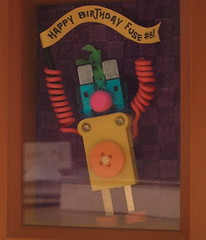
1911 Peter Pan & Wendy , Neverland , Pirates J. Barrie - $192.49 (23 bids) - not a first edition, but Bedford’s vintage illustrations would certainly have appeal.

J M Barrie Little White Bird (Peter Pan ) 1902 1st edit - $90 (store) - you might not know about this one!

Easton Press PETER PAN AND WENDY J M Barrie SEALED - $80 (19 bids) - lovely leather binding and a noted illustrator, too!

ARTHUR RACKHAM Peter Pan Kensington Gardens J Barrie HB - $68.98 (13 bids) - Arthur Rackham is a collectible illustrator.

Correct me if I am wrong, but The Little White Bird hasn't anything to do with Peter Pan, yes? Interesting look at Pete's current interest, just the same.

Webcast Mania

If you were to divide the thimble of a flea into 72 sections and assign me section #23, that would precisely mimic the amount of knowledge I have regarding the National Book Festival and all that fine n' fancy organization entails. Credit Pam Coughlan at Mother Reader, then, with telling me about the webcasts available through their site.

So let's see here... ah ... if you want to watch any one of the following, this is the place to go:
Don't like any of these people? Want some more choices? Well, howzabout these:

Click on zee name. Watch zee presentation. Marvel at zee simultaneous talents these people have at both writing/illustrating and showboating. Cry in your milk if, like myself, you lack any of those skills at all.

No Two People Are Not On Fire

You'll need sound on your computer for this. Sound and a workplace where if you guffaw it won't attract too much attention. If I can provide you with anything that will make your day, it'll be this. Why aren't all internet comedy pieces this on the ball?

Thanks to Elizabeth for the link.

Review of the Day: A Small White Scar

Cowboys are cool. They always have been and they always will be. It’s just a fact of life, really. Like pirates, they capture the childish imagination (though we've yet to host an International Talk Like a Cowboy Day as of yet). Who wouldn’t want to be able to say they could rope a buck, tame a steer, or ride a bull? It’s kind of funny, then, that there aren’t that many cowboy books out there for kids. You get the regular smattering of picture books, of course, and there’s usually at least one non-fiction title published every year for the true fans. Chapter books, however, are less common than you might think. Thanks goodness for “A Small White Scar”, then, eh? Part cowboy drama, part tale of brotherly love and hate, first-time novelist (and east Colorado native) K.A. Nazum gives this book her all. It’s a nice voice and a nice book and I think that that’s all there is to say about that.

1940. Colorado. The Bennon Cattle Company. Mesa de Maya. It’s the only place Will Bennon has ever called his home and if he doesn’t get out of there as fast as humanly possible he’s going to burst into two. For fifteen years Will has grown up alongside his twin brother Denny and for the last seven he’s had to “play nursemaid”. Denny was born, as they say on the farm, “simple”, but his devotion to Will knows no bounds. It shouldn’t come as a surprise then that when Will lits out to rope some fame and fortune at a rodeo in La Junta, Denny follows with inescapable tenacity. Will’s fighting his desire to escape Denny at whatever the cost and to help his brother as he’s done all his life. To his mind it comes down to this: If he stays on the ranch he’ll go stir-crazy and never make a name for himself. But does that mean hurting the person who loves him best in the whole wide world? Is it worth it in the end?

To Will, his father’s admonishment to “Take care of your brother. Look after him”, is the worst thing that could ever happen to him. “It took me a while to figure it out, but by the time I was twelve or so, I knew the only way I could ever escape the trap of those words was to chew my leg off just like a coyote would in order to free himself.” So it’s just bad luck that that leg happens to be Denny. The authorial choice of making Denny Will’s twin rather than his younger brother interested me particularly. There’s a reoccurring motif in the book where Will dreams that he and Denny have switched bodies and now he’s the one with problems and Denny is in his own skin. Right from the start Nuzum is challenging the reader. She’s throwing a great big There But For the Grace of God Go I in your face and I’m darned if it doesn’t make the reader stop and think a while. I mean, it could have easily have been Will rather than Denny born with what I suspect might be (though it’s never named) Down Syndrome. Which might be fairly impressive in and of itself, except that she manages to do it by page FIVE. Nicely played, Ms. Nuzum.

Nuzum also gets the flavor of the West down pat. You understand the lure of such a life and the desire that drives Will to be a part of it. The story of whether or not he can escape his job as his brother’s keeper is completely understandable too. Will feels that his father ignores his other talents and sees him entirely as a babysitter rather than a cowhand. Fortunately his dad gets a say at the end of the book that shows a different point of view and, more importantly, he apologises.

So will kids read this book? I think so. Sometimes a book is only as good as its first chapter. We’ve all gone into bookstores and perused the first few lines of a story in an attempt to determine how exciting the book to come will be. Well this book has rattlers, killer coyotes, a near-death injury, bull-riding, a treacherous river, and a fight, alongside a good story and some fine writing. If that’s not enough for a child reader you know, hand ‘em some fantasy and be done with ‘em. If, on the other hand, they’re interested in some historical fiction with a bit of bite and a Western taste, “A Small White Scar” has their number. A smart debut.

Notes On the Cover: Well, we’ve yet another disembodied kid on the cover, but this is pretty classy fare all the same. My husband took one look at it and said, “That’s a pretty bad-ass looking book.” Yup. Once more the good people at Getty Images (this time one Ms. Mary Steinbacher) have given us a truly interesting photograph for our perusal. I appreciated that someone took the time to give the legs on the cover some truly worn-down cowboy boots and a pair of jeans that have seen better days. If this had shown nice n’ new duds I’d have been a teensy bit perturbed. What I really loved, though, was that this book says “COWBOY” all over it but avoids the clichés. Yeah, there’s a cowboy hat shown here, but only its shadow. The lighting gives the whole venture a soft late afternoon vibe. I haven’t tested this book on a kid yet, but I suspect this has definite appeal. Dunno if I entirely support the subtitle, “Divided By Adventure . . . United By Blood”, since “adventure” isn’t exactly what’s dividing these two. Otherwise, there isn’t much to find fault with here. Well done, Harper Collins. Getty Images wins another round.

Monday, October 09, 2006

You're All Growns Up and You're All Growns Up

The 26th HMOCL, Jay Asher, known particularly well for his blog The Disco Mermaids, has had a drop of fabulous news.

Looks like our l'il boy is all growns up.
Can you say book deal? Can you say wholly deserving? I knew you could.
A Fuse #8 Production salutes you, Jay. You're living the dream.

A Holiday Worth Remembering

Happy Fiorello H. LaGuardia Day everybody!

Not being overly fond of Mr. Columbus, my husband and I have decided the day itself is not to blame. Just the man it happens to be named after. Ideally, then, it should remain holidayish but lose none of its Italian-American charm. Hence this new idol to whom we should all pay tribute. Now admittedly Fiorello didn't do much outside of NYC that y'all could appreciate. Still, I think we should all doff our caps to "The Little Flower" who inspired a Broadway musical (ten points if you know all the words to "I Love a Cop") and may have also participated in politics in some fashion. If you prefer to remember Columbus, however, find yourself a copy of A Coyote Columbus Story (which EVERY children's library should own) and read it. I consider that to be THE best Columbus Day picture book on the market today.

Now while I love holidays and the I-do-not-have-to-workness of them, they often mean a downturn in my blog hits. Hence the following strip:


Amen, brother.
Enjoy Fiorello Day to the hilt, then.

Amazon Rankings and Author Obsession

As a blogger, I have struggled with my addiction to my Sitemeter for months. Every day I race to it, sometimes before I even see if anyone has commented on a post, to view the number of hits Fuse #8 has accrued in the last, oh say, 4 minutes. Of course, I get no money from this blog. It's just an incredibly satisfying hobby that give me copious/mildly-disturbing amounts of joy.

I can imagine, though, how much worse it would all be if my Sitemeter hits meant I would receive money of some sort. That's kind of the premise behind a recent article on The Culture Vulture blog by children's author Lyn Gardner. Entitled By the Numbers: The Allure of Amazon Rankings, Ms. Gardner confesses her Amazon ranking fixation.
Why are we first-time authors so obsessed with the Amazon rankings? Partly because, like pretending to do your tax return or essential research, it offers yet another displacement activity to avoid the real hard business of writing. But it's also because once your book is out there, all alone in the big wide world, you desperately want to know if it's thriving or has got completely lost - and for a considerable period nobody can tell you.
A feeling not entirely unlike the intensity with which I check my blog. For anyone who has ever glanced at the Amazon ranking of their favorite book (their own or otherwise) this is an article worth reading. I was especially fond of the commentator who wondered, "if Amazon rankings are actually produced by some sort of random number generator." And having seen what some fo the top sellers are, that would certainly be my guess.

Review of the Day: The Road To Paris

Here’s a fun way to determine whether or not a book will make for a good discussion in either a classroom or a bookclub. First, read the book. Two possible choices now lay before you. If you finish the title and find yourself 100% perfectly clear on why every character performed as they did, that is not a good book for discussion. If, however, you do as I did with “The Road To Paris” and after finishing the book suddenly find yourself thinking and rethinking the book’s ending in a vain attempt to determine whether it was happy or sad, then THAT, my friend, THAT book has incredible promise. All the great classic books, from “The Giver” to “Charlotte’s Web” have that quality. Now “The Road To Paris” has it too, and I would not hesitate to thwap it soundly on the head with the CLASSIC stick. This is a good book. A good book that manages to talk about a serious, even depressing subject without dragging the reader down into the realms of misery. No small feat, to say the least.

“Ask Paris if a phone call can be deadly. She’ll tell you. She learned the truth of it last night.” For years, Paris and her older brother Malcolm have only had one another to count on. Though they’ve been taken from foster home to foster home, Paris can still remember and be hurt by the memory of their alcoholic mother. So when Malcolm and Paris escape the latest abusive home to stay with their grandmother, she’s unprepared for the horror of being separated from Malcolm after all these years. Paris has been sent to live with the Lincolns, a kind family who've dealt with foster kids before. It takes a great deal of love and understanding on their part to break through Paris’s wary shell so as to convince her that she is finally safe. But when a phone call comes from her real mother telling her she can come live with her again, Paris must decide what “home” really is.

Reviewers seldom comment on the length of a children’s book, unless they happen to be dealing with a 700+ page fantasy tome (or, as the book industry calls them, “the norm”). I, however, would like to point out that “The Road To Paris” stands at a handsome 153 pages. From this length, we may understand that Nikki Grimes does not stand for overwrought flowery speech. Her language is remarkably beautiful, as much in what she doesn’t say as in what she does. When, for example, you read right at the beginning that, “In the world of Paris Richmond, normal was rare, and rich”, those words weigh heavy on the page. Descriptions abound and they aren’t there to merely fill up space but to give the narrative itself a three-dimensional quality. There is a moment where Paris sees for the first time in her life her neighborhood buried until a thick covering of white powdery snow. “Paris thought it was a shame to disturb all that perfection, but she planted her bots into the snow, one step after another, creating a trail of fat footsteps even the man in the moon could see...”

Ms. Grimes also has the remarkable ability to preach without sounding preachy, if that makes any sense at all. In this book, Paris finds God. Early into her foster care stay with the Lincolns, her new foster brother David tells her that he combats fear by keeping “God in my pocket.” Later, as Paris grows emotionally strong, she holds fast to her belief that God is with her, even in the most unpleasant of circumstances. Some authors wouldn’t be able to write any of this without making the book into some kind of didactic sermon. Instead, Grimes balances out the good with the bad, allowing the reader the chance to decide for themselves whether or not Paris’s faith with help or hurt her in the future.

Until I read this book the only Nikki Grimes title I’d ever read was her Coretta Scott King Award-winning, “Bronx Masquerade”. Honestly, I didn’t like “Bronx Masquerade” very much. I thought the characters used too much contemporary slang that would grow outdated very quickly, thereby making an otherwise well-written book a relic before its time. “The Road To Paris”, in contrast, could not be more different. First of all, it’s difficult to say when exactly this book takes place. It could be in the past or it could be next week. It features a foster care system that performs in a believable fashion, sometimes making a situation better (for Paris) and sometimes making a situation worse (for Malcolm). The language doesn’t have a drop of soon-to-be-outdated slang anywhere, and nobody goes about yammering into the latest cell phone or iProduct. I hate to drag out that overused word “timeless” to describe “The Road To Paris” but the book leaves me with very little choice in the matter. How else am I going to describe a story that feels this real and, I know, will continue to do so for years to come?

Name five children’s chapter books written by and about African-Americans in the year 2006. Go on. Name ‘em. If you can’t do it, and I know that you can’t, then we have a problem. Nikki Grimes is an amazing writer but publishers would do very well to know that she can’t do it alone and she needs some company. If “The Road To Paris” doesn’t find itself included on every single Best Children’s Books of the Year list for 2006 then you’ll know something is terribly awry. One of the smartest titles to come out this year, to say nothing of its bravery. I won’t tell you the ending of this book, for obvious reasons, but a co-worker of mine recently commented that adults and children will have very different reactions to Paris’s final decision. Consider this a great title for discussion and contemplation. A book worth remembering for a long time to come.

Notes On the Cover: It seems to me that the people making the editorial cover decisions on this book had a very difficult task ahead of them. Here you have a book that could either be historical fiction or a contemporary novel featuring a mixed-race African-American girl with blond hair. I’ll tell you right now that Paris’s blond hair kind of threw me for a loop. I didn’t now how to picture her in my head, so I looked to the cover for guidance. G.P. Putnam’s Sons would have known that I’d do that too, so the designer of the cover, Kristin Smith, and photographer Marc Tauss played out the image with surprising dexterity. First of all, we see a girl wearing a shirt that could exist in the past, present, and future without too much stretching of the imagination. She’s carrying a bouquet of lilac flowers, just as she is at the beginning of the book. Now here’s where it gets clever. The lilacs are in focus, but the rest of Paris is shot through a kind of foggy sunfilter, rendering her hair a non-color. It definitely could be blond, and if so it doesn’t look at odds with her dark skin in the least. The overall effect is that it faithfully represents a book that couldn’t have been easy to present cover-wise. Yes, it chops the girl off right above the nose (making this disembodied children’s book cover girl #458) but all things considered I’m going to give this one a pass. Excellent excellent work.

Sunday, October 08, 2006

Spiderwick Casting

With the first Spiderwick movie coming out, I thought it appropos to pass along some info Ms. Holly Black recently posted on her blog. Observe:

Still in negotiations, but probably pretty far along considering there've been several stories about it:

Mrs. Grace - Mary-Louise Parker
Mulgarath - Nick Nolte
Thimbletack - Martin Short
Aunt Lucinda - Joan Plowright

Confirmed Cast:

Simon AND Jared - Freddie Highmore
Mallory - Sarah Bolger
Mr. Grace - Andrew McCarthy

And Phil Tippett is officially signed on to visual effects.
Slowly getting excited, but very worried about the Martin Short thing. Let us NOT make him the comic relief, people.

Thanks to The Longstockings.

Free Books!

I am aware that some of you who read this blog are librarians. I am also aware that there are libraries in this world that do not have collections of 100,000 books. As such, perhaps you would be interested in the following free books available.

For example, at Three Silly Chicks there is a contest to win a copy of Why Did the Chicken Cross the Road. All you need to do is leave a comment listing the title and author of your favorite funny book for kids before October 15th. So that's fun.

If Halloween free books are more your style enter here to win Usborne's Halloween Activity book from the blog A Readable Feast. That contest ends this Wednesday, October 11th though so hurry up and enter.

Or perhaps a Mitali Perkins book is more your style. 200 people can win her newest book Rickshaw Girl, so go for that one too, if you get a chance. And don't say never did nuthin' for ya.

Robin McKinley: Raw & Uncut

I will not piss-off Robin McKinley.
I will not piss-off Robin McKinley because if I do she will come after me with sharp pointy objects and horrible things may ensue.

I will not piss-off Robin McKinley . . . perhaps because of this.

Review of the Day: Up Before Daybreak - Cotton and People In America

As a children’s librarian, one of my jobs is to recommend non-fiction to kids that they’ll actually read. Interesting non-fiction. Now when I was a kid you couldn’t have bribed me with all the peanut butter cups in the world to pick up a non-fiction book that didn’t deal with animals in some fashion. So with my twelve-year-old self planted firmly in the back of my mind, I set out to discover whether or not Deborah Hopkinson’s, “Up Before Daybreak: Cotton and People In America”, would be something a child would find themselves voluntarily reading. Ms. Hopkinson had a very good 2006 publishing year, by the way. When she wasn’t creating picture books like “Sky Boys” to celebrate the construction of the Empire State Building she was writing gripping historical fiction like “Into the Firestorm” for the young ‘uns. Of these three 2006 ventures, however, “Up Before Daybreak” is the trickiest. You have to talk about a staple, how it affected the economy, the toll on human lives and do all this in an engaging factual manner. Some parts of this book work better than others and some parts garner more interest as well. “Up Before Daybreak” is a worthy effort to follow cotton and how it changed America. I’m just not entirely convinced that it's the best of Ms. Hopkinson's non-fiction work.

King Cotton. It’s one of those national products that made America what it is today. Tracing the beginning of cotton production from the birth of our nation onwards, the reader comes to understand how this fluffy white flower came to stand at the center of our nation’s economy. We see the birth of the cotton gin and the rise of slavery in the South. We watch as the Civil War neatly dismantles the farms and sharecropping rises. At the same time, the history of the mills that spun the cotton and the birth of the American Industrial Revolution all work together to bring us a well-rounded picture of cotton in all its myriad forms and how it affected the people that came in contact with it.

The book is neatly divided into two sections. The first is all that happened with cotton before the Civil War and the second all that happened after. Not only does Ms. Hopkinson discuss at length the effects that both slavery and sharecropping had on white and black workers, but she answers some questions I myself had about the times. For example, why do we never hear about any black mill workers? Well, that may have something to do with the fact that blacks tended to be barred from mill work (always excepting housekeeping and hard labor). Though the text jumps back in forth in time depending on the subject, the reader never gets the feeling that the story is difficult to follow. And while the effect of all of this on children is certainly a large part of the book’s focus, adults get just as much attention as well.

Which is maybe why I was a little baffled to find that labor unions didn't really get mentioned in the book. Unionism is reduced to a single paragraph on page 78 and a sentence on page 79, and even then it speaks of a unsuccessful attempt in September 1934. Other small mentions are made of unions, but none are more than a sentence or two here and there and a child reader could be forgiven for assuming through this book that all attempts to unionize mills were unsuccessful.

Yet the book is magnificent in its factual information. First of all, the photos in the book are top notch. Spottted regularly throughout the text they show cotton in different eras, to say nothing of different mill workers throughout the decades. I loved the Selected Bibliography which even went so far as to i